
Caroline’s Blogs
All Published Blogs
The 2026 nesting season on LPC’s LoonCam 2 was a rollercoaster of profound joys and heartbreaking losses. Through it all, the Looncam chat remained a place of warmth, education, and unwavering support. We want to take a moment to shine a spotlight on some of the most respected and dedicated chatters who made this season so special.
Thank you to these wonderful individuals, and to everyone in the chat, for your camaraderie, your empathy, and your shared love of the loons. We look forward to seeing you all again next year! Here is a short shoutout to the top 45 chatters.
Debra (@debrab8109) Affectionately dubbed the “Timestamp Wiz” by her peers, Debra is a constant, welcoming presence who patiently answers questions for newcomers. Her dedication is unmatched, often staying up through the darkest hours of the night to ensure no wail, egg roll, or predator visit goes undocumented.
EdamameBean (@EdamameBean) Bean brings a perfect blend of meticulous observation and much-needed levity to the chat room. Whether she is carefully calculating the exact 60-hour incubation windows for the next egg or cracking jokes about the loons building a “privacy curtain,” her contributions always enrich the viewing experience.
Gail (@GailMNLakeGal) Watching faithfully all the way from Minnesota, Gail is known for her boundless optimism and excellent note-taking. She provides detailed timestamps and acts as a steadfast cheerleader for the loons, bringing a warm, supportive energy to the community every time she logs on.
Tailfeather (@tailfeather6317) A seasoned veteran watcher, Tailfeather freely shares her deep understanding of loon biology and behavior with the chat. She is always eager to educate the community on the nuances of incubation cycles, mating habits, and complex loon vocalizations.
Clare (@claremc2130) Tuning in across the Atlantic from Ireland, Clare provides crucial overnight coverage when most local viewers are fast asleep. Her vigilant timestamps during the early dawn hours ensure the community never misses a moment of the action.
Sue (@suer7734) Serving as the chat’s resident “Loon Ranger,” Sue provides invaluable, on-the-water updates directly from her kayak. Her real-time reports on the loons’ whereabouts and her dedication to modeling safe boating around the nesting territory make her a vital protector of our beloved birds.
GailO (@GailO-x1f) A warm and constant presence, GailO always greets the community with kindness and was an enthusiastic participant in the community’s hatch-time guessing contest.
Jean (@jeanrich8037) A dedicated overnight watcher, Jean kept the chat lively during the wee hours while working on intricate wooden puzzles and proudly wearing her lucky loon earrings for the pip watch.
Mrs. Shiver (@MRSSHIVERR) With a keen eye for detail, she is excellent at spotting subtle nest activity and quickly alerting the chat to approaching predators like the Great Blue Heron.
Lucky (@luckyjones1622) A vital founding member of the “night owl club,” Lucky provided excellent overnight timestamps and shared the community’s emotional highs and lows with deep empathy.
TucsonMacBanshee (@TucsonMacBanshee) A wealth of knowledge who frequently shares fascinating insights about local loon censuses, loon behavior, and the Loon Preservation Committee’s activities.
Rick (@rickmacm) Rick brings much-needed levity to tense moments, offering hilarious observations like calling a Great Blue Heron a “swamp cobra” or joking about slipping the loon Dad five bucks to hurry up the hatch.
Luvs-Chickadees (@Luvs-Chickadees) Using her Merlin Bird App, she expertly identifies the beautiful background bird choruses, helping the chat appreciate the hidden songs of Veerys, Swamp Sparrows, and Swainson’s Thrushes.
Beatrice (@beatricel-ch) Checking in faithfully despite her busy schedule, Beatrice adds a wonderful international charm and steadfast optimism to the group.
603born (@603born) A proud New Hampshire local, 603born consistently shares encouraging news about successful loon hatches on other nearby lakes to keep the community’s spirits high.
jdullo (@jdullo218) A constant, friendly presence in the chat who is always quick to offer a warm greeting, praise the camera operator’s zooms, and enthusiastically join in the fun of the hatch-time guessing contest.
Fin (@finbladez) Fin brings boundless enthusiasm and New England pride to the chatroom. Fin is famously credited with “manifesting” the surprise fifth egg and always keeps the community’s energy high with celebratory cheers.
Judy (@judygilbert9628) Highly observant and inquisitive, Judy consistently enriches the chat by asking excellent biology questions and looking up loon behaviors to share with the group.
Vyrani (@Vyrani393) A wonderful, dedicated community member who is visually impaired but deeply enjoys listening to the stream’s relaxing audio and following the loon family’s journey through the chat’s vivid descriptions.
Shep (@shepqherd5803) Known as the chat’s resident comedian and nickname creator (like “Dot” and “Grumpy”), Shep keeps everyone entertained with his quirky puns and dependable early morning coffee greetings.
Merry (@merryforest2619) A warm and polite observer who uses her keen ears to pick out and identify the beautiful background bird choruses, from chatty barred owls to flocks of speedy bank swallows.
Kerry (@KerryKestrowl) A self-described “new bee loon lover” who is eager to learn, deeply appreciative of the LPC’s conservation work, and always ready with a kind word for her fellow chatters.
MSGS (@MSGS44) After exploring many different wildlife streams, MSGS found a home at Looncam 2 because of the amazing video quality and quickly became a cherished regular who keeps the mood light and supportive.
Aisle5 (@Aisle5-jdy) Highly engaged and deeply curious about the loons’ history, she even brought her enthusiasm into the real world by going on an LPC Loon Cruise and sharing her amazing experience with the chat.
Bill (@bpuddster) The generous and beloved organizer of the community’s hatch-time guessing contest, who added an extra layer of excitement to “pip watch” by offering a loon mug to the closest guesser.
Carr (@CarrM74) Carr checks in faithfully during lunch breaks and beautifully suggested the name “Hope” for the chick after all the challenges the resilient parents had endured.
Gavia (@GaviaImmer) Fittingly named after the Common Loon’s scientific classification, Gavia finds deep peace in the lake’s evening sounds, noting they are better than even the loveliest Baroque music.
LC (@loonychick822) A highly active and cheerful presence who shares a deep love for the loons and keeps the chat lively with good humor and helpful observations.
Beverly (@beverlyd1199) A wonderful, consistent observer who is always quick to express gratitude to the camera operator and send positive wishes to the loon family.
Cathy (@cathyl4566) Cathy enjoys the nostalgic nighttime sounds of the lake—like peepers and loon wails—which remind her of beautiful cottage memories with her husband.
Faith (@Faith-Grace-w4u) Faith brings immense empathy to the community, frequently offering prayers and heartfelt support for the resilient loon mama during stressful moments.
Violet (@violetsoldier133) Possessing an incredibly sharp eye, Violet miraculously spotted that the loon egg was still visible and seemingly intact right after the chaotic otter invasion.
Dawn (@dawnbirdnerd) A dedicated watcher who tunes in rain, fog, or shine, and stays closely connected to the community through the Loon Preservation Committee’s mailing list updates.
17cmMittlererMinenwerfer (@17cmMittlererMinenwerfer) Always eager to learn, this inquisitive chatter asks excellent questions about loon behaviors and greatly appreciates the scenic sunset views.
Mindy (@mindytillapaugh3465) Highly sympathetic to the loons’ struggles, Mindy frequently checks in to gauge the community’s hopes for a successful hatch after a tough season.
Lorraine (@lorrainekane6291) A self-described “newbie” who eagerly absorbs loon facts from veteran watchers, asking insightful questions about incubation habits and predator threats.
Denise (@Denise1310_) Denise provides fantastic timestamps of wildlife interactions, like brief altercations between loons and beavers, and deeply appreciates the peaceful lake views.
Donna (@donnadec2606) A dedicated timestamper who endearingly nicknamed the female loon “Domino” after the dots on her leg bands.
Luke (@lukestorm3432) Luke shares fascinating personal observations about loons from his own experiences, adding valuable context to rare behaviors like female loons yodeling.
Stef (@Stefrnheals) A newer loon fan who has quickly fallen in love with the birds, marveling at the diverse wildlife on the lake and cheering the parents on.
RainHeart (@RainHeart_60) The chat’s resident amphibian expert, who beautifully explained that the “plucked banjo string” sounds on the lake belong to male Green Frogs.
Jessica (@jessicab3370) An incredibly supportive cheerleader for the loon parents who finds comfort in all the lake’s wildlife, even hoping the duck family might enjoy the empty nest.
Christine (@christinemills4746) A third-year watcher who cherishes the chat’s camaraderie and regularly contributes fun observations, weather updates, and gratitude for the community.
Stabledragon (@Stabledragon) Quick to identify nocturnal wildlife, this observant chatter was among the first to realize it was otters playfully wreaking havoc on the raft.
Glasssoldier133 (@Glasssoldier133) Brings a wonderful perspective to the stream by reminding everyone to appreciate the beautiful scenery and special scenic treats even when the loons are off-camera.
The long night of July 13th into the morning of July 14th brought the devastating realization that the Looncam 2 community had been dreading. After the female loon left the nest at 19:43 the previous evening, the hours ticked by with no sign of either parent returning. Through the dark early morning hours, viewers listened to distant tremolos and the “hollow wail of a grieving loon”. Despite some hopeful chatters thinking they heard faint peeps coming from the fifth egg at dawn, the tragic reality began to set in. As the morning bird chorus started, watcher @Faith-Grace-w4u echoed the sentiment of many, sharing, “I am heartbroken… Shocking to go from Joy from a chick, to everything gone”.
As the morning progressed, the chatroom transformed into a space for mourning, reflection, and immense gratitude. Viewers began to say their emotional goodbyes, thanking the Loon Preservation Committee (LPC), the tirelessly dedicated Looncam Operator (LCO), and each other for the season’s camaraderie. Chatters reflected on the “loonie friendships” they had formed and the beautiful privilege of watching these majestic birds so closely. Veteran watcher @debrab8109 captured the community’s bittersweet mood perfectly: “It’s had its joys & sorrows, but that’s the realities of a loons life. Good bye my loonie friends until next year and stay safe little mama”.
Providing much-needed closure, Caroline from the LPC (@LoonOrgNH) joined the chat mid-morning to offer comfort and scientific wisdom to the grieving viewers. She explained that the LPC would wait until the egg had been unattended for a full 24 hours before collecting it, and they plan to x-ray both the second and fifth eggs to check for embryo development.
Caroline brought a vital, comforting perspective to the community regarding the fate of the nest. Addressing the tragic loss of the first chick, she reminded viewers that hatching is an incredibly hard, energy-intensive process, and sometimes chicks simply do not survive despite everyone’s best efforts. Importantly, she offered a powerful silver lining for the future: while the pair had a tough couple of years, the fact that this new female successfully hatched a chick proves that she is not infertile, dispelling speculation from last year.
Caroline also engaged with the chatters’ curiosities, praising an insightful hypothesis from watcher @EdamameBean, who wondered if the nutritional quality of the eggs decreased by the time the female laid her fourth and fifth eggs. Caroline noted that this was a great question that the LPC is in a position to investigate using their data on egg dimensions, mass, and volume.
Though the cam’s season has concluded, the community’s dedication continues. The LPC will share more updates on the retrieved eggs in their newsletter, and they invited viewers to tune into the State of the Loon Report on August 20th. As the community logs off for the summer, they do so with heavy hearts, but armed with a deeper understanding of the incredible resilience of New Hampshire’s loons. See you next year, Looncam 2!
Joy turned to sorrow on the morning of Sunday, July 12. After celebrating the arrival of a feisty chick the evening prior, the Looncam community awoke to devastating news.
Throughout the early morning hours, Dad took a remarkably long, quiet overnight shift while Mom took a much-needed break out on the lake. When she finally returned to the nest around 5:30 AM to relieve him and remove the hatched eggshell, observant viewers began to notice a tragic stillness. By 6:00 AM, the heartbreaking reality set in for the chat: the newly hatched chick had quietly passed away during the night.
As chatters mourned the loss, representatives from the Loon Preservation Committee stepped in to offer comfort and essential scientific context. LPC Intern Mariah (@lpcintern) confirmed the sad news, explaining that nature can be incredibly unforgiving for newborns. “Hatching takes a lot of energy from the chick and they might just not have enough left to survive,” she shared, adding that it is sadly not uncommon for a chick to pass due to “failure to thrive”. She assured the community that the LPC plans to collect the chick’s body to perform a necropsy once the family permanently leaves the nest.
Caroline, an LPC staff biologist (@LoonOrgNH), also joined the chat to manage expectations regarding the necropsy. She cautioned that “we collect at least a few chicks off of nests like this per year, and often there is nothing obvious wrong grossly”. Caroline also helped viewers understand the loons’ subsequent behavior; when chatters asked why the parents hadn’t removed the deceased chick, she explained that it is a normal pattern for loons to simply keep the chick in the nest bowl while they continue to incubate.
Despite the grief—and tears shed by loyal watchers—the resilient loon parents are not giving up. They spent the remainder of July 12 faithfully incubating their second egg, taking turns panting through the 80-degree heat and defending the raft from potential predators. As Caroline noted, July 12 marked Day 28 of incubation for this remaining egg, meaning a successful hatch is still possible, although increasingly unlikely. The community remains on “pip watch,” holding onto hope that this fiercely dedicated pair will finally get their miracle.
The suspense on Looncam 2 has finally broken! After a long, sleepless night of chatters listening to muffled peeps and scratching from inside the shell, the newest addition to the lake has officially arrived.
The excitement began early in the morning when eagle-eyed viewers spotted the very first “pip”—a tiny beak poking through the membrane of the left egg at 9:52 AM. But this little loon made the community wait all day for the grand finale. Finally, during a 5:49 PM egg roll, the top half of the shell nearly detached. Then, at 8:10 PM, the chick made its highly anticipated debut! (A huge shoutout to chat member GailO, who won the community guessing contest by predicting the hatch time within just three minutes!)
Right out of the gate, this chick proved to be a feisty little alpha. Instead of quietly resting, the newborn immediately started wiggling around under Dad’s left wing, popping its little head out to check out its new world. Viewers were treated to adorable “bobblehead” moments as the chick tried to figure out how to lift its heavy head and navigate its big, ungainly flippers. It was even caught playfully peck-peck-pecking at Dad from the safety of his feathers.
Dad, who took an unusually long shift to oversee the hatch, proved to be an absolute hero. Barely an hour after his new baby was born, he had to jump up and aggressively defend the raft from a lurking Great Blue Heron (we think), successfully keeping the feisty little chick safe from harm.
While Mom has been out on the lake enjoying a well-deserved break, Dad and his brand-new, energetic bobblehead are holding down the fort. We can’t wait to see this little one take its first swim!
A few of you have written in wondering why the audio on the LoonCam has been so quiet lately. Fair question. Here’s the honest answer.
The camera and all its gear live on a private island, and the folks who let us put it there are on the island right now, enjoying their vacation, for the next couple of weeks. At normal mic levels, the LoonCam picks up more than loon chatter. It picks up people talking on their own porch. Clearly enough to make out what they’re saying.
That’s not a trade we’re willing to make. They’ve been generous enough to host our equipment. The least we can do is keep the volume down while they’re around.
So for now, the mic is set low. You can still hear the nest at night, and you’ll still catch the occasional eagle screech, loon call, or beaver tail slap. It’s just softer than usual, and voices blur into background noise instead of coming through clearly. We know the sound is half the experience of watching this cam, so we don’t love it either.
Here’s the good news: once we get close to hatch, from pip through hatching and while the chicks are visible, we’re turning the volume back up. That’s the window everyone really tunes in for anyway. We’ve already let our hosts know that’s the plan, and they’re on board.
In the meantime, thanks for bearing with the quiet. It’s a small ask in exchange for the people who make this whole thing possible.
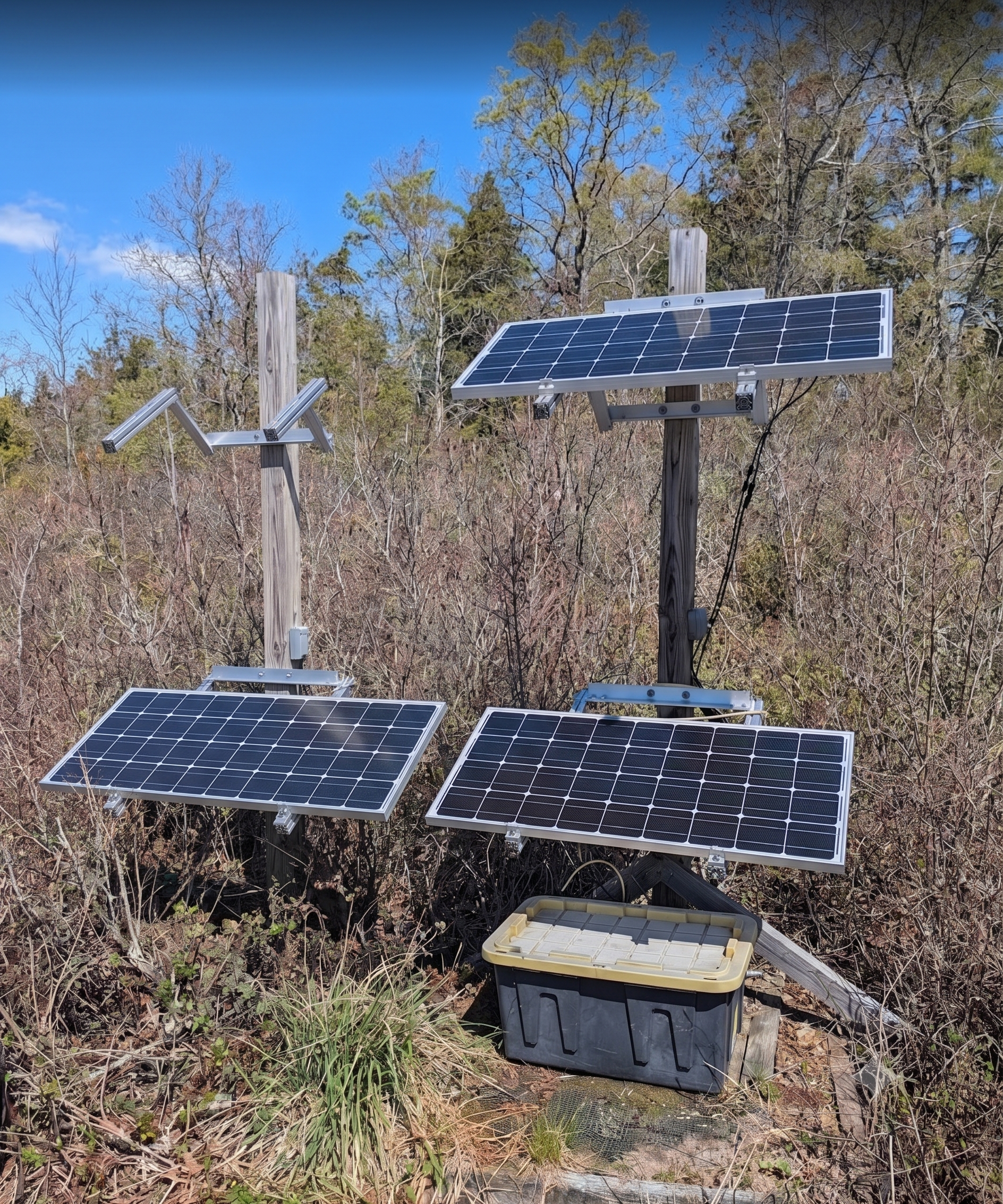
Most people watching the LoonCam see loons, water, wind, rain, nest exchanges, and the long wait for hatch.
What they do not see is the off-grid solar station quietly trying to keep the whole show online.
The camera site is not plugged into the grid. It runs from batteries, solar panels, a charge controller, network gear, and a bit of wishful thinking. In past years, that worked well enough. This year, after the upgrade to a 4K camera, the system started doing something new. It would run through the day, go offline overnight, then come back after the sun had been up for a while.
That is a classic slow-drain mystery.
The camera itself uses about 15 watts. That sounds tiny until you remember that it runs 24 hours a day. Then add the wireless bridge, network switch, power controller, cloudy weather, aging batteries, wiring losses, and the inconvenient fact that loons, chicks, and predators do not schedule their activity for sunny afternoons.
The first clue was that the batteries were not failing all at once. They were simply not getting far enough ahead during the day to survive the night. A small deficit, repeated daily, becomes an early morning outage.
So the fix is not one magic part. It is math, margin, and more charging capacity.
The upgrade plan adds another solar panel, cables, connectors, and an upgraded controller. This improves battery charging confidence and formalizes better field procedures for recharging and swapping batteries when the weather refuses to cooperate. In other words: less guessing, more reserve, and a plan B.
It is not glamorous. But it is the kind of quiet infrastructure that lets everyone else see the glamorous part: a loon turning eggs, a chick hatching, or the pair going through a quiet shift change.
Behind every peaceful wildlife camera is a small pile of electronics trying very hard not to become the story, again.
Following the devastating mink attack, the community held its collective breath. On the morning of June 12, their anxious vigil paid off. At 09:46:02, the female delivered egg number four. The chat room overflowed with emotion and relief, cheering on the resilient loon. One watcher confessed, “I can’t, I’m sobbing,” while others praised her as a trooper who “deserves to be a mama”.
However, the celebration soon gave way to agonizing frustration. Just as before, the loons did not immediately settle into a steady incubation routine. As night fell, the egg was left unguarded and stayed that way all night, leaving watchers terrified of another predator attack. One chatter lamented, “They are putting us through the ringer tonight,” admitting their heart couldn’t take the stress of the empty nest.
But the loons had a historic trick up their sleeves. On the evening of June 14, viewers watched in stunned disbelief as the female began to labor once again. At 19:30:49, the impossible happened: she laid a fifth egg. The chat erupted in absolute shock and glee, calling the event “unprecedented” and declaring her a “super mom”. When the camera finally revealed two eggs side-by-side, the community rejoiced, praying this relentless pair will finally hatch the chicks they so deeply deserve. Incubation seems serious now.
The final 48 hours of the 2026 season on Looncams 1 and 2 delivered an unforgettable mix of bittersweet farewells, soaring hope, and absolute heartbreak.
Looncam 1: A Bittersweet Goodbye to the Lake The peaceful waiting game on Looncam 1 has officially come to a close. After weeks of watching the new loon pair tentatively explore the territory, the Loon Preservation Committee (LPC) intern, Mariah, confirmed that the loons successfully nested in a private, off-camera location. Because the lake isn’t large enough to support a second breeding pair, the decision was made to pull the camera offline on the morning of June 10.
The chat community was thrilled for the loons’ success but deeply saddened to lose their beautiful daily view. Watcher @finbladez captured the collective mood, stating, “my whole heart aches – we’re supposed to say goodbye in July after a successful hatching”. Before the feed went dark, viewers were treated to one last stunning sunset and a final overnight visit from “Fierce Mama” wood duck, who tucked her seven growing ducklings safely onto the empty raft before swimming off into the early dawn.
Looncam 2: From Elation to Devastation Over on Looncam 2, the drama reached a fever pitch. On June 9, watchers were thrilled to see the brutal black fly swarms finally subsiding, allowing the loon pair to return to the nest to spend the day cooing and preparing the bowl. The anticipation paid off just after midnight on June 10, when the female successfully laid a highly anticipated egg at 00:06:23. The late-night chat erupted in celebration, offering joyous congratulations to the resilient “little mama”.
However, the immense hope was short-lived, quickly turning to horror. Just over an hour later at 01:47:04, a mink invaded the unattended raft and stole the freshly laid egg. Watcher @shepqherd5803 recounted the horrific moment to the chat: “I heard the CRUNCH! saw it leave with egg,” adding in frustration, “if it ain’t otter its mink – that stink!”.
The morning chat was left completely shell-shocked and heartbroken over the loss. Veteran watcher @tailfeather6317 admitted, “I don’t even have any words,” while @GailMNLakeGal expressed absolute disbelief that the loons’ instincts didn’t drive them to immediately incubate and guard the nest. After surviving a destructive otter invasion, weeks of agonizing black flies, and now a thieving mink, the community could only mourn as these dedicated parents were put “through the ringer” once again.
Mariah, LCP Intern, returned to the chatroom in the morning to offer a glimmer of hope of a fourth egg within 60 hours. We will wait and see.
@EdamameBean logged the pair mating on the mud flats, cooing to one another, and defending their territory by getting into altercations with a local beaver. Watchers are encouraged by this guarding behavior and are hopeful the pair will soon realize that “mud flats are good for mating and rafts are good for nesting”.- On Cam 2, the loons’ active mating, territorial guarding, and the receding black fly swarms point toward the pair laying a new egg soon.
- On Cam 1, veteran watchers are reminding the chat to be patient; last year, the resident female didn’t lay her first egg until June 19, so it is still early enough in the season for this new pair to claim the raft back from the ducks
A Bittersweet Weekend on Looncam 2: Saying Goodbye to the Second Egg
May 29: A Fleeting Visit and a Tough Reality The morning of Friday, May 29 began with observant viewers acknowledging that the unincubated second egg had likely been abandoned due to the black flies. However, the community was treated to a surprise glimmer of hope when the male loon suddenly hopped onto the nest at 9:39 AM. He stayed on the raft for about six minutes while the female stayed in the water right next to him. While this brief visit brought a flurry of excitement and joy to the chat, it sadly was not enough to save the neglected egg. Later that afternoon, the Loon Cam Operator (LCO) officially confirmed what many feared: the egg was no longer viable and would need to be retrieved by trained biologists the following week.
May 30: A Beautiful Bond Amidst an Unseasonal Chill Despite the heartbreak over the failed nest, the loon pair proved their bond remains strong. Early Saturday morning, the pair put on a spectacular, extended show in front of the raft. While taking a “nature’s shower” in the rain, the loons were seen swimming together, thoroughly preening, foot-waggling, and standing to flap their wings. The LPC intern, Mariah, even dropped into the chat later to share a highlight video of the beautiful display. Aside from the loons, the day was marked by bizarre late-May weather; viewers noted chilly mid-40s temperatures and could even see snow capping the mountains in the distance. LCO ended the day by treating viewers to a stunning pink and purple sunset.
May 31: Egg Retrieval and Hope for a Re-Nest The weekend concluded with the official end of the second egg’s journey. At 5:14 PM, Mariah announced to the chat that biologists were en route to the raft, and the egg was collected shortly after. Mariah stayed in the chat for a helpful Q&A session, explaining that removing the unviable egg is necessary to prevent it from decaying and attracting predators to the raft.
Crucially, she also offered the community a major silver lining: it is still very early in the season! Because most New Hampshire loons don’t begin nesting until the first week of June, there is a strong chance this pair will attempt a “re-nest” and lay one more egg once they have recovered their energy. The weekend officially wrapped up with a dramatic weather event, as a heavy lightning storm forced the LCO to temporarily pull both cameras offline to protect the equipment. The next morning, both cameras were still down and diagnosis was in process.
The story of LPC’s Looncams from May 26 to May 27 is a tale of two very different lakes. One defined by anxious waiting and harsh environmental realities, and the other defined by serene nature watching and community connection.
The Story of Looncam 2: The Battle with the Black Flies
- May 26: The day begins with a growing sense of dread as watchers realize the loons have not been on the nest to incubate the new egg for over 16 hours. The culprit is a colossal swarm of black flies. A viewer named Sue, out on her kayak, reports to the chat that the flies are terrible on the water. Later in the afternoon, a loon (likely the female) finally gets on the nest and is seen panting heavily, which veteran watchers note is a cooling mechanism. Viewers hold out hope that this means proper incubation is beginning or that a rare third egg is on the way.
- May 27: Hope begins to wane as the loons continue to leave the egg largely unattended, while crabby beavers frequently swim by and slap their tails near the raft. Mariah, the new Loon Preservation Committee (LPC) outreach intern, joins the chat and gently delivers the hard truth: if the egg remains unincubated in the coming days, LPC biologists will follow protocol and remove it. By the end of the day, the chat community begins to accept that the unbearable black flies have forced the loons to abandon the egg, though they remain hopeful the pair might try re-nesting later in the season once the flies die off.
The Story of Looncam 1: A Peaceful Sanctuary Restored
- May 26: Over on Cam 1, the day is marked by excitement for a technical triumph. The Loon Cam Operator (LCO) arrives by boat, easily identified by his signature tie-dye shirt, and successfully fixes the broken microphone. Viewers are thrilled to have the crisp, clear audio of the lake restored, spending the day listening to the birds and watching turtles sunbathe on the empty nesting raft.
- May 27: The serene atmosphere continues. Mariah, the LPC intern, introduces herself to this chat room as well. The highlight of the day occurs when an actual lake resident (@user-wi5oi3qw1b) joins the chat. They share “insider” information with the viewers, confirming that the loons have been incredibly vocal at night because there are eagles frequently present in the area. The resident also confirms that the male loon from last year passed away, making this a new pair that is still figuring things out.
Changes in Viewer Count and Tone
- Viewer Count: Cam 2 consistently draws a much larger audience due to the high-stakes drama, peaking at around 59 viewers during the day on May 26. However, as it becomes apparent that the loons are not incubating the egg, the numbers slowly drop and stabilize in the 20s and 30s by May 27. Cam 1 maintains a smaller, quieter audience, ranging from single digits overnight to peaking at around 33 viewers during the day.
- Tone: The tone on Cam 2 noticeably shifts from the frantic panic and celebratory highs of the previous days into a state of anxious waiting, culminating in reluctant resignation. The community is heartbroken over the likely loss of the egg but remains deeply empathetic to the loons having to endure the miserable fly swarms. Conversely, Cam 1 remains a relaxing haven. With the microphone restored, the tone is highly appreciative, peaceful, and focused on the broader beauty of the ecosystem.
The story of the two Looncams through May 25 unfolds as a striking contrast between high-stakes survival and serene wildlife observation.
Looncam 2: Heartbreak and Resilience Through late May, this nest became the center of an emotional rollercoaster. Shortly after the first egg was laid, disaster struck in the early hours of May 24 when a romp of otters invaded the raft, using the canopy as a trampoline and crushing the egg. Biologists had to intervene to remove the remnants and prevent attracting more predators. Miraculously, the loon pair rallied, and the female successfully delivered a second egg later that same evening. However, their struggles were far from over; the loons faced immense environmental pressure from brutal swarms of black flies, forcing them to minimize their time on the nest and making steady incubation nearly impossible.
Looncam 1: A Peaceful Waiting Game Meanwhile, Looncam 1 offered a tranquil, often comedic retreat. Because the resident male from the previous year had tragically passed away from avian malaria, a new, unbanded pair spent the month tentatively bonding, performing brief “nestorations,” and cautiously scoping out the territory without committing to laying an egg. Without an egg to protect, the empty nesting raft became a stage for the lake’s other residents. Viewers were treated to daily wildlife shows, including an osprey carrying away a freshly caught fish, a massive snapping turtle, a stealthy Great Blue Heron hunting for its breakfast, and a highly entertaining beaver who climbed onto the raft simply to meticulously groom itself. The serene atmosphere was only slightly dampened on the morning of May 25, when heavy spring rains temporarily drowned the camera’s microphone, cutting off the beloved ambient nature sounds.
The Watcher Community: Dedicated and Observant Behind both cameras is a remarkably dedicated community of viewers whose skill and empathy drive the experience. The chatters effectively act as citizen scientists, meticulously logging exact timestamps of loon vocalizations, nest exchanges, and wildlife flybys to assist in data collection. Despite the sometimes tedious nature of monitoring empty nests or waiting through the night, they maintain a warm, welcoming, and highly humorous tone. They balance a deep, protective emotional investment in the loons’ survival with a genuine appreciation for the broader ecosystem, finding as much joy in a chorus of spring peepers, a passing deer, or a beautiful sunset as they do in the loons themselves.
July 11, 2023
It was a successful hatch. Chick 1 emerged from its shell at 9:59 pm on July 8 and Chick 2 joined the fun around 3:30 pm on the 9th. At 17.5 hours, this was one of the shorter durations between hatches.
Much to our relief, Chick 2 was a feisty one and when the inevitable sibling brawl developed, #2 held its own. It took quite a beating but it kept fighting back. After a few minutes the chicks rolled off the raft in a mutual bear hug and thus was started the aquatic portion of the contest. Chick 1 won by a technical knockout when Chick 2 played dead by floating face down in the water. But by the time #1 climbed back on the raft to receive the gold medal #2 was attacking from behind and trying to drag #1 back in the water. And then #1 was doing the dragging. Mom intervened by inserting her bill between the two and forcing them to accept a truce.
Mom and Dad gave the chicks a couple of days near the nesting area to work things out to a mutual toleration. But the long stay also could have been due to neighboring loons standing between them and the brooding area (shades of last year’s siege). It’s likely that it was a combination of the two that made them stay near the nest. The chicks got to eat and practice their swimming skills, as well as learning to quickly climb up on their parents’ backs. Good skills to have when cruising through treacherous waters.
At 7:47 am today the family left the nesting area. A few minutes later we heard a short chorus of yodels and tremolos, an announcement of their territorial rights. Two strong and healthy chicks and two proud parents. You can’t do better than that!
July 5, 2023
So what does the title of this blog mean? Am I talking about eggs? Or am I saying that eggs can talk? A bit of both, actually.
We’re getting close to “pip watch” time. The pip is the first tiny hole in the egg, made by the chick as it begins pecking its way out of the shell. You can look for the pip when the adults are getting off and on the nest and when they are doing egg rolls. You need to see the blunt end of the egg; that’s where the pip first forms. I would expect to see the first pip on Friday or Saturday. But I’ve been wrong before so it’s worth keeping an eye on the eggs before then.
But before we see a pip, we are apt to hear muffled peeps coming from the chick inside the egg. That and the reactions of the adult sensing movement are apt to be the first signs that a hatch is imminent.
Two studies have shown that late-stage embryos in bird eggs can communicate with each other. A 1966 study found that the earliest laid eggs in a clutch of quail eggs would begin clicking 12 to 18 hours before hatch. The eggs that were laid later would respond to the clicking and the entire clutch would hatch hatch at the same time. This allowed the mother to forage for food without having any unattended eggs. Eggs experimentally separated from each other would hatch as much as two days apart.
A 2019 study of yellow-legged gull eggs showed that late stage embryos could detect warning calls of adult birds and communicate the danger to their nest mates. This resulted in the hatchlings presenting much more cautious behavior. The article I read didn’t specify but I would assume that meant less movement and less vocalization.
There haven’t been any similar studies on loon eggs but, considering that loon chicks are precocial (ready to jump in the water and swim after hatching), it’s a safe bet that by now these eggs are holding two conscious, sentient beings. I wonder if they are communicating with each other. I wonder if chick 1 is telling chick 2, “Stay out of my way, shrimp. I eat first!”
July 1, 2023
The long holiday weekend begins and the lakes fill up with people ready to party. It’s a good time to talk about fireworks, as well as boating etiquette.
This time of year we frequently get questions about fireworks disturbing nesting loons. Although there have been no rigorous studies into the possible effects of fireworks on nesting loons, LPC has crunched some numbers to see if there is any correlation between the July 4th fireworks and nest failures. None was found. Observations of loons during firework displays show varying degrees of alertness but little more than that. This fact sheet will give you more details.
On the other hand, fireworks can introduce perchlorate contamination to the water. On small lakes, levels can exceed standards considered to be safe. The good news is that the level of contaminants usually drops back to normal within 24 hours. Those using fireworks can minimize the chance of contamination by launching from an area that does not drain into the lake and by raking up any debris left from the fireworks. NH Dept. of Environmental Services has a useful fact sheet for those launching fireworks over a lake.
A more immediate danger for loons is poor boating etiquette. Ignoring “no wake” zones can cause nest flooding and possibly nest failure. And it’s important to remember that not all no wake zones are signed. Any time you are within 150 feet of the shore (including islands) you should be going at headway speed. And keep an eye out for chicks; there are quite a few of them out on the lakes now. An adult loon has little problem dodging boats but chicks are quite vulnerable to boat strikes. Let’s make this a safe holiday for the wildlife as well as the humans.
June 26, 2023
If you are a regular follower of LPC’s loon cams, you probably know that the male on Cam 2 is a fairly recent addition to the territory. In 2021 this territory was in a state of chaos and upheaval. Multiple intruders wreaked enough havoc to prevent any nesting attempt, similar to what is happening on Cam 1 this year.
In 2022, an unbanded male emerged as the new resident Dad. As far as we can tell, he is back again this year. Things have been going so smoothly that it’s highly likely that the pair has previously been together.
But what about Mom’s ex? How’s he doing? Well, he’s doing. Recently he was seen on the outer edge of this territory and over the past year and a half he’s been seen all over the bay in which this territory is located. He’s been a “local” loon since at least 2006, when he was banded as the resident loon on a territory next door to this territory. This is fairly typical. A general rule of thumb is that an adult loon will rarely move more than ten miles from where it first establishes residence.
Mom’s ex is still unpaired and living the vagabond life. We can calculate that he is at least 20 years old and maybe closer to 30. It’s probably getting tough for him to contend with the six to ten year-olds in the prime of their lives. But he still has a chance. It’s well documented that thirty year-olds can still be productive.
June 20, 2023
It’s been about seven weeks that we’ve been watching our cam 1 pair try to maintain control over the territory, sometimes with as many as three intruders at the same time. The female was seen beached once, which is strong evidence that she was in an altercation with an intruding female. However, she appears to be back in the water and holding her own.
Things have quieted down some. Lately, for the most part, we’ve only been seeing three loons with very little antagonistic behavior. It seems they are in a stalemate; sort of like your deadbeat uncle comes for a visit and refuses to leave.
Such a situation is not that rare. Sometimes it can last an entire season or even multiple seasons. I can remember two instances from my field biology days where the reluctant couple tolerated the uninvited guest through an entire season. The three were even seen working together to chase off a new intruder and taking a daytime nap together, all within 10 feet of each other. Any thoughts of nesting were abandoned; it came to simply accepting their fate and staying on territory.
Is that what’s happening on Cam 1? It sure seems like it. There’s only two weeks left until it will be too late to start a nest that has any reasonable chance of producing a surviving chick that’s ready to fly off the lake before ice-in. The pair hasn’t even shown any interest in the nesting raft. The situation would have to change very quickly.
June 15, 2023
Our Cam 2 pair deposited their second egg in the nest yesterday morning, exactly 62 hours and 30 minutes after the first egg was laid. Going by the general rule of thumb I learned when I was first introduced to the natural history of loons (2 eggs one or two days apart), we might think this was an abnormally long time between appearances but loon cam records over the past seven years show otherwise.
Of the nine nests where we are sure of the dates and times for both eggs (+/- an hour or so) we get an average of about 61 hours between eggs and a range of 58¼ to 63½. If we make subsets of the three females we’ve been following over this period, their individual time ranges are even smaller. Female #1 (the old Cam 1) had a range of 58¼ to 59½. Female #2 (Cam 2) has range of 61 to 63½. Female #3 (the current Cam 1) has two clutches so far, both had 62¼ hours between eggs. I feel comfortable in saying that our New Hampshire loons lay eggs about two and a half days apart.
So where did this “one to two days apart” thing come from? Well, for starters, we’ve never had 24/7 observation coverage until the loon cams became a thing. Prior to that, the best any nest had was a daily visit. Biologists covering numerous small lakes scattered over a region of the state would be doing fantastic work just to get weekly visits. The one data point we had to get was the OTN (on the nest) date. More often than not, that was “calculated”: the date half-way between two inspection dates. Determining the time between eggs was a practical impossibility..
The other issue is that the first egg is usually only sporadically incubated. A biologist might pass by the nest and not see a loon sitting on it, and just move on, not realizing that there was an egg in the bottom of the nest. Many recorded OTN dates are likely to be a day or two after the first egg was laid. And then after all that, the eggs hatch about a day apart. Logical reasoning based on low-accuracy data would result in an estimate of one or two days between eggs being laid.
This is just one of the revelations the loon cams have provided us. They will continue to give us more insights into the lives of breeding loons.
June 8, 2023
We’ve had a good thing going for the past six years: two live loon cams with dependable pairs that consistently begin nesting at different times. Loon cam 1 would get on the nest in late May and loon cam 2 would get started in mid-June. This gave us eight to ten weeks of non-stop action. But this year the loon world seems to have turned on its head.
The Cam 1 pair was on the lake when the live stream went public in early May. That’s the good news. The bad news is that they had up to three other loons as company. And so the territorial dispute(s) began. Reports from residents at the far end of the lake indicate that it was the female that was getting the heaviest competition from one or more the the intruders. At present, there continues to be a stand-off with occasional one-on-one fights. The pair is holding their own so far and they even get some personal time to inspect the nest raft. But that’s a far cry from their past standard that would have them near half way through incubation by now. It’s not to late for a successful nest; time will tell.
The Cam 2 pair were already mating before the live stream went public on June 2nd. Since then there have been about a dozen copulation events on the nest raft. We can expect an egg any time now. If it arrives before June 11th it will be the earliest on-the-nest date that we have for this territory. So, should loon cam 2 become loon cam 1 next year? That’s a question for our loon cam guru to ponder. One thing is certain: you’re living dangerously if you attempt to predict what the loons will do next.
May 31, 2023
Four loons on one small lake should be enough of a disruption for a territorial loon pair. Imagine living in an environment where you are subject to attack, not only from any side, but also from beneath. It’s no wonder that birds and aquatic mammals can practice unihemispheric sleep. Otherwise, it would be near impossible to get any rest.
To add insult to injury, the local bald eagle pair has been regularly visiting the lake, making it necessary for the loons to be constantly aware of what’s going on above as well as beneath them. This clip demonstrates the chaos eagles can inflict on loons. Although an eagle can rarely take an adult loon, it does happen on occasion. Loon chicks are much more susceptible to eagles, as evidenced in this clip.
But loons can fight back. In the summer of 2019 a dead eagle was found floating in a Maine lake. A necropsy showed that it had been stabbed through the heart. Further investigation revealed that the carcass of a newly hatched loon chick was also found nearby. The conclusion was that the eagle got the chick but an adult loon got the eagle, using the same tactics employed for protecting it’s territory from intruding loons.
Eagles have been making a strong comeback in New Hampshire. Considered extirpated in the 1970s, mostly due to the pesticide, DDT, the first confirmed territorial eagle pair returned in 1988. They remained as the only known pair for ten years, but around the year 2000 the population began a rapid increase. The 2022 census counted 92 territorial pairs in New Hampshire. The majority are along the Connecticut River and in the Lakes Region.
LPC has been following New Hampshire Audubon’s eagle population surveys and a study led by LPC Senior Biologist John Cooley showed that loons near an eagle nest experienced a higher rate of nest failures. This could be a cause for concern but, compared to anthropogenic stressors such as lead tackle, boat collisions and habitat degradation, eagles do not appear to cause any significant population effects. Eagles and loons have dealt with each other since time immemorial. They will both continue to prosper as long as we practice good stewardship.
May 23, 2023
So here we are, watching three to five loons chase each other around the lake as the end of the month nears. And we haven’t even gotten band readings to confirm that the resident pair is in the mix. I’m tempted to say that the competition is narrowing down to three loons. But I know better. Tomorrow there might be a half-dozen loons out there. There’s no telling if and when the loons will be ready to nest.
However, it’s way too early to start worrying. Statewide, most loon nests are initiated during the first two weeks in June. Recently, this territory has been known to start nesting in the last week in May. But that’s only been true starting in 2019. Before that, the current pair got on the nest around June 7, +/- 3 days. The latest known successful nest in this territory was initiated on June 15, 1992. But that was a second attempt. For first attempts, the latest nest initiation was on June 14, the following year (1993). Imagine the troubles that pair had to overcome!
Let’s hope for sooner than later, But, if need be, let’s not fret until we’re at least a week into June. In the past 48 years there have been only 4 years when there was no nesting attempt. So we have an eleven in twelve chance of seeing a nest this year.
May 19, 2023
I first noticed it last year, as did many of the regulars on chat. The Cam 1 male has his own peculiar accent. There is a hoarseness to it and he has trouble with the higher notes. His wails tend to be truncated and, when he yodels, the octave jump is a hurdle he can barely manage.
There is one glaringly likely reason for this speech impediment. When loons are fighting over a territory – and Dad has had plenty of one-on-one knock-down-dragouts in his life – a popular tactic is to grab your opponent’s neck with your bill and drag his head underwater. So I’m putting my money on an old war injury that didn’t completely heal.
But his injury doesn’t seem to affect him much, even though loons use inflection to judge an opponent’s demeanor and fitness (check out Jay Mager’s work on loon vocalizations). He has a number of tricks up his sleeve to let other loons know he means business, including some great body postures. He proved that last year when intruders showed up right at hatch time. The fact that both chicks hatched and survived to the end of the season is a testament to his fitness.
And for us, it’s a blessing. We can often identify him when he’s across the lake, with no chance of a band reading.
May 10, 2023
Success breeds envy in onlookers. And envy can breed animosity and treachery. So it is with loons as well as humans. If you can consistently hatch two chicks year after year, less successful loons will know about it and they won’t be shy about attempting to take over your territory. Our pair has returned (at least we can assume that until we verify by band readings) and there’s been no shortage of visiting loons getting in their face.
This clip is a good example. One loon is chasing another loon while a third loon casually floats nearby and seems to pay little notice. As long as the loons have read the manual, we can partially ascertain the identity of at least one of the loons. The disinterested loon is one of the resident pair. The chaser and chase-ee are of the same sex. We can only hope that the resident is the chaser. At this point, before the pair has made a significant investment by laying eggs in the nest, an intruding loon is likely to only draw the ire of the resident of the same sex. The disinterested loon is not having its right to the territory challenged and may or may not care which of the other two prevails. After all, you want the most fit mate you can get. After eggs are laid, things can change. Both loons are likely to challenge any intruder. No one wants to lose their home equity.
Intruders have been showing up frequently, and often more than one at a time. It may take a while for the situation to stabilize but they have plenty of time. They usually nest around May 24 to 28.
July 15, 2022
Isn’t that the way with the Loon Cam 2 pair; they always have us on the edge of our seats. I don’t even know where to begin. Let’s start with the chicks. Chick 1 hatched in the afternoon of July 12, a day or two ahead of schedule but we only had a rough estimate of when the egg was laid. Chick 2 hatched in the early afternoon on the following day. Shortly after that, Dad lost #1 because he was preoccupied with his own thoughts. #1 spent three hours imprinting on a buoy before the LPC biologists took pity on it, scarfed it up and delivered it back to the nest (but not before weighing it: 90 grams). At first, Mom seemed pleased to have #1 back in the nest. But soon #2 picked a fight with #1, who appeared to #2 to be a newcomer. It was the most evenly matched, knock down, drag out chick brawl I ever witnessed. Just before they were ready to resort to broken beer bottles they tumbled off the raft, each in a death grip of the other. That didn’t slow them down. Mom had to get in the water and break it up.
But let’s talk about Dad. He didn’t seem to be into the whole fatherhood thing. He was happy to let Mom to all the chick sitting while he went gallivanting off to do whatever. And when Mom wanted to to take a break, he just sat there with a confused look on his face. When Mom and the chicks were ready to go, he just took off without them. Chatters on the Loon Cam began suggesting that we had a deadbeat dad on our hands. The final straw was when Dad caught a minnow, showed it to the chicks and then ate it himself. That got him off everyone’s Christmas Card list.
Turns out Dad had a reason to be preoccupied. Unknown to us, there was an interloper on the territory who wanted Dad out of the picture. There were really no hints about that until it culminated in a battle for the territory in the early afternoon of the 14th. Watch it; it’s impressive. The family made numerous attempts to get the chicks toward the brooding area but it wasn’t until this morning that it appears they made any headway. Locals have reported that the family is in the next cove and still intact, although also still on guard. I have high hopes for them. Dad may be an airhead but he’s a hell of a fighter.
July 12, 2022
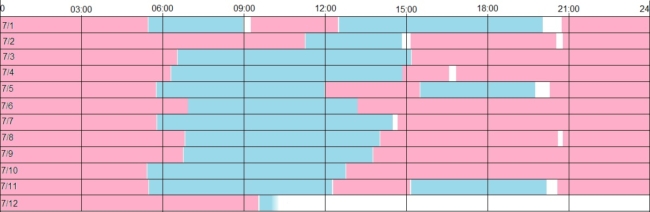
Eagle Kepr, one of our regular chatters on the Loon Cam, has been keeping a detailed record of nest sitting times, starting on July 1. It is posted online as an annotated spread sheet. It provides a great example of how the nest sitting is divvied up between the male and female, especially during the last week or so of incubation. I’ve used the data to create a graphic plot for those who prefer a visual aid over hard numbers. Pink is the female, blue is the male. You can see that Mom does all the nighttime sitting and at this late point in incubation she is covering two thirds of the nest duties.
July 10, 2022
Newcomers to the Loon Cam chat often ask or assume that the female is incubating the eggs in the nest. But, as long-time watchers can attest, the male and female share the nest sitting duties. The schedule for sharing duties varies between pairs of mated loons. Some switch off every three or four hours while others will go for twelve hour shifts or longer. There have been a few studies on nest sitting and they tend to agree on two points. The female is more likely to be on the nest during the night time and the female tends to increase her time on the nest as it gets closer to hatch time.
This pair is following the textbook very well. Mom is doing all the nighttime sitting and by now she is averaging about 15-16 hours per day. Expected hatch is only about 4 or 5 days away. But when it comes to hatch time, neither of the pair seems to feel any obligation to stay on the nest to greet the new chick. Even if the chick is well into breaking out of the shell, if the mate shows up and is willing to take over, the sitting loon will relinquish its seat. Perhaps they realize that it’s their last chance to take a swim alone, without the responsibility of feeding and protecting their offspring.
July 3, 2022
Now that the drama of Loon Cam 1 is over (and jubilantly successful), we turn our attention to the Cam 2 pair. Although the situation appears rather tame compared to Cam 1, The history of the Cam 2 territory is rife with upheaval.
The earliest record of loon occupation on this territory is 1987, although this may be because the pair moved the nest to a different island and it was assigned as a new territory. But there has never been a year when both islands had nests and the brooding area is believed to be the same for both territories. There were two years of successful nesting on the new island before development pressure and the raccoons that are attracted by the food opportunity of developed areas caused successive years of nest failures.
In 1992 LPC decided to install a raft. The challenge was where to put it and the chosen location was a compromise. This small cove was the only spot away from the boat traffic and the densely packed shoreline camps. The down side was that the nest was separated from the brooding area by a small cove of loon anarchy, given various names by LPC biologists such as “The DMZ” and “The Crossroads.” It all has to do with the geography of the lake, which in this area consists of densely packed, interconnected coves with numerous loon territories.
It is a challenging territory in which to successfully hatch and raise chicks, or even to just hold onto. In the past twenty years, there have been six times that total chaos has prevented nesting (one lasting for two years) and LPC couldn’t even identify a resident pair; just a number of loons harassing each other. Of the thirteen years with a resident pair, we know of at least five males and three females that held the territory during that time.
Despite the turbulent environment, in those twenty years the loons have managed to hatch 15 chicks, ten of which survived to the end of the season. So we have a 75% chance of a successful hatch and a 50% chance of a surviving chick. That’s pretty close to the statewide average.
June 25, 2022
Today dawned as a typical hatch day. Around 7 am the second chick hatched and we had a great view of Mom, and then Dad, nest sitting while the chicks peeped and had their first wobbly experience outside of an egg. Around noon the parents decided it was time that they all be real loons, get in the water and head for the brooding area. Chick #2 refused to go. Not unheard of and no big deal to the loons. Dad took #1 out for a paddle while Mom stayed on the nest with #2. Right about 1 pm Mom convinced #2 to join the others. They got in the water, gave a call, and then Dad and #1 began swimming back toward them.
Then it got weird. When Dad and #1 were still off camera and about 50 feet from Mom and #2, Dad let out some hideous sounds and began splashing in the water. When the camera turned we could see him beating his wings against the water and straining as if he were trying to release himself from something under the water. He also began moving away from #2 and the others, so #2 swam toward Mom and away from the commotion. Dad’s contortions went on for a couple of minutes. Three people reported seeing a large turtle head beneath him at one point. Shortly after that it appeared that Dad had shaken off whatever grabbed him and he swam further away, only to begin his bizarre behavior all over again. He worked his way to the middle of the lake, his efforts seemed to slow down as if he were wearing out, he dropped lower into the water, went under once, twice, three times, and then he sank out of sight.
Fifteen minutes later, still no Dad in sight. Mom looked confused and horrified, floating in the water with two chicks circling her. She didn’t change her expression or move more than twenty feet for an hour. During this time I was reviewing the video and trying to make sense out of it all. All the signs I saw pointed to an attack from under water. The only aquatic critter in the lake that could hold down a loon from swimming away would be a large snapping turtle. Why didn’t Dad come back after it was all over? It’s not like a loon to abandon its chicks on their first swim unless something was totally wrong. The only logical answer I could see was that Dad couldn’t come back and possibly wouldn’t be coming back and prematurely stated my fears to the chatters.
A little after two there was a wail in the distance. Mom answered back. At 2:25 pm Dad showed up, certainly weary and worse for wear, but intact, much to the relief of us all. A few chatters suggested that Dad had performed a distraction display but I don’t buy it. First, the only distraction display that loons are known for is the penguin dance. There is no wing beating in a penguin dance; it’s all in the feet that they use to kick up the water and rise up and puff their chest out to look menacing. Dad wasn’t being menacing; he was being frantic. But on the other hand, if a snapper had wraped it’s powerful mouth around the loons legs or feet the loon would surely be maimed after all that struggling. Perhaps Dad saw the snapper going for for the chick and he was trying to protect the chick and came up with this wing slap method, continuing to push/chase the snapper away from his family. That seems to have the best chance.
But more weirdness: When Dad got back both he and Mom continued to be animated and stressed out. An hour and a half wasn’t enough time to cool down? Something continued to bother them and that something was likely to keep Dad away for so long. But What? That’s the question. And then Dad took the chicks back to the nest, where they still are at 6:30 pm. Chatters think that #2 needs more time to dry out but I suspect that Dad needs the break more than the chicks do. It’s all kinda weird.
June 24, 2022
Is a chick sitting in half an eggshell hatched? In my book it is. And those constantly watching since the first pip at midnight 19 hours ago are likely to agree. Chick number one hatched at 7:00 pm this evening. Maybe earlier, but that was when Mom got real antsy and kept adjusting her left wing. Ten minutes later she lifted it high enough to reveal Junior sitting upright in his calcium cradle. Or hers; darned if we can tell the difference. LPC is proud of these parents. They are reliable brooders and we feel privileged to assist them by providing a nesting raft. Here’s hoping #2 hatches just as healthy and just as boisterous. This chick can sing! Nonstop.
June 19, 2022
This season has certainly shown us that there is intense competition between loons for the best breeding habitat. It seems to be a daily occurrence that our pair has to deal with intruders, sometimes as many as four or five at a time. A territorial pair must be constantly alert and know what’s happening within and beyond their territory. Exactly how they do it, how well they do it, and which senses they depend on for monitoring their territory have received very little study or discussion. Perhaps starting with the little bit we know about loons and throwing in some anecdotal evidence will shed some light.
It has been established that loons have high visual and auditory acuity. These are the two senses that are certainly most useful. Because loons are aquatic, they also benefit from the fact that water transmits sound five times better than air does, so they can increase their hearing by submerging their head. Loons also have a functioning olfactory bulb, above average in size compared to 107 other sampled bird species. So we can’t rule out the possibility that loons can smell each other, but it has yet to be positively demonstrated. Even if it were true, it wouldn’t be of much use other than at very close range, when the loon could already see and hear the intruder.
So, if they are using their hearing and vision, at what distance can they sense an intruding loon or other threat? I can recount two experiences that can shed some light on the question. On the first, I was monitoring a female with two chicks when the male showed up. The pair were exchanging pleasantries when suddenly the male turned toward the far end of the bay in a head up alert posture, gave a tremolo and then dove and swam in that direction. The female immediately stashed the chicks in a safe location and swam off to join him. I scanned the far end of the bay with my binoculars and could just barely make out a black dot floating in the water. Within a minute two more black dots appeared and a heated physical exchange ensued. The distance between the intruder and where the male was when he first sensed it was at least a half mile. That means that out in the open water, a loon might be able to sense another loon anywhere in a 500 acre circle.
The second instance started in a similar manner but this time the male didn’t swim off. He stayed within a hundred feet of the female and chicks, stared in one direction and let loose with some tremolos. At first I and the other biologist with me couldn’t figure what got the male all riled up. But, by the time the male switched to yodels and the female took over the tremolo, we recognized a paddleboarder headed in our direction. The loons didn’t take kindly to this newfangled sport. They gave him a royal tongue lashing as he passed. Again, the threat was perceived when it was still a half mile away. Although in this case a human standing on water is much more prominent than a loon. I think the take-away is that in many cases the loons know exactly what is going on in their entire territory. And then some.
June 12, 2022
Beware the cost of success; it brings notoriety. Notoriety brings envy and jealousy. Others want what you have. As I’ve written before, loons keep tabs on each other and they know who’s living the good life. Our pair has certainly been suffering the curse of notoriety lately. This clip, and this clip, show recent examples of our pair dealing with intruders.
But yesterday morning while Dad was on the nest he noticed something very concerning and went into a head-down defensive posture. It took quite a bit of scanning the lake but we finally saw five loons swimming and diving at the far end of the cove. Was Mom one of the five? Or was she laying low and monitoring the five? We’ll probably never know.
Five visitors on one territory during nesting is a bit much. Later in the season, after the chicks have hatched, five, ten or even twenty congregating loons is a common occurrence. Occasionally there might be a chick or two included in the group. It’s been suggested that loon parents bring chicks into another loon pair’s territory to fool visitors into thinking that the chicks are a product of that territory. Sneaky little buggers!
But how about a resident triad? On two occasions during my years of monitoring loons I’ve recorded three loons living in toleration of – and even in cooperation with – each other for the better part of the season. In each case I was able to identify a pair. Apparently the third loon moved in and couldn’t take over the territory but the pair was unable to drive the third loon out. That was enough to prevent nesting and the loons managed to live together in a form of detente. On one lake I found all three napping together within 20 feet of each other. On the other lake I witnessed the three loons cooperatively chase a fourth loon off the lake and then celebrate together. Three loons hurling insults at a fleeing visitor was a sight and sound to behold.
No matter how well you think you know loons, they’ll always come up with a new surprise.
June 6, 2022
Some Blog readers may remember my 2021 “Biff’s Scientific Hatch Time Predictions” blog, where I did some statistical voodoo and predicted the hatch dates based on Loon Cam records. If I recall correctly, I was pretty close. That makes the process a little easier this year. The time between the eggs being laid is the same as last year, as well as the greater than average time the first egg got incubated before the second egg was laid. This loon pair shows considerable consistency. Let’s hope the eggs can also follow the game plan. This is what I’m going with:
Egg 1 hatch: Friday, June 24 at 1:30 PM
Egg 2 hatch: Sunday, June 26 at 3:00 AM
June 4, 2022
The loon cam has recently been catching a few visits from intruding loons in the resident pair’s territory. One clip shows a single intruder nonchalantly swimming right between Mom and Dad. Dad (furthest away) raises up a bit, showing more white on his breast and and begins to swim toward the intruder. That was all it took to send the visitor wing rowing out of the frame and presumably flying off the lake. Mom, all this time, has a squared off forehead (akin to a dog raising its hackles) until at the very end when she decides there is no longer any threat.
The second clip shows a circle dance. Two intruders and one of the pair meet within range of the camera. The three approach each other, begin slowly swimming in a tight circle, and size each other up. The situation is tense so they each do a lot of peering (sticking their entire head under water) to guard against an underwater attack from any other loon that might be in the area. When one of them dives, they all dive. This for their safety and also it is an opportunity for them to assess their opponent’s defensive swimming skills. During the month of May you might see two loons doing a circle dance. But watch carefully. If the two are not pointing their bills at each other and if they are “dipping” (dipping only their bills and not peering) and doing synchronous diving, you are watching a courtship dance. These are not contestants; these are a pair taking their vows. And, yes, as far as I know loons renew their vows every spring, but it would be a difficult hypothesis to test. There may be some who don’t want to sign a prenuptial agreement.
But lets get back on track and ask the BIG question: why are there so many intruding visitors in this territory? Loons are social animals. The pair stays together all season, working cooperatively to do the daily chores and feed the chicks, but they also take a great interest in what other loons in their neighborhood are up to (see my May 24 post: The Territory). The territory of this pair is the entire lake so it’s not impossible for a visitor to safely land undetected, which would give it a bit of advantage in snooping around. And even more important, this pair’s home is in the middle of the Lakes District; it’s sort of a single home in the middle of a megalopolis. There is at least a dozen of other occupied loon territories within five minutes flying time, as well as a number of unpaired loons skulking about. They all want to know what’s happening here, just as this pair may individually take off to visit other lakes. Remember the female on the Loon Cam a few years ago? She left the lake for two days and left Dad to deal with the hatchlings. It’s all part of a loon’s life. It makes interesting viewing and with these two veteran parents it’s a minimal risk.
May 31, 2022
We can blame it on the new moon. It was pitch black in the dead of night; Mama couldn’t see past her nares. All she wanted to do was turn the egg a bit so she could get more comfortable. She knew she had messed up when she plopped down and found herself sliding down the exterior slope of the nest, egg in tow. What followed was three hours of confused and horrified desperation. She came so close to getting the egg back in the bowl but just couldn’t manage the last few inches. She cried for help but only got a string of distant yodels in return. Cheeky chatters theorized that hubby was hanging out with the boys at the Sand Bar. A forlorn Mama eventually left the nest area.
Eggs being knocked out of the nest or otherwise misplaced is probably more common than you would think. Over the years, the loon cam has recorded this happening two other times, as well as one egg being broke and removed from the nest by the loons. Loons are built to be in the water and are very awkward when on land. This is one reason you should never approach a nesting loon. If you flush it off the nest there’s a good chance it will either kick the egg out the back or drag it out the front.
Along about 4 am, with the first faint rays of morning twilight, Dad showed up from his all-night carousing. With no Mrs. around, he climbed up on the raft and saw the egg on the wrong side of the rim of the bowl. No problem; He gave it nudge and, voila, back in the bowl. He then promptly lost balance and slid down the slope into the predator guard. Dad really needs to cut down on his all-nighters at the Sand Bar. He climbed back up and sat on the egg for while before remembering he had an early appointment and took off. Shortly later Mama came back, looked at the raft, couldn’t see the egg in the bowl, circled the raft a half dozen times and swam away, still in despair. It wasn’t until 10 am that she finally realized the egg was back in the nest.
Oh, and by the way, that evening Mama laid her second egg at 7:23. Sitting on two eggs and watching the sun set over a mirror-calm lake, Mama figured life isn’t all bad.
You can watch the low-lights of Mama’s bad day here. And the highlight here.
May 28, 2022
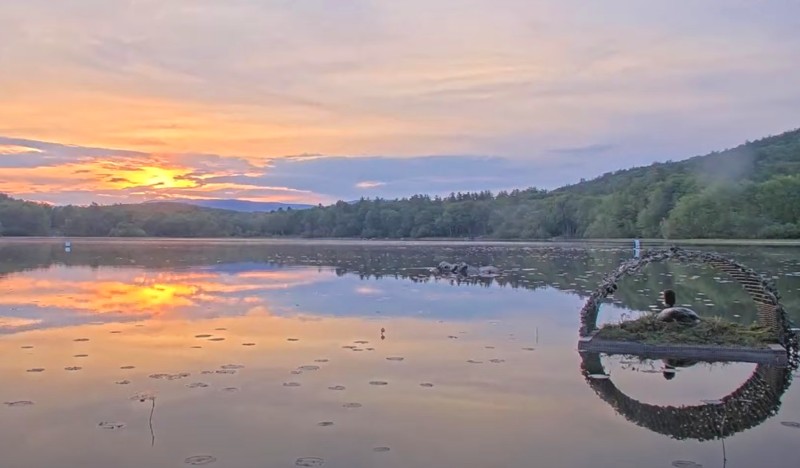
At around 9 pm last night there was an altercation between motel guests. The wood ducks, who were the first to check in, were accosted by the newly arrived geese. Although heavily outweighed, Mama Duck showed an incredible tenacity and managed to wear out the geese and sent them scurrying for alternative accommodations.
Motel management showed up at 11:29 pm and evicted all tenants. When interviewed, Mr Loon, co-owner of the motel, said “Enough is enough! We’ve had guests trashing the place on a nightly basis and this brawl is the final straw.” He added that now, with avian malaria becoming a health issue, none of the guests were willing to wear a mask. Or a diaper. “I’m not risking my life for a bunch of hoodlums!”
At 5:05 this morning Mrs. Loon deposited an egg in the nest; a decisive sign that the motel is not accepting guests. It’s sort of a shame. With the tourist season just getting started shore-front accommodations are at a premium.
May 27, 2022
I’ve already mentioned the various nest raft visitors we frequently see but this year the raft has been exceptionally busy. The local goose pair uses the raft every night, sometimes staying as long as six hours. But last night we set a record for occupancy: the two geese, mama wood duck and her three chicks. The ducks were on for eight and a half hours, 8:19 pm to 4:48 am. Now that’s a good night’s sleep, although the geese woke them up when they moved in at 11:41 pm. Here we see Mrs. Goose and Mama Duck exchanging pleasantries.
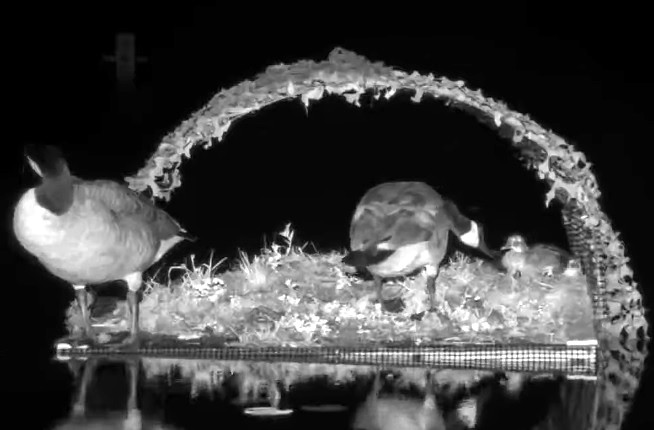
We’re having trouble hiring chamber maids. Those geese leave an awful mess!
May 24, 2022
I’ve used the term “territory” a number of times in these blogs. Perhaps I ought to define the term as it is used in wildlife ecology and discuss its implications. It often gets confused with “home range.” A home range is the total area that an individual uses on a regular basis, which can vary by season. A territory is the area an individual (or pair, in this case) will defend from intruders, particularly those of the same species (conspecific territoriality). When a loon pair is on the breeding lake their territory is their entire home range, with possible exceptions late in the season.
Loon territories in New Hampshire can be as small as 20 acres. On large lakes with many loon pairs close together their territories average around 40 acres. On smaller lakes that can only support one loon pair, the loons will typically consider the entire lake as their territory.
Our Loon Cam lake is under 100 acres and can only support one loon pair. Consequently, any visiting loon will be considered as a threat to the pair. Early yesterday there was a visiting loon on the lake. There was a lot of vocalization, including tremolos, and it was seen near the nest raft on one occasion. It may have been a lone loon looking for a territory to take over. It’s estimated that there are 100 or more single loons without territories in New Hampshire. Or it might be more likely that it was a curious loon from a nearby territory just scoping out the pond. This lake is in the heart of the Lakes Region and there are dozens of loons that could pop in by just flying a few minutes. Loons like to keep tabs on their neighbors. It’s always good to know your prospects in case you happen to lose your territory.
The short-lived and low-key confrontation between the loons makes me think it was just a nosy neighbor and not a loon looking to push one of our pair off the territory. Things rapidly returned to normal, and apparently without anyone getting a thrashing. Our pair is back to preparing for nesting. Any day now.
May 22, 2022
Choosing a territory is one of the most important decisions a loon needs to make. The “perfect” territory will have good water clarity, plenty of prey for both adults and chicks, is easily defensible from other loons, and has at least one good nest site.
In choosing a nest site, the loons are looking for a spot that is protected from terrestrial predators as well as wind and wave action. The more foliage the better, because it helps hide the nest from avian predators and nosy humans. The location that best fits the bill is the lee side of a tiny island in a sheltered cove. But there are not enough tiny islands in sheltered coves to accommodate all the loon pairs so they have to make do with what is available.
But who makes the choice? If you have the good fortune to watch a pair of loons nest site shopping in the spring, the soft vocalizations and head bobbing make it appear that it is a joint decision, made only after a long discussion and agreement between the two. But Walter Piper, a friend and colleague of LPC, has another idea. Walter reviewed the records of mate swaps and nest location changes on numerous loon territories in Wisconsin and found that nest site locations change much more frequently when there was a new male as opposed to a new female. (This is a bit of a simplification. Walter’s study was looking at the “win—stay, lose—switch rule”, but that’s a whole ‘nuther blog.) This is strong evidence that males choose the nest site. What it means for the loons is that it’s to the male’s advantage to keep a territory with which he is familiar; it’s to the female’s advantage to get on a territory that’s been held by one male for a long time.
And who chooses when to start nesting? This is a little more complicated. Sometimes it may not be the pair that makes the choice. If there is interference from other loons the pair may have to forego nesting until they can secure their territory. But when the territory is secure and the nest site is chosen, it’s up to the female; if not rationally, at least physiologically. One thing we know for sure, isotope analysis has shown that the eggshell and contents are from the lake, and not from the ocean, where the loon was before flying to the lake. So the female has to consume enough nutrients to replenish what was spent during the migration, to maintain good health, and then to produce two large eggs – about two thirds of a pound. Any nest initiation in May is earlier than average, which in New Hampshire is around the first week in June. This pair are pretty reliable late May nesters so we are expecting them to be on the nest any day now.
May 18, 2022
While the loons are settling in to their summer home and before they initiate nesting, now is a good time to enjoy the vast array of neighborhood wildlife likely to show up on the loon cam. The most frequent visitor is the red-winged blackbird. There is a shrubby marshland behind the camera, which is the preferred habitat of this bird. The resident male uses the raft as a perch for singing his “conk-a-ree” song, declaring territorial rights. You can also hear the “check” calls that both sexes make.
The painted turtle is the most common turtle in New Hampshire and you are likely to see as many as a half-dozen sunning themselves on the nearby rocks, as well as on the raft. They will continue to use the raft when the loons are nesting, well out on the edge of the corners in case the nesting loon decides visiting hours are over. The loons are much less tolerant of the snapping turtles, which will occasionally approach the raft. Despite their pugnacious attitude, the snappers pose little threat to the adult loons.
The most frequent nighttime visitor is the muskrat. These semi-aquatic rodents forage for food in the water but they need a dry place for eating. They build eating platforms out of mud and vegetation but they will use any available ready-made platform. Unoccupied nesting rafts make great eating platforms and the muskrats have been known to chew an access hole through the bottom of the raft so they can be more inconspicuous as they come and go. LPC now wraps the raft bottoms in a steel mesh to thwart the muskrat’s penchant for remodeling.
There is a resident osprey pair on this lake and some lucky viewers have witnessed an osprey scooping up a fish and flying off with it. Other visitors include great blue herons, kingfishers, otters, and various waterfowl. The loons will be nesting soon but there is much to see while we wait.
May 11, 2022
A topic receiving much attention on the Loon Cam is the pair of geese visiting the nest raft on a regular basis. They appear to have much more interest in it than the loon pair has. Geese have been known to nest on LPC nest rafts, although it is a very rare occurrence.
Because geese tend to nest a few weeks earlier than loons, they have an advantage in choosing nest sites. The incubation and nest brooding times for the geese are almost identical to those of the loons: 28 days for incubation and the chicks leave the nest in one or two days. So if the geese begin nesting on the raft in the next few days, then the raft would be unavailable to the loons until mid June. If this happens, the loons might wait, they might choose to nest elsewhere, or they might not nest this year. These possibilities are always present, whether or not the geese usurp the raft.
LPC would prefer to have loons nesting on the raft but we don’t own the lake and we can’t dictate the behavior of the wildlife residents on the lake. But we can take comfort in knowing that the goose and loon populations have both been increasing over the past few decades. Nature seeks a balance, and the loons fit comfortably in the balance.
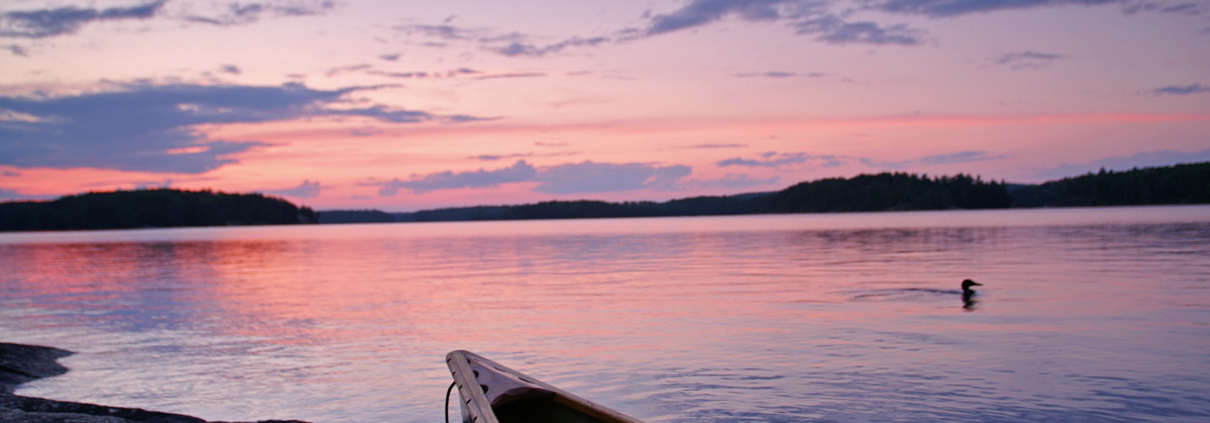
Is there anything better than exploring the lake on a sunny summer day? Self-powered vessels like canoes, kayaks, and stand-up paddleboards allow us to do just that. Paddling is a fun way to keep active in the summer, is a great way to get outside and enjoy nature, and can be enjoyed solo or with groups of family or friends. Given the physical, mental, and social benefits, it’s no wonder that kayaking, canoeing, and paddle boarding have been increasing in popularity in recent years.
From an environmental stewardship perspective, more people out enjoying nature is a great thing—in order for people to take steps to protect our ecosystems and wildlife, they first have to care about those ecosystems and wildlife. And what better way to develop care for our lakes than to get out on the water and experience them firsthand? However, while we’re out and about on lakes, it’s important for us to remember that wildlife can be affected by our presence. Although we typically think of motorboats as being the ones that negatively impact wildlife, self-powered boats like canoes, kayaks, and stand-up paddleboards can have just as big of an impact. It’s important for us to make sure that we’re paddling in a way that does no harm to the species that live on our lakes.
Loons, in particular, can be very vulnerable to human disturbance. While paddling on lakes, people often feel drawn to the nooks and crannies, eager to explore areas such as stream inlets, swamps, and islands. Our attraction to these areas makes sense, as they are typically the spots on the lake that are bustling with life, from turtles to fish to birds. But, these areas also happen to be the places where loons prefer to build their nests. And because loons cannot walk well on land, they are vulnerable when they’re on the nest. That means that when they detect something that they perceive as a threat (such as a person in a boat approaching too closely), their instinct is to get back into the water, where they are more mobile and therefore less vulnerable. If we paddle too close to a loon’s nest, we risk driving that loon from the nest, leaving its eggs exposed and vulnerable to predation and the elements.
Nesting isn’t the only time when loons are vulnerable to human disturbance. Loons on the water should also be given a wide berth (ideally, 150 feet or more), especially when they have chicks. To ensure their chicks’ survival, adult loons need to be constantly feeding them and keeping an eye out for predators. When humans get too close, the adults begin to pay attention to us, evaluating us as a potential threat. They may stop what they were doing and shift their focus to keeping an eye on us or getting themselves and their chicks away from us. If the loons are pursued and they have to continually swim away from us, they are distracted from performing other important tasks, such as keeping their chicks well fed. They may also pay less attention to other threats, such as predators, making the chicks more vulnerable to these threats.
Fortunately, there are some easy things we can do while paddling to ensure that we don’t have these negative effects on loons. Responsible paddlers should follow these easy guidelines:
- When paddling in or around areas where loons are likely to be nesting (islands, marshes, streams), take care to not paddle too close to the shoreline. Loon nests can be well camouflaged in these areas, making it easy to inadvertently get too close if we’re not careful. Be on the lookout for loon nests in these areas, and if you come across a nesting loon, be sure to give it as much space as possible (ideally, 150 feet or more).
- If you accidentally flush a loon off of its nest, leave the area immediately. More often than not, a loon will get back to its nest shortly after the perceived threat leaves the area.
- Give loons on the water space (ideally 150 feet or more), especially when they have chicks.
- Do not follow loons if they start to swim away from you. Swimming away is a low-level stress behavior in that a loon is uncomfortable with its proximity to a boat.
- Become familiar with the behavioral signs that you may be too close to a loon, and give loons more space if they display any of these behaviors.
June 27, 2021
While we’re waiting for the dust to settle in what appears to be a contest over territorial rights, now is a good time to take a look at the history of this territory. The LPC records for this territory begin in 1987 and can be neatly divided into four periods.
The Dark Age 1987-1996 We can call these ten years the dark age for two reasons. First, it was during this time that LPC was just starting to band loons and none of the occupants on this territory were banded. Consequently, we don’t know how much continuity there was within the pair or how many different individual loons occupied the territory during these ten years. Second, it was a time of turmoil. The natural island nest was experiencing heavy egg predation. In 1992 a raft was introduced and, although the pair successfully used it the first year, they then returned to a natural nest that failed. Over the entire ten year period this territory only fledged four chicks.
The Reign of King Henry IV 1998-2003 Why King Henry the 4th? Because he had half as many wives as King Henry the 8th. 1997 was a year of territorial conflict. There was no nesting and no definite territorial pair. By early 1998 a new pair was established. They successfully hatched two chicks and fledged one. King Henry’s coronation occurred that year, when he and his mate were banded. Henry had a very successful reign. In his six confirmed years he hatched eleven chicks and reared nine of them to survive to the end of the breeding season. That’s an incredible chick survival rate of 1.5, about three times as high as the average productivity rate. Henry accomplished this feat with three different mates, all banded either previously or on this territory.
The Reign of Queen Victoria 2003-2015 She earns the title of Queen Victoria because she reigned longer than any of the previous monarchs on this territory. In 2003 she became the third and last mate of King Henry IV. That year they successfully hatched and raised two chicks. Victoria received her bands and became the reigning queen. The following ten years were hard times; only one chick was fledged and there was no nest attempt on four of the years. 2014 was a turn-around year; Victoria and her third mate, who first showed up in 2013, hatched and fledged two chicks. And they did it on a natural island nest, the first and only time a natural nest was chosen over the raft since 1993. Victoria and Prince Albert III stayed together for two more years, producing one more surviving chick.
The Loon Cam Era 2016-Present 2016 was another year of turmoil. Although Albert the 3rd was confirmed to have returned to the territory, Victoria was seen strutting her stuff in multiple territories. The evidence leans toward an unbanded female being Albert’s mate. They nested but the nest failed. In 2017 there was a new male on territory; he was originally banded on a neighboring territory in 2006. Loon Cam viewers know him simply as “Dad.” Dad and an unbanded female (quite possibly the same female as 2016) hatched and fledged a chick. The female was banded and officially became “Mom.” The rest of their history is scattered in previous blog posts. Suffice it to say that they have hatched five chicks and fledged three in the past four years. That’s a record to be proud of. LPC would love to see this pair continue to reign on the territory but only time will tell. It’s all up to the loons.
June 22, 2021
Chick #2 hatched early this morning and by 8 this morning the pair decided it was time to leave the nest. Chick #1 had already spent a night on the pond with Dad and it was raring to go. But Chick #2 thought this raft living was a pretty cushy life and said “Not me!”. During a second try chick #1 and both adults were in the water and having a raucous celebration, singing camp songs and dancing around, but chick #2 stood its ground and replied “Uh-uh!”. So Mom got back on the nest with #2 while #1 and Dad went off fishing.
A little after 1 pm Mom had had enough of #2’s recalcitrance and pushed it into the water. Lo and behold, #2 quickly realized that it was a loon and that water was really neat! It became an expert swimmer in about 20 seconds and then they were off to do some fishing of their own. They soon met up with Dad and #1 and they lived happily ever after. Or at least as long as the loon cam could watch them before they were out of sight. We at LPC are proud of them. Hatching and launching two healthy chicks isn’t as easy as you might think.
June 21, 2021
Yes, chick #1 has hatched; exactly when is subject to personal opinion.
By 6 am yesterday (June 20) chick peeps were regularly emanating from the nest. That’s a sure sign a chick is on the way but not proof positive that the pip had started, much less a hatch. We never saw a pip (it’s a tough nest for egg viewing) but there were plenty of claims of sighting the chick, none which garnered a true consensus that you could hang a hat on. The first proof positive was when the chick emerged from under Mom’s wing at 4:56 am this morning.
We still have a wide range of opinions about hatch time. But a good piece of evidence is based on Mom’s behavior. It was around 1 am this morning that she started giving very clear indications that she had a chick under her left wing. So I would say that the actual hatch occurred no later than 1 am. But if you’re set in your mind that it should be a solstice chick, feel free to claim that the chick hatched on the 20th. There’s no one who can prove you wrong.
June 18, 2021
Yesterday the Loon Cam watchers noticed frequent antsy movements by the incubating loon, as well as more attention to inspecting and turning the eggs. That’s a good indication that the embryo in egg number 1 is close to full development and moving around, getting ready to position itself for hatching.
The next sign of an imminent hatch will be the pip. A pip is the first tiny hole in the egg that a chick makes as it begins to peck its way out. When the adult is turning the eggs, look at the blunt end of the egg for evidence of a pip. Sometimes a small chip of eggshell will be knocked off before the membrane is punctured. So if you see a bright white spot with crisp and irregular edges on the blunt end of the egg, you can count that as a pip.
If you turn the volume up high you might hear peeps coming from the egg even before the pip is made. The microphone for the loon cam is mounted on the raft, above the nest and is more than sensitive enough to pick up peeps from a chick still inside the egg.
How long does it take a loon chick to finish pecking its way out of an egg? The record long time on previous years of the loon cam is 19.5 hours for the 2019 Loon Cam 2 nest. The chick takes a lot of breaks so don’t get worried if you’re expecting a chick to pop up at any moment.
June 15, 2021
At 6 am this morning an otter popped up at the edge of the raft and flushed the female off the nest. Quite a bit of commotion ensued, mainly splashing and wing rowing around the raft by the female. Apparently the otter took the hint and left.
If you watch the video, you’ll notice that the loon used a lot of upward thrust when jumping off the nest. In fact, it jumped so high that it hit the nest cover hard enough to rock the raft. That was a wise move by the loon. Eggs can be accidentally kicked out of the nest when a loon flushes. By jumping upwards, she avoided kicking the eggs backwards. It’s hard to say if it was intentional but it certainly was fortunate.
Would the otter have been a threat to the eggs? It’s hard to say. Otters are not on our regular list of loon egg predators but there have been anecdotal reports of them eating bird eggs. In the only reliable record we have of an otter having a clear chance of grabbing loon eggs out of the nest, the otter left the eggs untouched.
June 14, 2021
Say What? Am I seriously going to lay this arcane ecological term on you?
Yes, I am. The subject of a recent discussion on YouTube Chat concerned the interactions between loons and other birds that eat fish. An animal that primarily eats fish is a piscivore. Birds are in the taxonomic class Aves. Avian is the adjective form of Aves. In ecology, a guild is a group of species that exploit the same resources, and usually in a similar manner. So we can translate the title to “The Group of Birds that Eat Fish.”
Loons share their lake with numerous other members of their guild. In New Hampshire this can include bald eagle, osprey, great blue and green herons, double-crested cormorant, common merganser and belted kingfisher. They all compete with loons to some extent but if we further divide them into three methods of fishing we’ll see that the methods are related to the intensity of competition.
The raptors (eagle and osprey) and the kingfisher all hunt for fish from the air. None of the three are good swimmers; they grab a fish at or near the surface and immediately fly off with it. There is no opportunity for any interactions with loons. Because the eagle is an opportunistic hunter and forager, eagle-loon interactions are only as predator-prey. However, anything an eagle catches in the water must be consumed at a terrestrial site. An eagle can only fly when carrying no more than a third of its own weight. Adult loons weigh about as much as an eagle (they may be smaller but they are much denser) so the only available prey items are chicks and eggs. Even so, an eagle needs stealth and cunning to get past a defending adult loon. Most eagle-loon interactions occur in open water when an eagle is after a loon chick. In the water, the loon has the advantage.
The herons are waders. They don’t like to get their feathers wet so they’re limited to shallow water that is no deeper than their legs are long. Loons prefer deeper water where they have more room to maneuver. However, loons and herons do occasionally meet but if a loon approaches a heron it will simply fly away. LPC has a few records of herons perched on the top of a nesting raft occupied by a nesting loon. Neither bird showed the least concern.
The third group includes the loons, cormorants and mergansers. These are the divers. All three spend almost all their time in the water and frequently encounter each other. The loon is the best adapted to an aquatic life, as well as weighing two to four times as much as the cormorant and merganser and having the most lethal, dagger-like bill. Avoidance is the responsibility of the cormorants and mergansers; if a loon shows up, get out of its way! This is normally not a big issue because, just like the herons, they can simply fly away. The only time there is a constant threat is when a merganser has a brood of chicks in tow. The chicks can’t fly and the adult is unlikely to abandon them. The loons find this to be irresistible. Picture a convoy of one ship and a dozen pleasure craft being targeted by a submarine.
The bottom line: The loon has evolved into an efficient specialist much more suited to an aquatic habitat than to a terrestrial habitat or flight. Within their guild, they rule as long as they stay in the water.
June 8, 2021
Here we are, halfway through incubation and everything is going splendidly. This is not normal. We’re used to witnessing dads frantically building up nests to stem the flood and accidentally burying eggs, moms going AWOL for days at a time, standoffs with belligerent snapping turtles, and dive-bombing eagles.
But this pair; they’re so… PERFECT! They must have read all the loon how-to books by Judy McIntyre, Jay Mager and Walter Piper. From courtship ritual to nest shift exchanges, they do everything by the book. And Dad is such a romantic, hooting and cooing sweet nothings to the Mrs at every nest exchange and wail texting her when he’s on the far end of the lake. And now they’ve proved they can handle a heatwave without skipping a beat, although Mom seems to have given up her reluctance act when Dad comes to take over nest duties.
May the second half of incubation go as smoothly as the first. Sure, drama and suspense add to the viewing excitement but I’m ready for a no stress hatch.
The National Weather Service is predicting a string of near 90 degree weather for the next four days. Not good news for the loons. The common loon is a northern species, adapted to relatively cool summers. Their thermoregulation system is better suited to conserving heat rather than dissipating heat. New Hampshire is on the southern edge of the loon’s range and, although the trophic status of the lake (chlorophyll, phosphorous, turbidity) plays a large part in determining habitat suitability, climate has an important role in controlling trophic status as well as challenging the loon’s heat tolerance. This is especially true for adults incubating eggs because they no longer have the cooling effect of being immersed in water.
You will see a lot of panting by the nesting loons, the same cooling mechanism that dogs use. During the hottest times of the day a loon is apt to take a short dip in the water to cool off. The time off the nest is usually no more than 10 to 15 minutes. On the hottest days, an egg exposed to direct sunlight can overheat and become inviable within a half hour. LPC has been experimenting with various nest raft coverings to provide shade on the raft while still allowing visibility for the loon in all directions. If the climate model projections are accurate, New Hampshire’s loons will face increasing climate challenges over the next few decades.
June 1, 2021
Loon watchers who follow the Chat on YouTube may have seen references to “forks”. It’s a means of using the loon’s necklace to differentiate between the male and female when the bands are not visible. The necklace consists of two rows of vertical white pinstripes, one on each side of the loon’s neck (or you could describe it as a ring with gaps in front and back). Most of the pinstripes are simple, straight lines but there are usually one or more pinstripes that diverge into a “Y” shape, which can either be right-side up (fork up) or up-side down (fork down). In the case of this pair, it’s been reported that, on the right-hand side, the female has two forks up and the male has one fork down.
During my first year at LPC as a neophyte loon biologist, I noticed this variation in necklace patterns and I suggested to a wise and venerable veteran of loon biology that it could be used as a unique identifier, just as oceanographers use the color patterns on whale tails. I was flatly informed that it wasn’t reliable; necklace patterns could change during preening or molting. That was fourteen years ago. In the interim, I’ve learned that my observations were certainly not unique and there has been much discussion about necklace patterns. Although I haven’t found any published studies on the common loon, a group in Finland did a study on variations in the neck patterns of arctic loons. They found that the patterns remained constant between years but use as a unique identifier was successful only 70% of the time in a population of 127 loons.
There is no doubt that loon watchers on YouTube or residents on loon lakes can use physical characteristics to distinguish between individuals. But when you are following 750 loons and covering 382 lakes, identifying loons by neck patterns becomes awkward and unreliable. We also have to deal with the simple fact that, for most of it’s life, a loon is not in breeding plumage and it has no necklace. Juvenile plumage lasts for the first three years and adults are either in or transitioning into or out of winter plumage from late September through March.
LPC and all other loon study groups rely solely on colored bands for identifying individuals. It’s a simple system to learn and it remains reliable throughout the entire life of the loon. But by all means, use physical (and behavioral) differences for keeping track of your favorite group of loons. It’s a great way to better know these fascinating birds.
May 30, 2021
Yes, real science! It may turn out to be real junk science, but it’s still science. After recording dates and times of Loon Cam nest events over the past four years and eight nest attempts, I’ve found some remarkably consistent timing between eggs being laid and eggs hatching, even though three different loon pairs were involved. By doing a few simple calculations we should be able to figure out some hatch times for these two eggs.
First we’ll start with time difference between egg#1 and egg#2 being laid. Most sources give a range of one to three days between eggs. Our sample size of reliable times (n=7) is in a tight range of 2.4 to 2.6 days, averaging 2.51 days. That’s remarkable for seven samples coming from three different pairs.
For total incubation time, we also have a pretty tight range if we separate 1st eggs from 2nd eggs. Incubation time for first eggs (n=6) has a range of 26.4 to 27.7 days (avg 27.2) . Second eggs (n=4) have a range of 25.4 to 26.7 days (avg 25.7). That’s kinda freaky; the range distributions are identical and exactly one day apart. Studies have shown that egg embryos can communicate with each other (https://newatlas.com/embryo-eggs-communicate-via-vibrations/60733/) and you might wonder if egg pairs are working out the schedule together. But that’s not the case. When we look at each pair (compare each egg to its nest mate) there is no correlation. The similar distributions are just serendipity. In statistical gobbledeespeak, we have skewed distributions; they don’t line up with each other.
So what’s causing the skew? There’s one factor that appears to be obvious: incubation effort between the first egg being laid and the second egg being laid. Typically, loons incubate the first egg only sporadically before the second egg is laid. It can be as little as just a few minutes a few times each day or it can be as much as maybe 50% of the time, maybe more. This is likely what causes the variation in the time between hatches, which ranged between 0.8 (assumed very little incubation before second egg) and 1.8 days (more incubation before second egg) (avg 1.4).
This year’s pair didn’t wait. From twelve hours after after the first egg was laid, the loons have been constantly on the nest. Egg#1 has gotten a good head start. Also, of all the nest attempts that hatched two eggs, this attempt has the longest time between eggs being laid (62.5 hours). I’m going to take the minimum first egg incubation time and subtract two hours: 26.3 days. For egg#2, the best I can do is take the average time: 25.7 days.
First egg hatch time: June 20, 1:22 PM
Second egg hatch time: June 22, 3:33 AM
I’m ready to eat humble pie.
May 28, 2021
Early yesterday morning the female was on the nest and she began to exhibit classic egg laying behavior. At 10:43 am she gave a final push. The problem is that this is a deep nest bowl with a high rim in front. We can’t see into the nest. We prefer to confirm eggs by actually seeing them but we are lucky to get a brief glimpse of the top of one egg when the loons are turning it. For now, we are assuming that there are two eggs. The timing between the two eggs (62 hours and 20 minutes) fits perfectly within the range of what we have previously observed (58 hours to 63.5 hours). During some of the egg turns it appears that the loon is manipulating two eggs.
May 25, 2021
In the early evening of yesterday, the Loon Cam 1 female got on the nest and began contractions typical of egg laying. The “final push” occurred at 8:23 pm. She remained on the nest for another hour and twenty minutes. The male got on the nest at 9:08 this morning and turned the egg, which was our first chance for visual confirmation.
So, can a loon lay a viable egg 14 hours after fertilization? It seems unlikely but there is no reliable data on the exact timing. It’s quite possible that previous mating had occurred off-camera.
May 24, 2021
This morning, at 6:40 am, The Loon Cam 1 pair mated on the nest raft. This is an encouraging event for all who watching and hoping for a successful hatch, but can we start predicting an expected hatch date?
Not really. It usually takes a number of tries before an egg is fertilized. In 2017, the first observed mating on Cam 1 was on May 3rd; the first egg didn’t show up until May 21st. But that was an extreme time period between first mating and first egg. It’s possible to have an egg within a week of first mating. This pair usually has eggs in the nest during the first week in June. Today’s event is consistent with their typical schedule.
May 20, 2021
The Loon Cam 1 male spent an hour on the nest this morning, talking to himself in plaintive hoots and coos. The female was nowhere to be seen. Precopulatory nest sitting is a common occurrence and is commonly referred to as “trying out the nest.” But this behavior is often observed when both loons are present and soft coos are exchanged between the two. It seems apparent that, in this case, the male wants to get the nesting started but the female is not ready.
A little knowledge is a dangerous thing but it’s fun to speculate why things are as they are. Something we know for sure is that the female of this pair is particularly small. Perhaps her metabolism rate is slower than average. We also know by way of isotope analysis that egg contents are derived from nutrients acquired on the nesting lake. She may still be accumulating and metabolizing enough nutrients to form viable eggs.
This pair typically initiates nesting around June 1st. I guess the male will just have to be patient.
Loon Cam season is rapidly approaching—if all goes according to schedule, Loon Cam 1 will be live by mid-May. This year, Loon Cam 1 will be streamed from a different lake than usual. We know that many will miss the pair from our previous Loon Cam 1 site, but rest assured that the pair on the new lake is made up of two wonderful loons! To help you become acquainted with them, we’ve compiled some information on their history. Please note that LPC biologists are not out surveying yet for the year, and as such, we can’t be 100% sure that the same banded loons are back on the lake this season; however, given that loons have high rates of territory fidelity and that they are a long-lived species, it is very likely that the pair we watch on Loon Cam 1 will be made up of the two loons described below. We hope that you fall in love with them, as the people who live on their lake have!
The members of the regular pair on this lake were both originally banded in 2013. Because they were banded as adults and loons do not reach adulthood until age three, we know that they are, at minimum, 11 years old; however, because they were banded after hatching chicks and the average loon does not hatch a chick until ~6 years of age, it is likely that these loons are 14 years old or older.
The male loon’s left leg band combination is white stripe (white background with a horizontal black stripe through the middle) over orange. His right leg band combination is silver over blue stripe (blue with a horizontal white stripe through the middle). This past winter, this male loon was photographed on the ocean, so we know that he spends his winters off the Connecticut coast.
The female loon is only banded on her right leg, which has an orange band over a silver band. The reason that she is not banded on her left leg is because she is tiny! When our banding crew caught her in 2013, they did not have small enough bands on hand to fit her left leg. Generally, the legs of the loons we band here in New Hampshire range from 24–27 millimeters wide along the flat edge. This female’s legs were just 21.4 millimeters—quite small for a New Hampshire loon! While we were able to trim down her aluminum US Fish and Wildlife service ID band to fit her leg, we only had a single plastic band with us that was small enough for her. As such, her left leg had to remain bare.
This loon pair has been together every year since they were originally banded in 2013. In that time, they have hatched 8 chicks, 6 of which have survived to the end of the summer. We hope that they will add to that number this year, and we’re excited to watch along with you as they nest!
It was a tough decision to change the Loon Cam location, and one that was made after careful consideration. We know that viewers have become attached to the pair that we’ve been livestreaming since 2014; however, a few different factors played into our decision to feature a new loon pair and location this year:
- The Loon Cam 1 nest site was quite far from the Loon Center. As our workload has increased over the years (a good thing, as the increased workload has been in response to an increase in New Hampshire’s loon population!), it’s become increasingly difficult for our staff to find the time to get out to the site to install the Loon Cam in the spring, check on it as problems arise throughout the nesting season, and break down the setup later in the summer. The new site is closer to LPC, and as such, it will be much easier for us maintain.
- The male loon from the old site had to be rescued last year after getting injured in a territorial fight on a nearby lake. He was examined, rehabilitated briefly, and released directly onto the ocean once given a clean bill of health. While it’s likely that he will return to his lake this year, we can’t be 100% sure. Given that male loons have been found to play a larger role in choosing the nest site (for more information, click here), it’s possible that if a new loon takes his place this year, the pair may not nest where we expect them to. It’s also possible that they may not nest at all, as is sometimes seen in pairs in which one member is new. We want to make sure that we give you a view of nesting loons, and as such, we think it makes more sense to broadcast from a lake where we’re more certain that nesting will occur this year.
We hope that you enjoy the new location and getting to know the new nesting pair, and we look forward to the Loon Cam going live in just a few short weeks!
It’s hard to believe Labor Day has come and gone, but here we are at the end of another loon breeding season —- and what a season it has been! I am delighted to report that all 8 chicks on Squam Lake and both chicks on Little Squam are still doing well! All but the youngest chick are in the “teenage” loon stage, and the youngster is almost 6 weeks old now and growing fast!
With these remarkable chick numbers on Squam Lake, 2020 is Squam’s best year for loon breeding success since 2003! The 11 chicks hatched this year on Squam Lake are the most since 2003, as are the current number of chicks surviving. All of the surviving chicks on Squam Lake this year —- and all of the chicks that hatched except for one —- hatched off of nesting rafts floated by Loon Preservation Committee. I hope the chicks —- and all the loons —- will continue to thrive as they prepare for migration, or just plain grow up in the case of the youngest chick! But no need to worry about migration for the youngest chick —- it has plenty of time to grow and learn how to fly before it needs to leave.
Many thanks to all of you for helping to protect the loons of the Squam Lakes this summer, for looking out for them, and for helping spread the word to others to be respectful of the loons! I really appreciate everyone’s help! This will be my last e-newsletter of the season, but I will continue to be out on the lake through the fall keeping an eye things and will let you know if anything happens to any of the loons. Please don’t hesitate to contact me with any questions, concerns, or reports. And please report any sick, injured, or dead loons to Loon Preservation Committee. The Loon Center is currently closed, so please report any loons in distress on our website at https://loon.org/report-loon/ or by emailing info@loon.org. And our online store is still open for all your loon-themed shopping needs! Please visit: https://loon.org/shop/.
The last email of the season means it’s once again awards season on Squam! Please see the P.S. below for the Seventh Annual Squam Loon Achievement Awards and find out who walked away (swam away???) with the coveted Productivity Award this year!
Thank you for your interest in Squam’s loons! I wish everyone a happy, safe, and healthy Autumn!
Tiffany
P.S. Seventh Annual Squam Loon Achievement Awards: It’s awards season, time to celebrate everything the loons on the Squam Lakes have accomplished this year!
First, let’s pause to remember the loons we have lost in the past year: the unbanded adult loon found dead at Long Island last October who died of lead poisoning from ingested lead fishing tackle; the Perch Island female, killed at the end of June by a boat strike; and the three chicks on Squam Lake who died this summer, one of whom disappeared at just over 2 weeks of age, another died during hatching, and the third disappeared just after hatching. These are all very sad losses to Squam’s loon population.
But now, let’s celebrate the achievements of Squam’s loons in 2020!
Productivity Award: For the coveted 2020 Productivity Award…we have a tie! Considering how many deserving loon pairs we had this year, it seems only right to spread the award around. Our winners this year are the Heron Cove pair and the Mooney Point pair! The Heron Cove loons were the only pair to fledge two chicks on Squam Lake this year —- congratulations! (Don’t worry, Little Squam pair, your award is coming below!) And the Mooney Point pair shares the award for finally, after many years of nest failures, plucking up the courage to try a new nest site and successfully raise a chick! The current male was part of the pair that last had a chick in Mooney Point in 2014. Clearly buoyed by his success, he stuck doggedly to that nest site despite succeeding years of nests being lost to predation, black flies, and intruding loons. Each year I would hope that the pair would try a different location, each year my hopes would be dashed as they once again settled on their old spot…until this year! I was thrilled when they selected a new, safer location, and they have a beautiful chick as the ultimate reward for making the switch! So, for the Mooney Point pair’s great decision-making skills that resulted in a chick and the Heron Cove pair’s two-chick brood, these are the 2020 co-winners of the Productivity Award!
Ten-Year Productivity Award: Taking the long view —- hands down, it’s Little Squam once again! With their two chicks this year, the Little Squam loons have produced nine chicks in the last 10 years!! Keep up the great work, Little Squam loons!!
Pair Together the Longest Award: I’m awarding this as a two-part award this year, the first half of the season and the last half of the season. For the first half of the season, this award belongs to the Perch Island pair, together for 10 years. Sadly, their 10th anniversary season was cut tragically short when the female was killed, but let’s celebrate once more their 10 years together at Perch Island.
The Pair Together the Longest Award for the second half of the season goes to, ironically, the Long Point pair —- last year’s winners of the “Most in Need of Marriage Counseling” Award! I like to think that the fact that they actually DID pair up this year indicates they took my advice and got some professional help over the winter. As you may remember, this is Squam’s on-again/off-again pair. Including this year, they have been a pair for a total of 7 years, but these 7 years have been interspersed with years when both of them were present in the territory but they never actually paired up. After a promising start together in 2019, the relationship again hit the rocks; and, after seemingly being unceremoniously ignored by the female, the male had little choice but to spend the latter half of the summer hanging out with other females. I was left wondering if this was the end of the road for this twosome, so I was pleasantly surprised to see them both together this summer —- and vaguely shocked when they settled down on a nest. The nest of was on the verge of hatching when, sadly, it failed, possibly due to the presence of intruding loons. What this setback will mean for their fragile relationship remains to be seen —- maybe another winter of marriage counseling is in order? In any case, I am both pleased and amused to award Squam’s own on-again/off-again pair with the “Pair Together the Longest Award —- Second Half of the Season”!
Father of the Year Award: Even without chicks, this award definitely belongs to the Perch Island male. As many of you will remember, after his mate was killed while the pair was actively nesting, the male tried incredibly hard to continue incubating the eggs. As far as I could tell, he was on the nest almost constantly for a week after she died. Loons are not cut out to be single parents —- they need their mate to chip in so they have time during incubation to feed, preen, and take care of themselves. Obviously, that was no longer possible, but he gave it an absolutely heroic effort to stick to those eggs. He was finally forced to abandon them; and, as I collected the eggs for LPC’s research the day after the expected hatch date, I was thinking about what could have been but also filled with admiration and respect for the male and his valiant efforts to hatch those eggs.
Mother of the Year Award: This goes to all the female loons of the Squam Lakes who had chicks this year! It was a remarkable year for productivity on Squam —- for all the hard work all those loons put in to make it happen, they all deserve the award!
She’s Just Not That Into You Award: The poor Squaw Cove male was trying so hard. Sitting in front of a potential nest spot, he was patiently waiting as his mate slowly made her way down the cove, preening, bathing, and generally appearing rather self-absorbed and oblivious to the presence of her mate eagerly waiting for her. As she (finally!) got closer, the male began cooing, trying to entice her to come and check out his perfect nest site. But she just kept going past, preening away, seemingly studiously ignoring him and all his efforts. The male continued cooing determinedly, convinced this must win her over. Finally, even he couldn’t ignore her indifference and he gave up at last, swimming after her, clearly determined to keep trying. They never did nest. For all his hopeful cooing, for all his efforts to win her heart, and for all her determination to ignore him, the Squaw Cove male wins the “She’s Just Not That Into You” Award. Well, Squaw Cove male, there’s always next year…
Messiest Break-Up Award: It was an epic loon chase by any standards, as the two loons wing-rowed deep into Owl’s Head, back out again, and then went clear across the entrance to Sturtevant Bay, swerving and dodging as they raced across the water. I watched the chase for at least ten minutes and was told by other boaters in the area that it had been going on for quite a while before I happened upon them. But aside from the impressive speed, maneuvering, and stamina of the loons and the tenacity and fierce determination of the loon doing the chasing, what was truly remarkable about this fight was who it involved: two loons who had been blissfully paired up just last year, the 2020 Kimball male and his ex from 2018-2019! There was a new female in Kimball this year, who was peacefully sitting on her and her mate’s nest while he was busily chasing his ex all over the place. The former Kimball female was a single this year, and I can only speculate on how this fight began —- loon fights are typically between same-sex birds, so to see a male and a female going at it was very surprising, complete with the added twist of this being a former pair. All I can say is, they were engaged in this chase with all the enthusiasm, hostility, and stubbornness that can only result from a very, very bad break-up! With that, I bestow the Messiest Break-Up Award on the Kimball male and his ex from 2018-2019, congratulations!
Congratulations (??!?) to all the winners of the Squam Loon Achievement Awards 2020! It was wonderful having so many pairs to choose from for the Productivity Award —- I hope I will have so many options in 2021 too, or more! Have a wonderful Autumn, everyone!
Just a quick note to let you know that the 8 chicks on Squam Lake and 2 chicks on Little Squam are continuing to do well! As the chicks get older, the families are moving around quite a bit–please remind your friends, neighbors, and other lake users to boat carefully and keep an eye open for the loon families. Thank you!
In case you missed it last week, LPC Executive Director Harry Vogel’s end-of-season presentation is available on our YouTube channel: https://www.youtube.com/user/LoonCenter. Find out what the 2020 season was like for New Hampshire’s loons!
Don’t forget to clean the lead out the old tackle boxes in the garage or boathouse, and spread the word to your friends and neighbors to do the same! Since 1989, lead fishing tackle ingestion has been responsible for 44% of the documented mortalities of adult loons in New Hampshire. Please help protect loons and other wildlife by having only non-lead tackle in your boxes. As part of LPC’s Lead Tackle Buyback Program, you can turn in old lead tackle in return for a $10 voucher at Squam Boat Livery. For more information or to see a list of other participating tackle shops around the state, please visit www.loonsafe.org.
Please don’t hesitate to contact me with any questions, reports, or concerns about Squam’s loons, and please report any sick, injured, or dead loons to Loon Preservation Committee at (603) 476-5666.
Great news, we have a new chick on the lake! One of the two nests I mentioned as being still active in my last newsletter hatched one chick and it is now growing fast! The other chicks on both Squam and Little Squam are also still thriving, and the chicks that hatched the earliest this summer are just beginning to lose their down and grow regular feathers. It seems like only yesterday they were the size of the newest little chick!
Sadly, the news from the other nest that remained active was not as good. One chick also hatched there; but, unfortunately, it disappeared immediately. It was likely taken by a predator, although it is not clear exactly what happened to it. This was a very sad and disappointing outcome for this nest.
There are no more nests on Squam, so all the focus now is on making sure the chicks continue to grow and thrive on the Squam Lakes. Right now, there are 2 chicks on Little Squam and 8 chicks on Squam Lake. Please help spread the word to your friends, neighbors, and other lake users to be careful when boating and to look out for loons and loon families. Here are a few safe boating tips to pass along:
Please ask them to boat slowly and carefully in areas marked with Loon Preservation Committee’s orange “Caution: Loon Chicks” signs. Please remind them that the loons may be anywhere in an area marked with these signs and to look carefully for chicks. Chicks can be difficult to see on the water and may be alone on the surface if both parents are diving for food or if the adults are elsewhere, as starts to happen more frequently at this time of year.
Even if they are not boating in an area marked with chick signs, please ask them to be alert and boat carefully. Loons can be anywhere.
Please give loons and loon families plenty of space —- at least 150′ (the no wake distance) or more if loons show signs of stress. This distance applies to both motorboats and kayaks/canoes/paddleboards. Many people think they can get closer if they are in a “quiet boat,” but please remind them that the close approach of a kayak is just as stressful and potentially harmful to loons and chicks as that of a motorboat.
Please do not boat between the shoreline and the loons if the loons are in towards the shore —- this also applies to both motorboats and kayaks/canoes/paddleboards. Going between the loons and shore can push the loons away from shore and into more open water that is less protected for the chicks from wind and wave action and where there is greater risk of collision from motorboats or water skiers/inner tubes/jetskis. Instead, please ask them to go around the loons at a safe distance.
P.S. “Meet the Loons of Squam”:
Five Finger Point —- Every spring I approach the Five Finger Point territory with considerable anxiety: will she be back? “She” is the female from Five Finger Point, the oldest known loon on the Squam Lakes and the last of the Squam loons that was banded in the 1990s. Given that she was banded in 1998 as an adult with chicks and, on average, loons don’t start nesting until they are 6-7 years old, she is at least in her late twenties —- truly the Grand Old Lady of Squam, and most of those years have been at Five Finger Point! By the time you’ve reached that age if you’re a loon, you have more than earned the prerogative to do what you like, and the Five Finger female likes to delay her arrival back on Squam each spring —- considerably protracting my anxiety on whether she will return or not! But it is always a source of much happiness —- and relief! —- to me when I see she’s back for another year, so let’s look back at her long history in the Five Finger Point territory and her busy summer this year with a new mate.
Those early years in Five Finger Point right after she was banded were her glory years —- of course, we don’t know her history before she was banded; but, from 1998-2002, she fledged a chick every year except one, when the pair was forced to abandon their nest due to human disturbance. Five Finger Point was a very successful territory in the late 90s-early 2000s, and this female was a big part of that. But then things turned for her in a puzzling way: she was not seen on Squam in 2003, she was back in the territory in 2004-2005 but did not nest, and then she was not seen again in 2006-2008. Where she was during these years remains a mystery —- as well as why she went from being such a productive loon to being absent or not nesting if she was present in the territory. These will always be question marks for me and gaps in her story.
But, in 2009, there she was again —- back in Five Finger, this time playing the supportive partner to her mate that year who had an injured wing. Fortunately, he healed, but it ruled out nesting for that year. After seven years of the quiet life, she apparently decided it was time to step into the limelight in a major way. In 2010, she and her mate delighted people at Rockywold-Deephaven Camps (and, no doubt, were the subject of many pictures!) when they nested in easy view of RDC guests! The nest was also near a muskrat house, so the pair spent their days sitting on the nest taking jabs at the rather oblivious muskrat as it swam back and forth in front of them. Despite several weeks of fame and muskrat harassment for the pair, it ended in sadness —- just days before the expected hatch, the nest was destroyed by a mammal. Whether the muskrat finally took its revenge or if it was something else, I wish I knew.
After the excitement of life in the spotlight, the female apparently decided to return to a quieter life, settling in at Mink Island for the next 2.5 years. In 2012, she successfully raised her first chick since 2002 —- quite an accomplishment after so many years! But her successful raising of a chick put a target on her back for other loons seeking a territory where they could raise a chick too; and, the following year, she was driven out of the Mink Island territory. The next several years were a succession of years alternately being an unpaired single and being the territorial female in the Five Finger Point territory. She did have a nesting attempt in 2016, but the nest failed. She was a single loon again last year, and it looked like her fortunes were on the downhill slide.
But little did I know how much things would change when I noticed the male from Mink Island over in the Five Finger Point territory late last summer. Since it was late in the year, his presence didn’t elicit any serious reaction from the territorial pair, but he did seem to be making himself quite comfortable there. Many of you may remember this male as the winner of the “Klutziest Loon Award” in my 2017 End-of-Season Loon awards, after he single-footedly booted 3 eggs between 2 different nesting attempts into the water. He has been at Mink since 2014 and his tenure there was marked by a series of territorial intrusions, getting kicked out, fighting to regain his territory, nesting, kicking eggs into water, returning to Squam late and having to fight to recover his territory from the already-nesting new male, etc., etc., etc. In short, his life has been as drama-filled as the Five Finger female’s life has been one of steady persistence. In short, they would seem to be an unlikely pair.
But there they were this year, together —- definitely the odd couple, but an odd couple that apparently meshed! They got right down to the business of nesting —- but their first nesting attempt failed almost immediately, the victim of a mammalian predator. But they were soon nesting again, and this nest went for the long haul. I was hopeful this would be the year the Grand Old Lady of Squam would be successful again. Sadly, it was not to be: they indeed hatched a chick, but this was the chick I mentioned above that disappeared almost immediately, perhaps the victim of a predator. Based on the timing and behavior of the pair, I don’t think the chick ever made it far from the nest. When I went to take care of final business around the nest, the pair swam in, with the female floating near shore, making the soft moaning sounds loons make when they lose a nest or lose a chick. It was heartbreaking to watch and hear her, and a very sad end to what I thought would be the year she would again have a chick.
But the story doesn’t quite end there: when I went in to look at the nest, I found one intact egg —- in the water. Whether this was yet again the work of her mate, the former winner of the Klutziest Loon Award, I don’t know. You be the judge.
It has been a somewhat bumpy last 10 days or so for Squam’s loons, but the families are continuing to hold on. Sadly, we did lose a chick from one of our two-chick families shortly after my last e-newsletter. It is not clear what happened to it, but happily the remaining chick in that family is doing well. And we have also had two nest failures, disappointingly both failures happened when the nests were on the verge of hatching. But the good news is that the remaining chicks are growing fast! With the loss of the one chick, we now have 7 chicks on Squam Lake between 6 families and there are still 2 active nests on the lake. And the two chicks on Little Squam are thriving as well!
Thanks to all of you who participated in the annual Census on Squam! As many of you know, loon watchers across New Hampshire, Maine, Vermont, and New York fan out to provide a region-wide snapshot of the loon population on the third Saturday in July. This year, in addition to the chicks, volunteers tallied 43 adult loons on Squam. Squam had a number of visiting loons that day, so this number does not reflect Squam’s resident loon population, but it is an important contribution to this region-wide look at loon populations.
LPC has issued our annual Squam Lake Loon Initiative progress report to bring you up to date on both what’s been happening with Squam’s loon population, LPC’s contaminant research, and our activities to investigate the declines in Squam’s loon population and restore a healthy population of loons to the lake. Please click here to read it, and don’t hesitate to let me know if you have any questions!
As always, please let me know if you have any questions, concerns, or reports about Squam’s loons, and please report any sick, injured, or dead loons to Loon Preservation Committee at (603) 476-5666.
I’m happy to report that the loon families are continuing to thrive on the Squam Lakes —- and we have some new additions! In the past 10 days, we had three more loon chicks hatch from two families on Squam. Sadly, one of those chicks died immediately after hatching and never left the nest, but fortunately its sibling is doing well. This brings us to 8 loon chicks between 6 families on Squam Lake, and the 2 chicks from the Little Squam family are growing by leaps and bounds! And hopefully there are more to come —- we still have 3 active nests on Squam Lake and my fingers are crossed for them!
I want to update you on what happened in the Perch Island territory since the female was killed by the boat collision. As you’ll recall, the nest continued to be active and continuously tended after her death, leading me to question whether the female who was killed had been evicted from the territory right before nesting began and the nest was with a different female. As I continued to watch the nest, it soon became apparent that this was *not* the case and the male was tending the nest by himself, making a truly heroic effort to keep the nest going after the female died. This was by no means easy —- he was trying to juggle feeding and taking care of himself while taking care of the eggs at the same time, and he no longer had his mate to share incubation duties with him. Finally it became too much —- eight days after she died, it was evident that he was struggling and starting to give up. By day 10, he was off the nest. Per Loon Preservation Committee (LPC) protocol, I marked the eggs to be certain they had been abandoned and then collected them (under LPC’s state and federal permits) the next day for our research. In a sad coincidence of timing, the day I collected them was the day after the eggs’ expected hatch date. The male gave it his all to care for the eggs, it was really impressive how hard he tried. He has continued to be in the territory, and an unbanded female is spending some time in the territory as well. Hopefully they are laying the groundwork for becoming a pair next year.
LPC is running our Lead Tackle Buyback program again this summer, so, if you haven’t done so already, please clean out those old tackle boxes in the garage or boathouse! Our friends at Squam Boat Livery are helping us again this year and are the location on the Squam Lakes to turn in your lead tackle and get a $10 voucher for anything at Squam Boats. The Loon Center is also a buyback location as well. Please spread the word to your neighbors and other lake users to use only non-lead tackle while fishing to protect loons and other wildlife and let them know about buyback program! For more information on Lead Tackle Buyback, please visit www.loonsafe.org.
LPC’s Thursday night nature talks are virtual this year due to the virus, and this Thursday Dr. Mark Pokras of Tufts University will be speaking on “Common Loons: Past, Present, and Future.” Dr. Pokras is a wonderful friend of LPC , loon scientist extraordinaire, and is the pre-eminent authority on loon mortality, having necropsied several thousand loons over the years, including most of the loon collected by LPC. You can find more information about his talk here: https://loon.org/event/summer-nature-talk-series-2/. I hope you will join us to hear Dr. Pokras this Thursday, July 16th, at 7:00 pm by clicking here: https://www.youtube.com/user/looncenter. If you cannot make it at the scheduled time, the talk will be available at the same link for later viewing.
Please do not hesitate to contact me with any questions, concerns, or reports, and please report any sick, injured, or dead loons to Loon Preservation Committee at (603) 476-5666.
The past week has been a rollercoaster of a time for the loons of the Squam Lakes, filled with wonderful highs and terrible lows. Let’s start with the (very!) good news: We had an unbelievable 8 chicks hatch on the Squam Lakes since last Thursday!!! Little Squam started off the roll with 2 chicks hatching, followed closely by 6 chicks between 4 families on Squam Lake! And hopefully there are more to come — we still have 4 active nests on Squam. All the families are thriving, and I could not be more delighted with all these chicks and the continuation of the active nests!
Amidst all this happiness, there was a terrible incident Sunday when the banded female from the Perch Island territory was killed after being hit by a boat. She was picked up freshly dead in the boat lane north of Potato Island. We sent the loon to the New Hampshire Veterinary Diagnostic Laboratory for necropsy and they confirmed she died of massive trauma from impact as well as injuries from a propeller. Many thanks to the people who reported the dead loon– it is so important for Loon Preservation Committee to be able to document these causes of mortality.
With the chicks out and about and given what happened on Sunday, please help spread the word to your friends, neighbors, and other lake users to be careful when boating and to look out for loons. Here are a few safe boating tips to pass along:
1) Please ask them to boat slowly and carefully in areas marked with Loon Preservation Committee’s orange “Caution: Loon Chicks” signs. Please remind them that the loons may be anywhere in an area marked with these signs and to look carefully because loon chicks are small, dark, hard to see on the water, and may be alone on the surface if both parents are diving for food.
2) Even if they are not boating in an area marked with chick signs, please ask them to be alert and boat carefully. Loons can be anywhere, as was sadly demonstrated last Sunday.
3) Please give loons and loon families plenty of space— at least 150′ (the no wake distance) or more if loons show signs of stress. This distance applies to both motorboats and kayaks/canoes/paddleboards. Many people think they can get closer if they are in a “quiet boat,” but please remind them that the close approach of a kayak is just as stressful and potentially harmful to loons and chicks as that of a motorboat.
4) Please do not boat between the shoreline and the loons if the loons are in towards the shore— this also applies to both motorboats and kayaks/canoes/paddleboards. Going between the loons and shore can push the loons away from shore and into more open water that is less protected for the chicks from wind and wave action and where there is greater risk of collision from motorboats or water skiers/inner tubes/jetskis. Instead, please ask them to go around the loons at a safe distance.
Thank you very much for helping to spread the word about safe boating practices and helping to keep loons safe!
Please see the P.S. below for “Meet the Loons of Squam.” This week, we will have a remembrance of the Perch Island female who was killed and celebrate her years on Squam Lake.
As always, please do not hesitate to contact me with any reports, questions, or concerns, and please report any sick, injured, or dead loons to Loon Preservation Committee (603-476-5666).
Have a safe and happy holiday weekend, and thank you for your interest in Squam’s loons!
Tiffany
P.S. “Meet the loons of Squam”— a remembrance of the Perch Island female: Some of you may remember that the Perch Island pair won my “Pair Together the Longest” award in the end-of-season loon awards last year for their 9 years together. Not that those were 9 consecutive years of domestic bliss, but let’s just view those intervening years as a bit of an adventure and look back at the life of the scrappy and determined Perch Island female.
Both she and her mate were banded in 2007 when they were the parents of the only surviving chick on Squam– certainly a bright spot during a difficult year for Squam’s loons. But things became more difficult for this particular pair in the following years: they hatched a chick each year in 2008 and 2009 but neither survived, and nest failures in 2010-2011 continued the downward spiral of their nesting success. But, through it all, they remained a solid pair: early to arrive and pair up on the lake each spring, they were always a welcome sight at the start of each year and they seemed to have a go-getter attitude towards nesting, despite the difficulties they were running into.
But apparently, below the surface, there was trouble in the pair bond: after the nest failures of 2010-2011, the pair did not nest in 2012, despite continuing to check out their nesting spots. And then, in 2013, there was a new female in the territory, and I did not see the now ex-Perch Island female until August that year. After her absence earlier in the summer, she made up for it in the fall! She spent that autumn, well into November, picking multiple fights with the Little Squam female. I was a bit concerned as there was a chick at Little Squam, but the Little Squam female was not about to lose her place there! It was an unusual time of the year to be fighting so vigorously; but the ex-Perch Island female had her eye on the future, hoping to go into the following year with a winning hand at Little Squam. It was not to be; but, given the extraordinary productivity of Little Squam that we looked at in my last newsletter, you can hardly fault the ex-Perch Island female for trying and she did put up a good fight. Plus, it does take some bravado to take on the Little Squam female!
Having seen the broader world of the Squam Lakes in 2013 and been at the losing end of the battles, the ex-Perch Island female had little choice but to go back closer to home in 2014. Returning to Squam Lake, she took up her position as the territorial female in Piper Cove, but this didn’t last either. By 2015, she was leading the single life on the fringes of her old territory at Perch Island. However, this scrappy and determined loon was not cut out for life as a single. Returning to her fighting ways, she took 2016 by storm, spending 3 weeks straight in early summer battling with the Piper Cove female for a spot back in that territory. Just like her concerted efforts at Little Squam a few years back, it ended in failure.
Just when it seemed that this determined loon would not be able to gain a territory, an opportunity presented itself-and she took full advantage. In August of 2016, the female who was in the Perch Island territory at the time was killed in a boat collision. Within days of this event, the old Perch Island female was back swimming around with her former mate, the two of them acting as if they had never been apart! I knew the best opportunity to quickly stabilize the territory and have a return to nesting would be for her to once again be the territorial female. She knew the territory, knew the male– it would be a smooth return to the old days. And so I spent the winter wondering: would she once again be the territorial female in Perch Island in 2017?
That spring, I was eagerly and anxiously watching…and you can only imagine how pleased I was when I saw that, yep, there she was— once again serenely ruling Perch Island. They quickly got down to the business of nesting; but, over the next two years, black flies, intruding loons, and predators caused their nests to fail. However, last summer finally brought success, when she and her old mate successfully raised their first chick together since 2007! It seemed to be the start of renewed hope and renewed success for Perch Island, and I could not have been more pleased when I saw them together again this year. A nest was soon started — and it is actually still going, leaving me with some questions: is the male-an old hand at nesting— just not wanting to give up on the nest? Or was the Perch Island female actually evicted right before nesting by another female? I suspect it’s the former, but we will wait and see.
In the meantime, we are faced with the loss of the long-time Perch female. It is ironic that she met the same sad fate as her predecessor in the territory, the female killed by a boat in 2016 whose death this loon was able to capitalize on to move back into her old territory. For now, let’s celebrate the life of a loon who was a steady presence at Perch Island for 10 years-with a bit of an adventure in the wider world that brought out her scrappy side in the middle!
It’s been an “interesting” three days since we first saw the pip on what we assume was egg #1. The chick hatched in the dark, early hours of Thursday morning but we didn’t get a look at it until daylight. The loons continued incubating the second egg and we hoped to see another hatch soon. The following night, loon cam watchers reported hearing peeps and tapping coming from the egg (it’s so great to have a microphone on the raft!) and our expectations were high.
Meanwhile, the hatched chick was getting rambunctious and the parents had their hands (wings?) full, trying to incubate an egg while taking care of a precocious chick. By the time daylight arrived on Friday, both parents were spending more time with the chick than incubating the egg. Viewers reported and discussed interesting features on the surface of the egg but we never saw a classic pip (the beginnings of a chick emerging from the shell. By nightfall, it was apparent that the loons were more concerned with the chick and ignoring the egg.
Today it’s safe to say that the second egg will not hatch and possibly never would have hatched. The loons haven’t been back to the nest and they are busy feeding and guarding the chick. Soon they will start moving toward the brooding area, which is in another cove. The loon cam was shut down shortly after noon.
Losing an egg is a disappointment but the loons have to protect their investment, which is now a healthy chick in the water. When we look at the big picture, our two Loon Cam pairs have hatched three healthy chicks this year. If they all survive to the end of the season, then that is a roaring success; three times the statewide average. Here’s wishing a long life to the chicks and their parents, who we hope to see back here next year, contributing again to a sustainable loon population.
Sure looks like it!
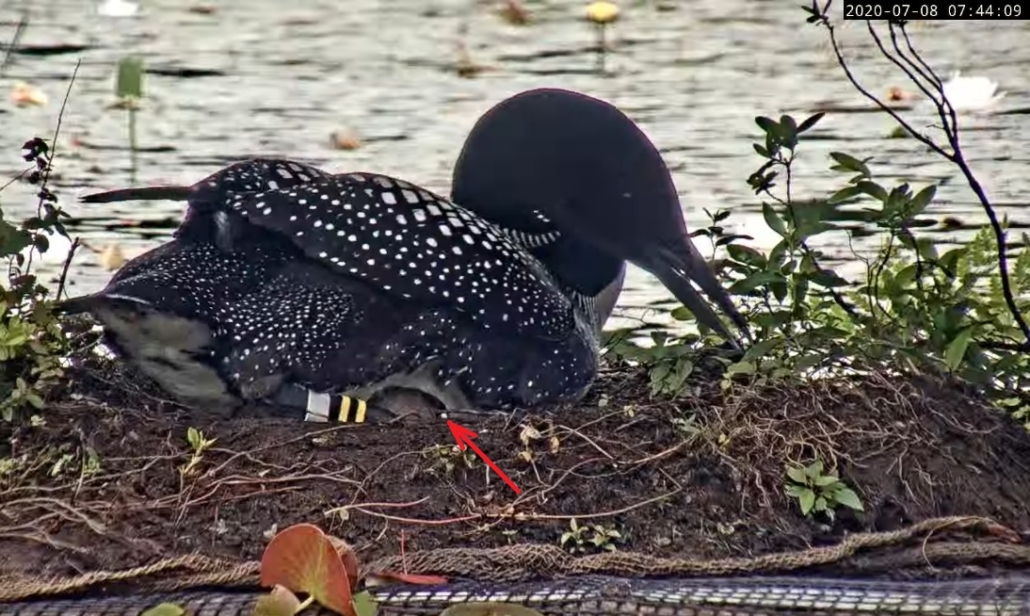
Comments in the YouTube chat show some misconceptions about loon anatomy, particularly about anatomical structures lacking in loons. Here are some features found in a wide range of birds but not found in loons:
The Crop – A crop is an enlargement of the esophagus that allows storage of food prior to continuing to the stomach (more properly known as gizzard or ventriculus). It allows birds to gorge on food where it is plentiful and then digest the food when they’ve moved to a safer location. It also does some predigestion preparation and may be useful in combating harmful bacteria. Omnivorous and herbivorous birds are most likely to have a crop, and to have a well developed, complex, lobed crop. Loons are nearly exclusive fish eaters (piscivores) and that may have something to do with why they don’t have crops. Penguins are another piscivorous bird without a crop. Cormorants have a rudimentary crop, which is nothing more than an extra wide section in the esophagus.
Brood Patch – A brood patch is a featherless area on the underside of an incubating bird. It usually has a number of blood vessels near the skin and it aids in heat transfer to the egg. Brood patches typically are only present during breeding season. Loons seem to manage well without a brood patch. Exactly why loons don’t have a brood patch is unknown but it might have something to do with waterproofing. A loon’s feathers form a watertight envelope and they can control buoyancy by expanding and contracting their feathers. Perhaps a brood patch could compromise the watertight seal.
Egg Tooth – An egg tooth is a protuberance used by the offspring of egg-laying animals to break through the eggshell. On birds, it is normally found on the top of the upper mandible and falls off within a few days after hatching. Loon chicks can do well without an egg tooth. Their bill is well formed at hatch time, and although it isn’t as sharp and dagger-like as an adults, it’s still more than adequate for punching a hole in the eggshell. Loon chicks are precocial, meaning that they are fully developed and ready to jump in the water and swim with their parents the same day that they hatch. They are well past the stage where they would need an egg tooth.
Our Loon Cam 2 pair has so far had an uneventful incubation process. These two loons just don’t seem to present the non-stop drama of the Loon Cam 1 pair. But that’s good for us; we don’t need the stress of anxiety. And it’s good for the loons; they can concentrate on taking care of the eggs.
Now that the eggs are barely more than a week away from hatching, let’s see if we can nail down the hatch times. We only have two years of to-the-minute data that we can use but they are in close agreement. If the loons hold true to form, we should be able to accurately predict hatch times within a few hours. Incubation periods for egg 1 average 27 days and 13.5 hours. That would put this year’s first egg hatch at 5:30 AM on Thursday, July 9. Egg 2 is a little tougher to predict because only one egg hatched and the timing suggested it was egg 1. So, going by the one known incubation period for egg 2, we would expect the second egg to hatch around midnight (12:00 AM, July 10).
Taken together, these two loon pairs have a very similar and consistent egg-laying-incubation-hatch record. The two eggs are laid about 60 hours apart, on average. Incubation is very sporadic until the second egg is laid. The time from laying to hatch is about 27.5 days +/-10 hours for the first egg and a little over 25.5 days for the second egg. The result is that the eggs hatch about 1 day apart. Because this year the first egg was laid late in the day (June 11) and the second was laid early in the day (June 14), there’s a slight chance they will both hatch on July 9, one predawn and one well after dark.
Now that the Loon Cam 2 pair is almost half-way through its incubation period, it’s time to clear up some confusion about the history of the pair and reading the bands on the loons’ legs.
In 2016, intruding loons interfered on this territory enough to cause a nest failure. Without a nest or chicks to defend, the bond deteriorated between the pair, which had been together on the territory since 2013. The rest of the 2016 season was chaos with no clear resident pair.
In 2017, the current male and female emerged as the new resident pair and immediately began nesting. They successfully hatched and raised a chick, which suggests that both of these loons probably had previous nesting experience on other territories. We know that the male did because he was banded in 2006 on a nearby territory on the same lake. We banded the female this same year (2017), so we don’t know her previous history.
Both loons have two bands on each leg.
Female left: A white stripe band (white band with a dark stripe through the middle) over a blue band
Female right: A silver band (the aluminum USFWS band with a unique number) over a yellow stripe band (yellow band with dark stripe in middle)
Male left: A red band over a white band
Male right: A silver (aluminum) band over a red dot band (a red band with a white dot in the middle)
And by one band being over the other, it means it’s the closer one to the location the leg is attached to the body. It’s easy for people to mess that up when the loon is sitting on the nest. Closer to its rear end might be a better way of putting it. The standard practice is to put the silver band on the right leg when the loon is banded as an adult and on the left leg when the loon is banded in its hatch year.
This territory has been monitored since the mid 1980s. The nest site was originally on an island but new development in the 70s and 80s caused a deterioration of the nesting habitat that resulted in increased terrestrial egg predation. The raft was added in 1992. Since then, the average annual chicks surviving rate has been 0.643, which is higher than the statewide average. This pair has fledged 2 surviving chicks in the three years it has been on territory (0.667).
During the Loon Cam 1 chaos of the intruding loons on the evening of June 15, the parents decided it would be safer if they each guarded one chick. Mom took the elder chick around the bend and started fishing according to reports we received, while Dad and the 12 hour old chick remained near the nest, in camera range. While Mom was trying to feed the older sibling, she suddenly dove and disappeared. Most likely she sensed the intruders and went off to do battle, or at least distract them from the chick. The chick gravitated toward a nearby double seat kayak. Much to the occupants’ surprise, it appeared that the chick had decided they were a new-found parent. Fortunately, they were aware of the loon cam and the precarious situation the loons were in. With mom out of sight, the kayakers decided it was best to paddle over to the nest site. The chick went with them, practically glued to the kayak.
All this time another lake resident was reporting the activity on the YouTube chat, so it wasn’t a total surprise when the kayakers came into view on the camera. The little chick saw Dad and sibling and made a beeline for them. The kayakers smiled. What more can I say? The photos are courtesy of our Kayak Heroes.
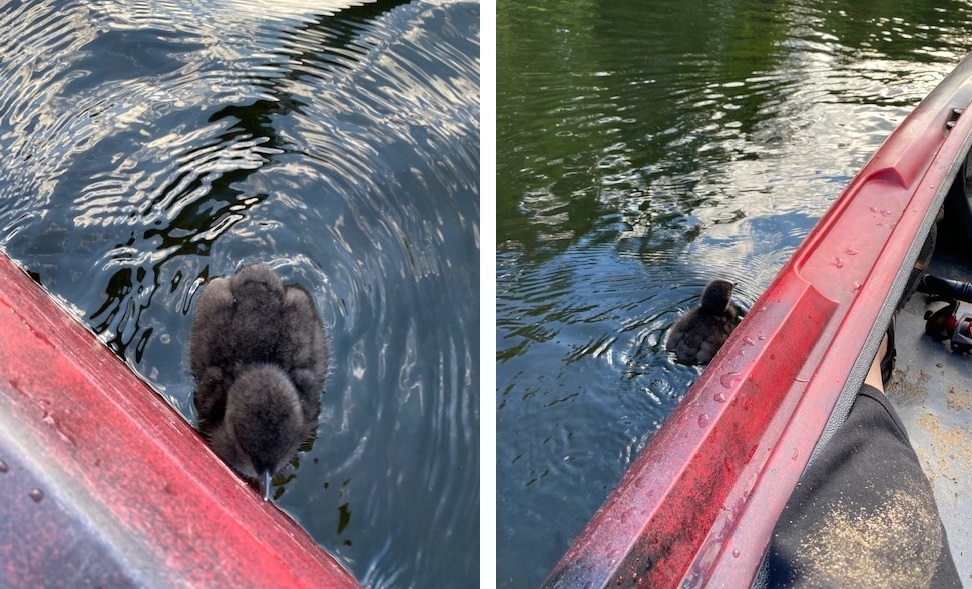
So was it imprinting? Was the chick still ready to accept more beings into its trust even after imprinting on two parents? That would be what conventional wisdom would dictate and I think that’s the best bet. The only reason I have any question is because I’ve spent enough time observing loon behavior to realize that (1) loons can recognize individual people (and judge their character), (2) loons can signal to chicks to stay and wait by a certain area while the adult takes care of important business, and (3) loons will temporarily turn the care of their chicks over to a trusted person. I’ve personally witnessed it and LPC has video documentation of another example.
Unfortunately for me, I’ve only made myself an enemy to loons, at least in their judgment. Chase a loon around a lake at midnight while shining a bright spotlight in its eyes, and then drag it into a boat and hold it down while it gets banded, and you’ll be branded an enemy for life. The worst tongue lashing I ever got came from the Lincoln Island female when I went back the next day to do a welfare check.
LPC does not recommend that you paddle up to a loon and introduce yourself or invite it to dinner. That will be counterproductive; loons don’t like pushy people. But if you spend a lot of time on one lake with loons, keeping your distance and enjoying the sight, a loon might pop up right beside you. That’s your chance to show that you’re no threat. Chill and enjoy the amazing treat. Let the loon decide when the visit is over. Always leave it up to the loon.
It seems that something has cursed the Cam 1 pair with this left-handed blessing. In previous years we’ve witnessed hail the size of golf balls pelting the nest, an AWOL Mom during hatch, lost eggs – both kicked into the water and buried in the nest – and an eagle flying off with a chick. It’s truly amazing that this pair has managed to meet or exceed the statewide productivity (chicks surviving) rate during this time.
This year is no exception. Lake residents have reported that there have been “visiting” loons on the lake for quite a while. Any extra adult loons are a threat to the resident pair and particularly a threat to any recently hatched chicks. Basically, there’s a territorial war going on.
Somehow the pair has managed to have a successful nest while dealing with the intruding loons. The second chick hatched yesterday morning. Under normal circumstances, the family would leave the nest after the new chick had dried off and then become accustomed to swimming, which only takes a few hours. The brooding area, which is where the pair would take the chicks because it has plenty of bite-sized chick food, is on another part of the lake and near where the intruding loons are lurking. In effect, the family is under siege and cut off from essential food supplies.
During and after the hatch, Mom and Dad have each gone off to battle with the intruders while the other tends to the chicks. There was a brief time last evening when it appeared that the pair had vanquished the enemies. A lake resident reported seeing a loon flying off and leaving the lake and Mom, who was on the battle lines at that time, returned to the nest area and there was a raucous celebration of tremolos. But they still wouldn’t leave the nest area. Mom took both of the chicks and returned to the nest, where the three of them spent the night. The loons obviously still perceived a threat. We assume Dad resumed patrol duty.
This morning things still haven’t changed. A lake resident reports that there is still at least one intruding loon on the lake and the chicks are confined to the nest area, in the company of one adult. We’ll keep watching and reporting. There will be another post shortly that discusses an encounter that deserves its own blog. Stay tuned!
Two Loon Cams going and major events happening at both of them.
On Loon Cam 1 the pip was first observed yesterday at 4:16 pm and this morning the chick hatched around 4:00 am. It’s a feisty one and it escaped Mom’s sheltering wing and made a solo voyage. Mom called for Dad to come back to the nest but a local lake resident reported that Dad was busy dealing with a visiting loon. What terrible timing! Mom managed to coral Junior and entice the chick back into the nest. It remains to be seen what the outcome will be concerning the extra loon on the lake. We’re hoping Dad can convince the visitor to leave.
On Cam 2 the second egg was laid around 8 am. (The first egg showed up Thursday afternoon, before the cam was set up.) So this pair has started its (hopefully) routine incubation duties with the first hatch expected around July 8 or 9.
So the action for the next day or two should be on Cam 1, where there is still an egg that is expected to hatch sometime tomorrow, and a new chick to entertain us while we’re waiting for the second hatch.
It’s getting close to hatch time, which we would expect to be most likely Sunday or Monday. Hatching is a relatively long process. It can take up to 20 hours for the chick to completely break apart the shell. The first clear visual sign of an imminent hatch is the pip, a tiny hole at the blunt end of the egg. A loon sitting on the nest can be aware of an impending hatch before the pip because it can sense movement in the egg, which may cause the loon to be more attentive to the egg, frequently shifting its weight or rising up to inspect the egg. It’s always fun to watch for these signs and be the first to see the pip. By tomorrow (Saturday), it will be prime time to be on pip watch. (Unless it happens sooner. Mom is acting kinda twitchy this morning)
It’s been twenty-three days of incubation now and getting close to hatch time. Reports of the average time for incubation generally call for 27 to 28 days. However, reported ranges of incubation times span from 25 to 30 days. Now that we’ve been closely following this pair for six years, it would seem reasonable that we could narrow that range down by calculating previous incubation times for this pair. The problem is that because of nest failures and egg losses or abandonments we only have two definite times for the first laid egg and two less definite times for the second laid egg.
For the first laid egg, we have 27 days, 3 hours (2017) and approximately 26 days, 10 hours (2018; approximate because we don’t know exactly when it was laid overnight). So the average is a little shy of a full 27 days. This year’s first egg was laid at 8:21 am on May 18th. A full 27 days would be the morning of Sunday, June 14th. It’s also interesting to note that, for this pair, all four recorded hatch times occurred between midnight and 6:00 am. So sometime in the early morning of Sunday looks promising.
We can do the same for the second egg. The records are a little sketchy but it appears that a reasonable estimate for incubation time is 26-1/2 days. It would seem the earliest we could expect a hatch would be Monday night or Tuesday morning.
Now all that’s left is waiting to see if the loons show consistency or decide to make a fool of me. Having come to know these two, I’m thinking the smart money is on the latter.
Regular loon cam watchers have witnessed various visitors to the nest, including painted turtles, snapping turtles, great blue herons, muskrats and eagles. Most of these visitors present little threat to nesting loons. In fact, loons can be quite tolerant of painted turtles, herons and muskrats, all of which are likely to use loon nest hummocks and the floating nesting rafts for perching (herons), sun basking (painted turtles) or feeding stations (muskrats). Snapping turtles can be a threat to chicks after they leave the nest but they are not a significant egg predator. Adult loons can easily defend a nest from a snapping turtle. Eagles, on the other hand, have been known to attack chicks, and adult loons in some cases, while on the nest. Most of our recorded eagle attacks in New Hampshire have occurred against chicks in the water after leaving the nest.
The leading cause of egg predation in New Hampshire is mammalian predation, with raccoons doing most of it. This is presumed to be the reason why loons prefer to nest on small islands or hummocks in marshes and use the mainland shore as a last resort. The more difficult it is for a terrestrial animal to access the nest, the safer the eggs. Other mammals known to pilfer loon eggs include coyotes, foxes, and some members of the weasel family (mainly mink). As development steadily increases on New Hampshire’s lakes, raccoons in particular become more prevalent because they have acclimated to human presence and view us and our waste stream as a food source. That plus the loss of good nesting habitat due to development has resulted in a higher probability of nest failure due to egg predation.
Loon pairs have been busy settling in on their territories, and some pairs have gotten right down to business! In fact, the past week has been a flurry of activity as pair after pair have gone on their nests! We already have 4 pairs nesting on Squam Lake and the Little Squam pair has started nesting too. This is a good (and fast!) start! Loon nests initiated earlier in the season have a better chance of success, so I’m hoping this bodes well. Please remind your friends, neighbors, and other lake users to respect the protective signs and ropes around the loon nests and to give the loons plenty of space. There are still a few pairs that haven’t clearly settled on their territories, but hopefully it won’t be much longer before they do!
I’m sure many of you heard about the new fish consumption guidelines that NH Department of Environmental Services announced in late March for the Squam Lakes as a result of finding elevated levels of PCBs in the fish. Their investigation was a follow up to the research of the Loon Preservation Committee documenting elevated levels of contaminants (including PCBs) in unhatched loon eggs from failed nests on Squam Lake and our subsequent identification of areas with contaminated sediments in the watershed, including a site with elevated levels of PCBs. This certainly demonstrates how loons are sensitive indicators of the health of aquatic ecosystems and potentially, as in this case, threats to human health as well. For more information on the fish consumption guidelines, please visit https://www.des.nh.gov/media/pr/2020/20200330-squam-lake-fish.htm.
I hope many of you were able to attend the virtual public forum highlighting research into the contaminants issue on Squam in April. Presenters included representatives from Loon Preservation Committee, Plymouth State University, NH Department of Environmental Services, and Squam Lakes Association. If you were unable to attend, you can catch up by visiting https://loon.org/lpc-work/squam-lake-study/ and clicking on the red button titled “Squam Contaminants Public Forum” below the banner.
As always, please do not hesitate to contact me with any questions, concerns, or reports, and please report any sick, injured, or dead loons to the Loon Preservation Committee (603-476-5666).
Thank you for your interest in Squam’s loons, and be well!
Tiffany
The male is pulling 20+ hour nest sitting shifts lately; certainly not unheard of for this pair but normally it occurs later in the nesting phase or it is attributable to oppressive conditions, such as black fly infestations or heat waves. With the exception of one short hot spell, nesting conditions this year have been quite tolerable. Perhaps it’s the female’s old age that makes her reluctant to incubate, or maybe it’s her innate disposition. Two years ago she was AWOL for two complete days while the eggs were hatching, apparently not even on the lake. We looked for her.
But the male has always shown a steadfast commitment to hatching the eggs. If he can solo babysit two newly hatched chicks for over 48 hours, he can handle a 20 hour nest sitting shift.
This past week we had a string of hot, sunny days, getting as high as 90 degrees F. After the first two days, the female swapped nest tending shifts, preferring the cooler nights. Now we’ve returned to cool days with highs in the 60s and 70s. Will momma loon return to the day shift? Let’s watch and find out. It sure seems that she is calling the shots.
It is a common misconception that, within the bird community, females do all the nest sitting. Although that may be the case for the majority of bird species, it is heavily influenced by the large number of Passerines (songbirds). In other bird orders (and some Passerines), nest duties are shared by the mated pair. And in a few species, such as some penguins, the male does all the incubating.
Common Loons share the nest duties. Each pair seems to work out its own schedule for who is on the nest at any time. Shifts can last from an hour or two to twelve hours or more. Earlier studies, mainly in the 1970s and 80s, concluded that females did most of the nighttime incubating and males would relieve them at dawn. But our observations show that it varies between pairs.
The loons on this territory fly in the face of conventional wisdom and demonstrate that the more we learn, the less we know. At this time, the male is doing most of the nest sitting and virtually all of the night shifts. But don’t be surprised if you tune in tomorrow night and the female is on the nest.
We honestly don’t know what drives the variations in nest sitting behaviors but it’s fun to speculate. This female is well into her twenties, at minimum. By loon standards, she’s an old lady. Nest sitting actually can have higher energy requirements and stress levels than other normal daily loon activities. Contributors to this are temperature, insects (black flies in particular), and being out of its natural element. Loons are essentially aquatic animals. As the temperature warms up, we might see the female take on more of the nighttime sitting, when it will be cooler and less stressful. But I’m not putting money on that.
Mom added the second egg to the nest at 6:38 pm today. Now it’s down to four weeks of incubating. The black flies have been pesky lately but not so bad that the loons can’t tolerate them. Let’s just hope the flies don’t get thicker.
The first egg was laid at approximately 8:21 am today. If all goes well, we’ll have a second egg tomorrow. The loons will usually have very sporadic incubation until the second egg is laid. After that, incubation will be almost non-stop, with occasional breaks of less than 15 minutes for cooling off on hot days and shift changes. Yes, male and female share the nest sitting chore.
Other causes of leaving the nest during incubation include intruding loons (and humans), chasing egg predators and black flies if they are numerous enough. So far, the black flies are present but not very thick.
Is the female ready to lay the first egg? The pair kicked in to high gear this morning and spent a good two hours of non-stop nest building, as well as some work in the rain last evening. Prior to this, their attempts were sparse and halfhearted. In fact, it seemed that they were spending more time window shopping for other possible nest sites. But now it seems they are sticking with last year’s nest site.
Our loon pair continues to build up the nest mound, although at a leisurely rate. In fact, it seems they spend more time inspecting other nearby spots as possible new nest sites. We shouldn’t be surprised at this. This pair has used different sites in the past. In fact, the current nest is the second location they’ve used since we began the loon cam in 2015. Also, loons are much more likely to abandon a nest location after a failed nesting attempt. Although by LPC standards last year’s nesting attempt was successful (they hatched a chick), the chick was taken off the nest by an eagle just hours after hatching. So it shouldn’t be surprising if the loons are contemplating a change in location, especially considering that the eagle has blatantly made its presence known to the pair.
The good news (for camera logistics) and bad news (for the loons) is, other than this general location, there is no desirable nesting habitat on this lake. There are no islands nor sizable marshes. The mucky peat mounds in this cove offer the best nesting opportunities for the loons. Chances are excellent that if the nest is moved it will still be within sight of the camera. But predicting loon behavior can be a fool’s errand. We’ll just have to keep watching.
The high water level doesn’t seem to be slowing this pair down. They’ve been working on building up last year’s nest mound and by this morning the mound broke the surface of the water. And then they wasted no time, mating at 8:46 am. This will likely go on for a week or so before the first egg is laid. By then, the pair should have a high and dry, well-formed nest bowl to receive the egg.
You may notice that some taller saplings have been added around the nest. This is our effort to supply a “natural” cover to act as avian avian predator guard. Last year, the one and only chick to hatch from this nest was taken by an eagle just hours after hatching. We would rather not have a repeat this year.
What a difference a day makes. While the camera was having trouble this week, the loons were busy nest building. Thursday morning, there was a mud pile where there used to be only water, and the loons were mating around 8:45. We’re still having network reliability issues, but have been assured by the cable company that they will try to fix them.
On Monday, May 3’rd, looncam 2020 went live. We are still in testing mode, but already we’ve seen the loon pair stop by so want others to enjoy the occasional spotting. The pond level is very high, so they will have to build their up nest with pond-bottom, something they have already started to do. It will likely take a few weeks.
Over the next day or two, we hope to move the camera from on-shore to in the pond, move the mic near the next area and hope to get our bandwidth problems fixed.
Our network problems are severe. We’ve had two visits from the “cable guy”, but after 8 hours of work, not improvement. The problem is upstream from the pole. Hopefully the issue has been escalated to the right people to get it fixed. Their last words were, “give us until Friday.”. ugh!
Things are looking good for the looncam to go live on Monday, May 4’th. The loons are in the area and the internet circuit should be in by then. We have the logistics worked out on how to keep our distance from each other and still get the camera working. Last year, the loons and newly hatched chick were attacked by an eagle, so we’re wondering if they will pick the same nesting area.
Blog entries to the Staff category will be published here.
Even though we are many weeks away from the start of 2020 Looncam streaming, pre-season activities have already started. The camera software has to be updated and the various cloud-service accounts checked. YouTube always seems to have some new features and challenges. On the hardware side, we are constantly looking for better ways to improve reliability, from more stable mounts to waterproof connections to easy hook-up. We’ll write more as the season gets near.
Welcome to LPC’s web site, online since February 5, 2020. We welcome your feedback. Please share your ideas of how we can make the site can be better for you. […]
If you would like someone from LPC to present to your group, please fill out the form below. We will be back to you shortly. Thanks!
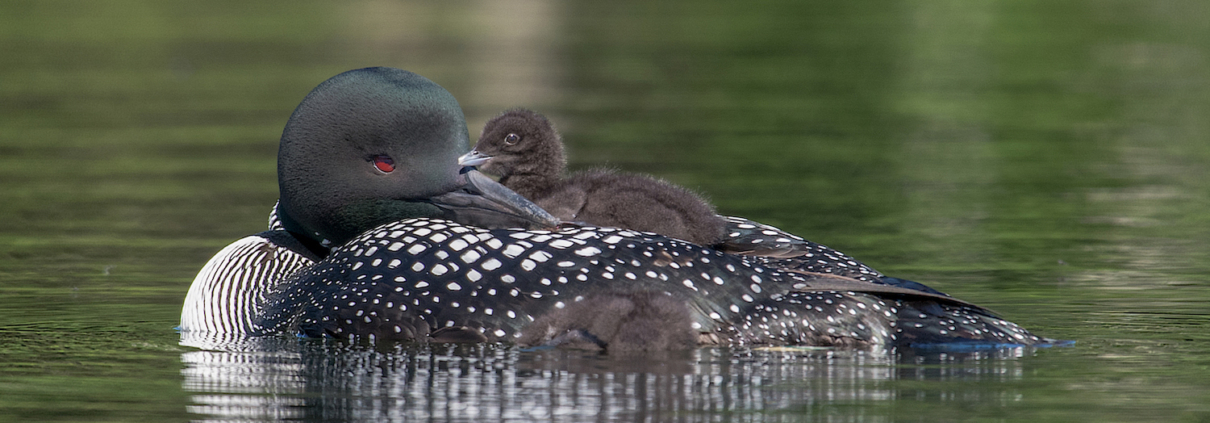 Rick Libbey
Frequently-asked Questions About the Decline of Squam’s Loons
Could these contaminants be coming from the ocean, rather than from Squam?
LPC’s data indicates that ocean contaminants and pathogens, while present, are unlikely to be the driving force behind the decline of loons on Squam. Data from banding done by LPC and the Biodiversity Research Institute in Gorham, Maine, indicates that Squam’s loons do not migrate or overwinter as a group. Loons breeding on Squam probably overwinter over a large stretch of the Atlantic, from Maine to Rhode Island. Therefore, any contaminants or pathogens picked up on the ocean would affect loons on many lakes and not be specifically focused on Squam as these declines seem to be. Research also indicates that the materials in eggs primarily come from recent (within three week) dietary sources, an additional fact pointing to Squam as the source of contaminants in loon eggs. Stable isotope testing conducted by LPC on these eggs indicated that, while there may be some mix of freshwater and ocean sources supplying nutrients to the egg, the majority of the material deposited in the egg comes from freshwater sources.
Could Squam’s loons simply be migrating to nearby lakes rather than expiring?
LPC’s research and monitoring indicate that emigration of loons cannot explain the drop in Squam’s loon population. We know from tracking the movements of banded loons that few loons disperse farther than 10 miles after they have lost a territory. LPC has not recorded an increase in the loon population of neighboring lakes, and banded loons that have disappeared from Squam have not been sighted on other lakes. These findings suggest that the territories vacated on Squam during the decline are a result of mortality, rather than emigration of loons.
Could the Squam eagles be contributing to the decline?
Like recreational use of Squam, eagles are more likely to contribute to reduced productivity of loons than to mortality of adult loons. There have been a few cases of eagles predating adult loons in the Midwest, but these loons are only half to two-thirds the size of our large New England loons. Eagles established themselves on Squam in 2002 and first bred successfully in 2003, and Squam loons fledged 26 chicks over those two years. It is possible that Squam’s eagles might have developed a taste for loon chicks over the past several years, but LPC has not heard of any eye-witness accounts of eagles predating loon eggs, chicks or adults on Squam.
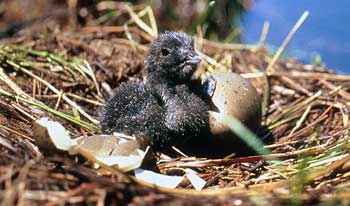 Could density dependence (i.e., too many loons) on Squam have contributed to the decline?
Data collected by LPC since 1975 does not indicate that density dependence is a factor on Squam Lake. Although loon chicks have been killed on Squam by intruding loons, there is no clear relationship between the number of loons recorded on the lake and the rate of chick survival on Squam. If density dependence was impacting adult loons, we would expect to find carcasses of adults killed by other loons. Since 2004, only one adult loon has been collected on Squam that was killed by another loon.
What are the next steps for the Squam Lake Loon Initiative?
Click here for the latest report to learn more about what has been happening on Squam recently.
Hello, I want to send you a quick update from the Squam Lakes to let you know that, unfortunately, a dead loon was found on Squam Lake in the middle of October. This is the same loon that I had reported on in my final newsletter of the summer that was sick and I was tracking at the time. Unfortunately, despite the loon’s weakened condition, it was still diving well and unable to be captured. This loon soon disappeared and I was unable to relocate it in my searches of neighboring coves. What I had not counted on was that the loon would cross a sizeable expanse of open water, given the condition it was in, but that is what happened. The loon was found dead and badly decomposed on an island a good distance across open water from where I had been monitoring it, and the molt pattern matched the sick loon—it had evidently died shortly after I had last seen it.
We have now determined the cause of death of the loon and the results confirmed what I had feared when I was watching it: lead poisoning from ingested fishing tackle, in this case a large lead jighead. Sadly, Squam Lake has lost a loon to lead poisoning in each of the last three years. *Thank you* to the people who reported this loon to Loon Preservation Committee—it is so important for us to collect dead loons and document causes of death. And *thank you* to everyone for helping to spread the word about the dangers of lead fishing tackle and encouraging friends, lake neighbors, and renters to use only non-lead fishing tackle.
On a much brighter note, all 4 chicks on Squam Lake and the chick on Little Squam were all thriving and looking beautiful when I last saw them in mid-October! It is wonderful that these chicks did so well, and many thanks to everyone for helping to protect and look out for the loon families!
Wishing you a happy fall and winter season!
All the best,
Tiffany
—
Tiffany Grade
Squam Lakes biologist
Loon Preservation Committee
To be added to the weekly Squam mailing list send an email to squam @ loon.org.
It’s hard to believe it’s September already, but I guess the ever-growing loon chicks should have given me a clue! All 4 loon chicks on Squam Lake and the chick on Little Squam continue to do very well. At this point, they have all lost their down, are in their juvenal plumage, and are beautiful young loons, ranging in age from 8.5 weeks to 11 weeks. This will be my final newsletter of the season, so let’s recap the 2019 year for Squam’s loons: on Little Squam, we had 1 territorial pair, which nested and hatched 2 chicks, of which 1 is still alive and thriving on copious numbers of crayfish provided by its obliging parents. On Squam Lake, we had 12 territorial pairs, and 10 of those pairs nested (with 11 nesting attempts between them). Four chicks hatched between 3 families, and all four are doing beautifully! While fewer chicks hatched on Squam Lake this year compared with last year (4 vs. 6 in 2018), we have more surviving chicks (4 vs. 3 in 2018)—so that is good news! Loon Preservation Committee (LPC) will be working hard to help that improvement continue next year!
Thanks to all of you who were watching out for the tangled loon I reported on in my previous e-newsletter. Unfortunately, despite much searching by myself and others, there have been no further sightings or reports. Please continue to keep your eyes open for this loon
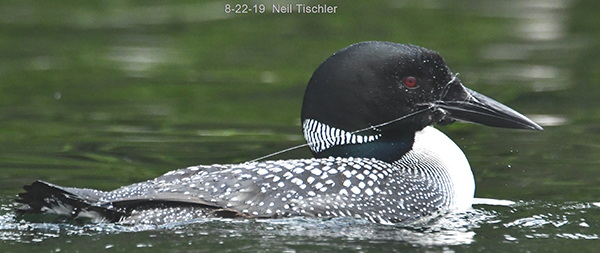
and please report any sightings (or, worst case scenario, discovery of its body) to LPC at (603) 476-5666. There is another loon in the northern part of the lake that appears to be unwell that I have been monitoring. It spends its time sheltering under overhanging trees along the shoreline or swimming close to shore, peering in the water looking for food, and behaving very lethargically. It doesn’t dive unless approached closely; but, when it does dive, it can still dive quite well–thus, we are not able to capture it yet. It is starting to molt around its chin, so it has a fair amount of white on its chin and lower face right now. If you see this loon, please send me an email so I can keep track of its location. If you see it pulled up on shore (or again, worst case scenario, find it deceased), please call LPC as soon as possible (603-476-5666). Thanks for everyone’s help!
As we wrap up the 2019 loon season, I want to give a big “Thank You!” to everyone for protecting and watching out for Squam’s loons this year, for helping educate people about loons and their needs, for spreading the word about the dangers of lead fishing tackle and how to fish in a way that is safe and responsible for loons and other wildlife, and for your reports to me and LPC about what you are seeing! I am so appreciative to everyone for your help and concern for Squam’s loons! And thank you to all who volunteered for Loon Chick Watch—thank you very much for volunteering your time to help protect Squam’s loon families and educate lake users about loons!
I also want to express my sincere thanks to LPC’s partners around the lakes for their work helping loons: to the Squam Lakes Conservation Society—this year, loons nested on land protected by SLCS at no fewer than6 (yes, 6!!!) sites! In addition, one of the successful pairs spent a lot of time brooding their chicks along shorelines protected by SLCS; to the Squam Lakes Natural Science Center and Rockywold-Deephaven Camps (RDC) for everything they do to educate their guests about loons, and to SLNSC for the partnership with LPC for the Loon Cruises; to the Squam Lakes Association for helping to spread the word about loons on Squam and for partnering with LPC on the Loon Chick Watch program and handling the administration of the program; to SLA and Plymouth State University for their assistance in investigating the issue of contaminants on Squam Lake; and to Squam Boat Livery and RDC for their participation in LPC’s Lead Tackle Buyback program. As you can see, it takes the community to create a lake where loons can thrive, and I am so grateful to Squam’s residents, visitors, organizations, and businesses for all you do to make the Squam Lakes a safe, respectful, and welcoming place for loons. Thank you all for helping protect Squam’s loons!
As many of you know, the final newsletter of the season means it’s awards season on Squam! Please see the P.S. below to see who won the 2019 end-of-season Squam Loon Achievement Awards! Please continue to let me know if you have any reports, questions, or concerns about Squam’s loons, and please report any sick, injured, or dead loons to Loon Preservation Committee at (603) 476-5666. If anything happens to any of Squam’s loons during the fall, I will certainly be in touch to let you all know.
Thank you for your interest in Squam’s loons, and have a very happy Fall and Winter! Tiffany
P.S. Sixth Annual Squam Loon Achievement Awards! It’s that time of year again, time to celebrate the accomplishments—both real and dubious!—of Squam’s loons over the past summer, so let’s hand out the sixth annual Squam Loon Achievement Awards! But, before we do, let’s pause to remember the loons we lost in the past year: the 2018 Moon Island female, who died after ingesting a lead fishing jig last fall and was recovered in Cape May, New Jersey; the 2019 Yard Islands female, who died in early July from avian malaria—only the second loon documented in North America to have died of avian malaria, a disease in loons that may be associated with a changing climate; and one of the two Little Squam loon chicks, who disappeared at 2 weeks of age, likely a predation incident. These are all sad losses to Squam’s loon population.
But now let’s celebrate Squam’s loons! The 2019 Squam Loon Achievement Awards go to… (drum roll, please!)
Productivity Award: Rattlesnake Cove pair! Without question, the most coveted award of the year has to go to the Rattlesnake Cove pair! Not only did they hatch two chicks, but they successfully pulled them through a very difficult and stressful summer. There were times when I was not sure the chicks would survive. Almost immediately after the chicks hatched, intruding loons descended on the cove, trying to take over the territory and threatening the survival of the family. These ongoing intrusions both threatened the survival of the chicks and pulled the parents away from caring for them, seemingly resulting in food stress for the chicks. As a result, the younger of the two chicks began to be excluded from the family (see below, “Pluckiest Loon Chick” Award). Despite all, the parents successfully defended their family and the chicks persevered, resulting in the first surviving chicks in this territory since 2010 and the first surviving twosome in Rattlesnake since 1976! This is truly something to celebrate, and I hope it will be the first of many successful years to come for this pair!
Pluckiest Loon Chick Award: Younger Rattlesnake Cove chick! This chick owes its survival to its plucky nature and determination to survive despite huge odds. Not only was it dealing with the danger presented by intruding loons to the family as a whole, but the younger chick began to be driven out of the family by the older chick at around 3.5 weeks of age. This sibling rivalry is normal for loons to ensure that at least one chick will have enough food to survive if there is a shortage of food—and there seemingly was, apparently because the parents were spending so much time fighting off intruders. Despite being apart from the family for two days (an attempt at re-unification was successful only in the short-term and resulted in the younger chick promptly getting beaten up again by its sibling), the younger chick held on and was forced at a very young age to catch food on its own. Usually loon chicks don’t begin catching their own food until they are 6 weeks old and they can’t completely feed themselves until 10 weeks old, but this chick was forced to begin catching its own food at 3.5 weeks. It’s noticeably smaller than its sibling, but it is alive, thriving, and I could not be happier or more relieved that it is doing so well! Beyond doubt, this chick deserves the Pluckiest Loon Chick Award!
Ten-Year Productivity Award: Little Squam pair! While the Rattlesnake pair walked away with 2019’s Productivity Award, let’s not forget to take the long view and celebrate the astonishing run that has been going on at Little Squam. Over the last 10 years, the loons on Little Squam have produced 9 surviving chicks! Keep up the great work, Little Squam loons!
Pair Together the Longest Award: Perch Island pair! Congratulations, and Happy 9th Anniversary (at least!) to the Perch Island pair! Not that this is nine successive years, but let’s not quibble about those years the male was with another female! This pair was first banded in 2007, so they may have been together for even longer before we could start following them. But after being together from at least 2007 to 2012, the female was evicted from the territory by another female. The male spent 2013-2016 with this other female, while his former mate bided her time as a single, pairing up one year in the Piper Cove territory but soon resuming the single life. When the new Perch Island female was killed in a boat collision late in 2016, the former Perch Island female saw her chance—and, within days of her rival’s death, she was making a bid for her old territory. They have been together ever since and fledged their first chick together this year since 2007, and I’m looking forward to celebrating their 10th anniversary next year!
Most In Need Of Marriage Counseling Award: Long Point “pair”! In contrast to the 9 years of “pair-ital” bliss for the Perch Island pair, we have the Long Point twosome, who just can’t seem to make paired life work. After hatching a chick together in 2011, they failed to nest the next several years—but at least they were together! In 2014, the male spent much of the summer sitting by the nesting area, apparently waiting for the female to turn up—which she finally did, only late in the summer and much too late for pairing, much less nesting. But the male was apparently willing to overlook this lapse, and they were together again the next 3 years and attempted to nest each year, albeit unsuccessfully. But last summer, their relationship hit the rocks again, with the female only showing up briefly and the male again left to drift around the territory, waiting for something to happen. This summer, things looked like they were off to a promising start—in spring, I was seeing the two together and was optimistic they would actually pair up…until they didn’t. The\ relationship fizzled again and the male, apparently fed up, started swimming around with another female—despite the continued presence of the original female in the area. We’ll see what next year brings, but I intend to study loon marriage counseling over the winter so at least I’ll be prepared if these two both show up again!
Incubation Stresses Me Out Award: Rattlesnake Cove Female! Yes, she was part of the pair that won the Productivity Award, but the road to such heights wasn’t easy—even before the chicks hatched and the loon intrusions started. The Rattlesnake female is unbanded, but it is clear that the same female has returned for several years, because each year the female of the pair has been a nervous wreck during incubation. This year was no different, and this continued for the first couple weeks after the chicks hatched. At one point, she was even ready to attack her mate after seeing him across the cove, apparently believing he was one of the intruding loons they had been battling! But, after those first couple weeks post-hatch, she seemed to settle in, and she remained calm and focused during the remainder of the summer spent raising her chicks. I guess raising older chicks agrees with her more than incubation and raising young chicks! I’ll look forward to seeing what next year brings: will she again be a nervous wreck during incubation, or will a year of successfully raising chicks have permanently calmed her down? Stay tuned to next year’s episodes of “As Squam Turns” to find out the answer to this, and all the other drama a summer of loons on Squam brings!
Congratulations (?!?) to the 2019 winners of the Squam Loon Achievement Awards, and I hope there will be many contenders for the Productivity Award next year!
To be added to the weekly Squam mailing list send an email to squam@loon.org.
Sadly, Loon Preservation Committee (LPC) received a report that there is a loon badly tangled in fishing line on Squam Lake, and I am writing to ask everyone to please keep their eyes open for this loon (picture attached).
Fishing line is wrapped around its bill and may be caught on a wing as well. The loon was seen on Thursday morning in the vicinity of Shadbush Cove and Potato Island, shaking its head a lot in an effort to free itself. This is *not* one of the parents of the chick in that part of the lake. Tangled up loons sometimes travel widely on a large lake–we have even seen loons tangled up on Squam go over to Little Squam–so please keep your eyes open wherever you are on the Squam Lakes. If you see this tangled loon, please call the Loon Preservation Committee at (603)476-5666. Thank you very much, and many thanks to the person who reported the loon and sent the photographs and to the people who went out to confirm that the parents of the loon family in that part of the lake are free of fishing line. Everyone’s assistance is very much appreciated!
On a much happier note, the chicks of the Squam Lakes continue to do great! The 4 chicks on Squam Lake and the chick on Little Squam are alive, well, and growing fast! Right now, they range in age from 6.5 weeks to 9 weeks old.
With this tangled loon on the lake, please remind your angling friends and neighbors to fish responsibly: please ask them to use only non-lead fishing tackle and to reel their lines in if loons are in the area. Loons can easily mistake a bait flashing past them for a minnow or small fish, strike at it, and end up in the situation of the loon in the attached photographs or with lead poisoning. Please remind anglers to hold off on casting until loons move out of the area. Also, LPC’s lead tackle buyback program runs through Labor Day—please help spread the word for people to clean out their old tackle boxes! Squam Boat Livery is our local participating shop, and more information can be found at www.loonsafe.org. Thanks for helping to get to the word out about safe angling practices!
As I mentioned above, the chicks of the Squam Lakes are growing fast and entering that fraught “teenage” stage. What is life like for a teenage loon? We’ll take a look at that in the P.S. below in this week’s edition of “What are those (crazy!) loons doing??!?” As always, please don’t hesitate to contact me with any questions, reports, or concerns, and please report any sick, injured, or dead loons to Loon Preservation Committee at (603) 476-5666—and especially please keep your eyes open for the tangled loon.
Thank you for your interest in Squam’s loons!
Tiffany
P.S. What are those (crazy!) loons doing??!?: “Teenage” loons! Like humans, loons have a protracted “teenage” period; and, also like humans, teenage loons are out exploring their world and taking on adult responsibilities but also still driving their parents crazy! Three of the Squam Lakes loon chicks have entered that teenage stage (and the other 2 aren’t far behind!): they have lost all of their down, are in their beautiful juvenal plumage, and are able to catch some of their own food. It will still be another week or so before they can catch enough fish to completely feed themselves–this happens around week 10–but they are certainly well on their way! You may be lucky enough to witness feeding session with these teen loons, in which the chicks are busily diving and the adults were even more busily bringing up lots of fish and crayfish for the chicks. But even once they can completely feed themselves, young loons, like teenagers the world over, are not going to pass up a free meal if they can get it! I’ve seen 16+-week-old chicks begging mercilessly from their parents, who end up looking very harassed. Loon chicks beg by pecking at the parent’s neck or bill–I can only imagine being on the receiving end of that from a ravenous loon chick! But loons are wonderful parents, and they invariably end up obliging their demanding chicks!
Along with catching their own food, other adult responsibilities come with being a teen loon as well–most importantly, the business of flying. By 12 weeks old, the flight feathers of these young loons will have grown in and they will begin learning how to fly. Of course, this doesn’t happen easily. As heavy-bodied birds with small wings, loons have a hard enough time getting into the air. But, if you’re a young loon trying to learn, things are especially difficult. I’ve seen young loons running across the water, trying to get airborne, and ending up making a face plant back into the lake. But eventually they get the hang of it, just in time for migration.
Adult loons leave the lake around mid-late October, although loons with chicks may stay into early November. The adults generally leave between several days to a week apart; and, after the second adult has left, the chicks usually leave a few days to a week later. Like adults, New Hampshire chicks likely migrate to the New England coast, anywhere from Rhode Island up to Maine—although you may remember that the Moon Island female from 2018 was recovered (sadly dead, from lead poisoning from ingested lead fishing tackle) last fall off of Cape May, New Jersey. So we still have a lot to learn about where New Hampshire’s loons all go! Once on the ocean, young loons spend the next two years there growing up. Loons don’t mature until they are three years old, so young loons stay out on the ocean as teenagers. They are in an immature plumage, which differs from the juvenal plumage by lacking the pronounced scalloped pattern on the back that you can see right now on the older chicks of the Squam Lakes. At 2.5 years old, they finally molt into the striking black-and-white plumage with the bright red eye that is so characteristic of loons; and, the following spring (their third year), is when they finally travel back to the freshwater lakes as mature loons.
But, along the way, teenage loons have many adventures! I’ve seen young loons posturing and trying to intimidate each other, going through exactly the same motions and positions as adults in a conflict situation. I’ve also seen teen loons learning from their parents the oh-so-important adult responsibility of picking on cormorants–and then trying it out themselves! And, of course, there are plenty of free meals from their obliging parents before they are on their own. Young loons have a lot to learn, and I wish the chicks of the Squam Lakes all the best while negotiating the trying life of a teenage loon!
To be added to the weekly Squam mailing list send an email to squam@loon.org.
Good news—the chicks of the Squam Lakes continue to do well! There have been several cases of other loons intruding on a couple of the families recently, but the parents have been able to battle them off—I hope that continues! The chicks are growing fast and range in age from 5-7.5 weeks right now, with several of the older chicks losing their down and getting their regular feathers. So, our totals for the week remain at 1 chick on Little Squam and 4 chicks on Squam Lake.
If you’ve been wanting to get on a loon cruise this summer, there are just a few more weeks to join us! Loon cruises are offered through a partnership between the Loon Preservation Committee and our friends at the Squam Lakes Natural Science Center. They run each Monday and Friday afternoon at 3:00 through the end of August and give people a chance to see loons and learn about them. For more information, please visit https://www.nhnature.org/programs/loon_cruise.php.
Please join us for a volunteer potluck at the Loon Center on Thursday, August 22nd, at 6 PM! This is our chance to say “Thank You!” to all our wonderful volunteers, so we’d love to have you join us! This will be followed by the end-of-season report by Loon Preservation Committee’s Senior Biologist, Harry Vogel, at 7:00—our first chance to hear how the summer went for loons in New Hampshire! Even if you can’t make the potluck, please come for Harry’s talk. Please see the attached flyer for more information. Hope to see you on the 22nd!
We will continue our “What are those (crazy!) loons doing??!?” series with a look at why you might be seeing groups of 4-14 loons out and about at this time of the year. What is going on with these loon gatherings? Please see the P.S. below to find out! As always, please contact me with any questions, concerns, or reports, and please report any sick, injured, or dead loons to the Loon Preservation Committee at (603) 476-5666.
Thank you for your interest in Squam’s loons!
Tiffany
P.S. “What are those (crazy!) loons doing??!?”—Social gatherings: We’re all used to the idea that loons are solitary birds and don’t like other loons, right? We see them in their pairs and we know they defend their territory against other loons. Later in the fall, we might see them grouping up before migration, but the received wisdom is that loons wouldn’t be in groups other than for migration. It turns out that this is\ true only to a point—because those groups of loons that you see from mid-July through August are, in fact, social gatherings, loons just hanging out. Who would have thought?!?
The received wisdom about loons as “anti-social” birds is only true in so far as it goes. Loons, of course, are territorial birds; and as long as the potential for nesting and raising young exists, loons don’t want other loons in their territories. But once that potential is over with—whether the pair didn’t nest, lost their nest and have decided against nesting again, or lost their chicks—loons will start socializing with other loons. These are loons with no responsibilities whatsoever and have nothing better to do than socialize!
Social gatherings comprise anything from 4-14+ loons and include both males and females. They will come in from across Squam as well as surrounding lakes and spend time together for several hours before returning to their “home” territories. A number of years ago, I saw the banded female from Red Hill Pond on Squam in a social gathering. A few weeks ago, I saw a gathering of 9 loons that included both members of the Kimball Island pair, the Moultonborough Bay female, the ex-Mink Island female, and 5 unbanded loons. Loons will gather in a “neutral zone” of the lake (i.e., an area of the lake that is not part of a loon territory), or a portion of the lake that is in a loon territory but the pair is no longer actively defending it because the breeding potential for the year is over. As the loons are meeting up, they will do a lot of hooting to each other, their single note call that is essentially loon chatter (see last week’s edition of “What are those (crazy!) loons doing??!?” to learn more about the hoot and other calls). The initial meeting among loons can include a healthy degree of distrust, especially among loons who don’t know each other very well. You may see some circling, diving, and peering in the water, as the loons size each other up and figure out whether they are going to get along or not. Sometimes social gatherings do end in a scuffle, but usually the loons settle in and decide to get along with each other. Once they’ve met up, social gatherings include a lot of swimming along, hooting to each other.
But it is not necessarily all completely innocent socializing. There is some evidence that loons are scoping out potential future territories for them to takeover while in these groupings, and perhaps seeking strength in numbers to test the defenses of existing pairs. After all, the loons in these gatherings are the “losers” of the loon world—they weren’t successful this year and don’t have chicks to care for. They may be looking for a better territory—and a chick is the ultimate sign of a better territory. Last year, the Kimball Island pair had two chicks. In early August, a group of 9 loons started putting pressure on the pair, intruding into their territory, and finally one of their chicks was killed during a coordinated attack by these 9 loons. This was a calculated assault to try to weaken the pair in the hopes that one or two of the group could take over the territory. Over the next several weeks, the pair and their remaining chick endured near-constant intrusions, and I was terrified the remaining chick would be killed. Fortunately, the parents hung on and the chick survived. But loons have long memories; and, as the Kimball pair settled into nesting this year, they soon drew the attention of intruders as well, who likely remembered that they had two chicks last year. The near constant intrusions while they were trying to incubate finally forced the Kimball pair to abandon their nest. It wasn’t long after their nest failure that the Kimball pair turned up in a social group too.
But most social gatherings are simply that—a social gathering! It is an extraordinary sight to see so many loons together and always fascinating to watch their interactions and behaviors. So as you’re boating around the lake, keep your eyes open for groups of loons—you never know where the party might be!
To be added to the weekly Squam mailing list send an email to squam@loon.org.
The good news for the past week is that all of the chicks on the Squam Lakes are still doing well! There are 4 chicks on Squam Lake and one chick on Little Squam—they are being busily fed minnows and crayfish by their hard-working parents and are growing fast. As they get older, the families are starting to move around more widely within their territories, so please keep ask your lake neighbors to be alert for loons and boat carefully in areas of the lake marked with Loon Preservation Committee’s (LPC) orange “Caution: Loon Chicks” signs. The unhappy news for the week is that the final nest on Squam Lake has failed. The nest went beyond its expected hatch date and the adults gave up on it yesterday. Working under LPC’s state and federal permits, I collected the single egg on the nest for LPC’s research, and it will be a candidate for contaminant testing as part of our Squam Lake Loon Initiative. It is disappointing—I was hoping for another chick or two on the lake yet! But please spread the word to lake users to boat carefully in areas marked with the chick signs and to keep a respectful distance (at least 150’) from loons and loon families—let’s all work together to give the chicks the best chance for survival! Thank you for your help!
I received a report last week that there may be a loon with a fishing lure or fishing line attached to it in the area of Owl’s Head. Please let me know if you see this loon. So far, the loons I have seen in this area of the lake have been fine, but I am continuing to watch carefully. Thanks to the people who reported this possible problem—it’s very much appreciated!
Just a reminder to spread the word about LPC’s lead tackle buyback program (download flyer) and to ask lake users, neighbors, and renters to use only non-lead, loon safe tackle. Lead fishing jigs and sinkers weighing 1 oz or less are banned for sale and use in New Hampshire, so it’s both the law and the right thing to do to protect loons and other wildlife. The good news is that LPC’s data suggests that the majority of loons that die from lead tackle ingestion acquire it from current fishing activity (ingesting a fish that has broken a line and has tackle attached to it or striking at a bait or fish being retrieved by an angler). It used to be thought that loons ingest lost tackle from the lake bottom as grit, but LPC’s data suggests that this seems to be only a relatively minor way that loons ingest lead tackle. This is an encouraging finding—if people stop using lead tackle, we should see an immediate benefit to our loon population with fewer lead deaths! So far this summer, 6 loons have already been documented statewide that have died from lead tackle ingestion. Unfortunately, these likely won’t be the last this year. Squam Boat Livery is participating in the lead tackle buyback program and lead tackle can be turned in there in exchange for a $10 coupon, Lead tackle can also be turned in at the Loon Center, Squam Lakes Association, and NH Fish and Game offices. Also, please remind people to reel their line in if loons are in the area where they are fishing and to wait for the loons to move on—loons’ natural instinct is to strike at something that flashes past them, thinking it’s a fish. Unfortunately, it could be a bait being reeled in, resulting in that loon being hooked. So please encourage people to fish in a way that is loon safe—lead free and reel in around loons!
Mark your calendars now for August 22nd—that is when we will have the preliminary data pulled together on how the 2019 season was for New Hampshire’s loons! LPC’s Senior Biologist, Harry Vogel, will be giving the end-of-season report at the Loon Center at 7:00. Please join us to get the first word on the 2019 loon season!
We wrapped up the “Meet the Loons of Squam” series with the last of our banded singles on the lake. “Meet the Loons of Squam” will return next year when we will revisit the territories and see what changes have occurred in our pairs. For the rest of this summer, please see the P.S. below for “What are those crazy loons doing?!?”—a look at loon behavior and what it all means! This week, we’ll take a look (and a listen!) to those iconic calls—what are the loons saying? Please see the P.S. below to find out! As always, please feel free to contact me with any reports, questions, or concerns, and please contact the Loon Preservation Committee to report any sick, injured, or dead loons (603-476-5666).
Thank you for your interest in Squam’s loons!
Tiffany
P.S. “What are those crazy loons doing?!?”: The Calls—As anyone who has spent any time on New Hampshire’s lakes knows, loons have a lot to say for themselves The calls of the loons are just as iconic as the beautiful black and white plumage of the birds themselves. It’s hard to imagine the Squam Lakes without those haunting calls echoing off the mountains. But just what are the loons saying? Loons have an extraordinary communication system and convey a lot through their calls. Let’s take a quick look (and listen!) at the loons’ 4 main calls and what they mean. You can click on the following link to listen to the calls: https://www.loon.org/voice-loon.php.
1) Tremolo: Many people have a misconception about the tremolo, which is often called “the loon’s laughter.” Unfortunately, the loon is not laughing at all. This is the loon’s main distress call, given in situations when a loon is very upset, such as when an eagle is flying over or a boat is much too close. If loons give this call when you are in the vicinity, please back away from them. This is also the strongest call a female loon can give, and a female loon will use it during fights with other loons. You will sometimes hear a “tremolo duet,” in which both members of a pair tremolo to express their upset over whatever is happening. At night, especially in early spring, a pair may tremolo duet to announce that they are on territory, and this also serves as a pair-bonding ritual. This call is the only call a loon gives when flying. In this case, it is a little higher-pitched than the on-the-water version and is simply a contact call.
2) Wail: The wail is the main contact call for loons, given to reconnect with a mate that may be at the other end of the territory or to call chicks over to a parent. The wail basically means, “Where are you? I’m here, come here.” It is frequently heard at night as loons make contact with their mates and communicate with neighboring loons. The wail can also be a low-level distress call—if a loon is feeling a little nervous but it hasn’t risen to “tremolo-level” distress, they will use the wail. Again, if a loon gives a wail when you are nearby in a boat, please back away.
3) Yodel: This call is given only by male loons and is used as a territorial defense call. Individual male loons have their own version of the yodel, and they are distinct enough that even human listeners can identify individual males by their yodel. With their yodels, males let other male loons know they are on territory—and that other male loons should stay away! It is also given in fights between male loons, and research has shown that male loons can tell how strong another male is by listening to their yodel. This gives them a chance to back out of a fight if they realize they are facing a much stronger loon! I once saw a loon pair scuffling over a territory boundary. The mini-fight soon broke up and both pair members were swimming back into their respective territories. Suddenly, one of the males turned around, swam right up to the territory boundary, and yodeled—it was like he was saying, “And stay out!” Males will also yodel to express upset/distress, they will yodel at bald eagles, and they will yodel at passing airplanes–oversized bald eagles to loons!
4) Hoot: The hoot is essentially loon chatter and is much softer than the other calls. The hoot can be given in family groups as a checking-in/life-is-good call. You may see a family swimming along together with the adults hooting back and forth to each other. Adults will hoot to encourage their chicks to eat, especially if the chicks are being stubborn and refusing the food. The more the chicks refuse to eat, the more vehement the hoot from the adult gets! Hoots are also given between loons in social groupings who don’t know each other. In this case, loons seem to be talking out whether they are going to swim along together for a bit or if they are going to end up in a scuffle.
While these are the four main calls given by loons, loons also have other sounds. Loons make cooing sounds as they are looking for nest sites or preparing to mate. When chicks hatch, loons will give any combination of coos and the above calls. In this case, the usual meanings of the calls seem to disappear and the loons are simply announcing the hatch to the world! On a much sadder note, loons make soft moaning calls when they lose a nest or chicks. This is a truly heartbreaking call to hear. But loons have an amazing vocabulary and can express so much, so keep your ears open and listen to what the loons are saying!
Thank you for your interest in Squam’s loons!
Tiffany
To be added to the weekly Squam mailing list send an email to squam@loon.org.
The past week has been a challenging one for the loons of the Squam Lakes. Sadly, one of the chicks on Little Squam has disappeared in what was likely a predation incident. It occurred between late last Friday afternoon and early Saturday morning—if anyone heard or saw anything, please let me know. If anyone finds the body of the chick, please call the Loon Preservation Committee at (603) 476-5666. Fortunately, the remaining Little Squam chick is looking good and getting stuffed full of crayfish by its parents! On Squam Lake, one of the two remaining nests failed as a result of frequent and intense intrusions from other loons trying to take over the territory. So our totals for the two lakes right now are 1 chick on Little Squam and 4 chicks on Squam Lake, with 1 remaining active nest.
You may remember that a dead adult loon was collected from Squam Lake in early July. This loon was the incubating female from a territory where the eggs were due to hatch just days after her death. As is normal when this occurs, the nest was abandoned after she died, so both the female and her nest were lost in this incident. The necropsy results are in, and this female loon died from avian malaria. This was only the second loon ever documented in North America to have died from avian malaria (the first being at Lake Umbagog in 2015) and suggests the influence of climate change in exposing loons to new pathogens that previously were not extant within their range. A dead loon collected elsewhere in the state the same weekend as the Squam loon was also subsequently determined to have died from avian malaria as well, so this may be a new, emerging threat to loons in New Hampshire. Avian malaria is a mosquito-borne disease but is not transmissible to humans. Many thanks to the person who collected and reported this dead loon. It is very important for LPC to recover these dead loons to better understand causes of death in loons and threats facing the loon population.
Thanks to everyone who participated in the Census last weekend! Census participants joined other counters throughout New England last Saturday morning to give a region-wide snapshot of loons in the Northeast. On the Squam Lakes, 36 adult loons and 5 chicks were counted.
In lieu of the P.S. feature this week, I am attaching a copy of the July 2019 Loon Preservation Committee’s annual progress report for our Squam Lake Loon Initiative, our intensive research, monitoring, management, and outreach effort to understand the causes of declines in Squam’s loon population and to restore a healthy population of loons to the lake. Please let me know if you have any questions about the report or LPC’s work on Squam.
As always, please contact me with any reports, questions, or concerns about Squam’s loons, and please report any sick, injured, or dead loons to Loon Preservation Committee at (603) 476-5666.
What a week it has been on the Squam Lakes, full of highs and lows—all I can say, the Squam loon rollercoaster is going full force. First the(very!) good news: we have 3 new chicks on the Squam Lakes!! Two chicks hatched on Little Squam and we also have a new chick on Squam Lake! The nest that hatched on Squam Lake was 3 days beyond the expected hatch date, so I was starting to be afraid the egg wouldn’t hatch—but it did, and I could not be happier about it! The totals on the Lakes right now are 2 chicks on Little Squam and 4 chicks between 3 families on Squam Lake. In addition, there are still 2 active nests on Squam Lake, so hopefully there will be more chicks to come!
Now for the bad news: a dead loon was collected last Sunday. The loon was unbanded; but we were able to determine, both through circumstances and through the necropsy, that it was the incubating female at a nest near where the loon was collected. Needless to say, the nest failed as well–sadly, the nest had been due to hatch this past week. This was a devastating series of events. We are still awaiting the results of further tests associated with the necropsy to determine the cause of death of this loon, but I will let you know when we have more information. Many thanks to the people who reported and collected this loon—it is so important for us to get these mortalities and understand the causes of death for these loons.
With more loon chicks out on the lake, please remind your lake friends and neighbors and other lake users how important it is to look out for these chicks and give them plenty of space (at least 150’–no wake distance—or more if loons show signs of stress). This distance applies to both motorboats and kayaks/canoes/paddleboards—many people think they can get closer if they are in a “quiet boat,” but please remind them that the close approach of a kayak is just as stressful and potentially harmful to loons and chicks as that of a motorboat. It is also important to ask them not to boat between the shoreline and the loons if the loons are in towards the shore and that this also applies to both motorboats and kayaks/canoes/paddleboards. Going between the loons and shore can push the loons away from shore and into more open water that is less protected for the chicks from wind and wave action and where there is greater risk of collision from motorboats or water skiers/inner tubes/jetskis. Instead, please ask them to go around the loons at a safe distance. Also, please ask them to boat slowly and carefully in areas marked with Loon Preservation Committee’s orange “Caution: Loon Chicks” signs. Please remind them that the loons may be anywhere in a cove or bay marked with these signs and to look carefully because loon chicks are small, dark, hard to see on the water, and may be alone on the surface if both parents are diving for food. Thank you very much for helping to spread the word about safe boating practices around loon families and helping to keep the loons safe! Also, please consider signing up for Loon Chick Watch, a partnership between Loon Preservation Committee and Squam Lakes Association. For more information, please visit https://www.squamlakes.org/loon-chick-watcher-program or email Melissa Leszek at melissaleszek@squamlakes.org.
Last week we wrapped up our “Meet the Loons of Squam” series, which will return next summer as we revisit Squam’s territorial pairs and catch up with them. We will be starting a new series for the remainder of this summer; but, this week, the P.S. feature will take a hiatus as I work on the Squam Lake Loon Initiative annual Progress Report, which you will receive with the next e-newsletter. As always, please contact me with any questions, reports, or concerns, and please report any sick, injured, or dead loons to Loon Preservation Committee at (603) 476-5666.
Now that the loon cam season is complete, we can review the events we witnessed over the past two months and see how they fit with the conventional wisdom of loon behavior and ecology. We think we know so much but we are constantly reminded that there is always more to learn. Here’s a few things that added to or reinforced our knowledge base.
Nesting loons have more ways of losing eggs than we thought. Disappearing eggs are nothing new. It’s more common than you might think. Loons can accidentally knock an egg out of the nest. Boat wakes can wash an egg out of the nest. Some predators can carry eggs away from the nest (raccoons and eagles are good examples). We’ve even had some suspected human thievery. But a loon accidentally burying an egg wasn’t on our radar until the Nest Cam #1 loons demonstrated that it could happen. Had we known that there were two eggs on the nest but didn’t have the camera to witness the occurrence, we would have listed the ultimate fate of the egg as unknown, or possibly unknown predation if a biologist had a chance to survey the area shortly after the egg disappeared.
An egg in the middle of the incubation phase can remain unattended for 10 hours and still remain viable. The Loon Cam #2 loons demonstrated this. This is just one data point and certainly doesn’t mean that all eggs would remain viable. Had the day been sunnier and warmer, or much cooler, the outcome may have been different. But each new observation narrows the unknown range.
Predation by eagles is increasing in NH. This isn’t really new, nor is it unexpected. In fact, LPC Senior Biologist John Cooley recent published a paper concerning this in the Wilson Journal of Ornithology. But watching it happen live on Loon Cam #1 certainly left an indelible impression on the minds of the viewers. And it demonstrates that even the smallest loon pond can be subject to predation by an expanding eagle population.
Loons have a wide variety of nest sitting schedules. The literature says that female loons are more likely to do the nighttime incubation and they tend to invest more time to incubation as the hatch date approaches. Observation of the Loon Cams over the past few years show that this is not always the case. The male on Loon Cam #1 does a lot of the nighttime sitting and he is consistently on the nest during hatch, whereas the female has been known to take off for extended periods when hatching is imminent. All pairs we have observed seem to have a very fluid schedule. As soon as we start predicting who will be on the nest at a certain time, the pair will call our bluff.
It all adds to our knowledge base and reminds us that we don’t know everything and sometimes we don’t even know what we think we know. Here’s looking forward to next year’s humbling lessons from the Loon Cam loons.
The pip was first seen at 4:09 pm. If all goes well, there should be a chick in the nest by daylight, tomorrow morning.

Let’s review the Loon Cam nesting results so far.
On Cam #1, the loons lost one egg due to some frantic nest building in response to major rainfall and water level rise. Then we celebrated the hatching of one chick, only to watch an eagle carry it away before it had a chance to leave the nest. 0 for 2.
So far on Cam #2, we’ve witnessed one egg get accidentally crushed and then disposed by the loons. The crushing appears to have happened during a violent thunderstorm. So we’re pinning all our hopes on the one remaining egg in the Cam #2 nest. So, a pretty pitiful year, huh? Well, maybe we shouldn’t jump to conclusions… yet. Lets compare the productivity of these two nests this year to the average statewide loon productivity and see what we get.
Nest initiation: Statewide, about 70% of territorial pairs actually nest; on the Loon Cam we have 100% (2 for 2).
Nesting success: Statewide, it averages around one chick hatched per nesting pair. On the Loon Cam it’s going to be either 0.5 or one chick hatched per pair.
Chicks surviving per territorial pair: Statewide average is about 0.5. The Loon Cam average will be 0.5 if the remaining egg hatches and the chick survives to the end of the season.
So, pinning our hopes on the remaining egg, this would be about as close to a “typical” season as two random pairs could get. We’ve just been spoiled over the past few years by watching two excellent nesting pairs.
Here’s hoping for a “typical year”.
It was another very busy week for the loons on the Squam Lakes, highlighted by the hatching of another chick on Squam! We also gained another nesting pair on Squam Lake but also had two nest failures (1 nest failed due to a mammalian predator, 1 nest was abandoned). So this brings us to the totals for the week of 1 active nest on Little Squam and, on Squam Lake, 3 chicks in 2 families and 4 active nests.
As we head into 4th of July week, please remind your lake friends and neighbors, renters, and other lake users to be respectful of loons, loon families, and nesting loons. Please ask them to stay a minimum of 150’ away from loons and loons with chicks and to move further away if loons show any sign of stress. Please ask them to stay back from roped and signed nesting areas and to slow down, boat carefully, and keep an eye open for chicks in areas marked with Loon Preservation Committee’s (LPC) orange “Caution: Loon Chick” signs. Please remind them that loons with chicks may cross coves, that they will not only be by the orange loon chick signs, and loon chicks may be alone on the surface if the adults are diving for food. And please remind them to fish only with non-lead fishing tackle to keep loons and other wildlife safe. I’ve attached a poster with information on LPC’s lead tackle buyback program, which we are working on in partnership with NH Department of Fish and Game. Please feel free to distribute to friends who may live elsewhere in the state, so they know their local tackle shop participating in the program, and remember that Squam Boat Livery is our local participating shop. Let’s encourage everyone to clean out those old tackle boxes and get the lead out!
With the chicks coming out, we are looking for volunteers to help with Loon Chick Watch, LPC’s partnership with the Squam Lakes Association (SLA)to protect loon families on the Squam Lakes during the busy summer weekends and holidays. This is a wonderful way to help loons, and what could be more fun and rewarding than spending an hour or two with a loon family while working to protect them? For more information, please visit https://www.squamlakes.org/loon-chick-watcher-program or contact Melissa Leszek at the SLA (melissaleszek@squamlakes.org).
Please see the P.S. below for our final “Meet the Loons of Squam: The Singles’ Edition,” in which we’ll meet a loon who was the ultimate Squam single but is now giving hope to single loons everywhere. As always, please don’t hesitate to contact me with any questions, concerns, or reports, and please report any sick, injured, or dead loons to the Loon Preservation Committee (603-476-5666).
Thank you for your interest in Squam’s loons, and have a safe and happy 4th of July! Tiffany
P.S. “Meet the Loons of Squam: The Singles’ Edition”–The Ex-Sturtevant Female: The ex-Sturtevant Bay female was Squam’s ultimate single, which is not to say that she was happy about it and it certainly wasn’t for lack of trying to get a territory on her part. But her history is remarkable quite apart from her single life, if only because she is sharing Squam Lake with her mother! She hatched in 1998 at Five Finger Point, and both she and her mother were banded that year. Her mother is now the oldest banded loon on Squam Lake, the venerable Five Finger Point female. Given that loons don’t nest on average until they are 6-7 years old, the Five Finger Point female is at least in her late 20’s! Her chick apparently decided life on Squam was pretty good and returned as an adult, only on the southern end of the lake in contrast to her mother’s life in the northern part. After being banded as a chick, she first came back on our radar when she turned up as part of the pair in Sturtevant Bay in 2008. That year, she was paired with a male who hatched in 1999 on Winnipesaukee—from the nesting raft in front of the Loon Center of all places! She spent 2008 and 2009 with him in Sturtevant, hatching two chicks each year; but, sadly, none of those chicks survived. She was back in Sturtevant early in 2010, but this is when her life as a single began. I was there when the Kimball Island female, apparently fed up with several years of no nesting success and well aware of the chicks hatching in Sturtevant, came down to take over the territory. The Sturtevant female came out to fight and the two had a very impressive battle, which ended with the Sturtevant female being chased by the Kimball female and wing rowing out of the territory, tremoloing the whole way. She was now a single and would have had little idea at the time just how long this would last.
The now ex-Sturtevant Cove female spent the next several years trying her hardest to get a territory. Pretty much whenever there was trouble on the lake, I knew I’d find her there—in the middle of many fights, trying to get a territory. Her efforts centered on her old territory of Sturtevant, as well as the Yard Islands and Moultonborough Bay. In 2014, she actually teamed up with the newly single ex-Yard Islands female to drive the incubating Moultonborough Bay female out of her territory, resulting in a failure of the nest there that year. After they mutually drove the Moultonborough female out, the teammates then turned on each other to determine the ultimate winner. The ex-Yards female easily won the fight, the futility of the ex-Sturtevant female’s efforts being accentuated by her opponent casually snacking on a ~6” perch in the middle of fight—talk about rubbing it in! 2014 was the year that the ex-Sturtevant Cove female won the “Unhappiest Single” award in my end-of-season Loon Achievement Awards for all of her efforts over the years to win a territory. (You may remember from my 6/15 newsletter that the Squam female likely seen in Rhode Island this past winter won the “Happiest Single” award that year for her completely opposite approach to the single life!)
Despite having lost the fight over Moultonborough Bay in 2014 to the ex-Yards female, it was none other than the ex-Sturtevant female who was the pair member in Moultonborough Bay the following year (2015)! After all her years of frustration, she finally had a territory! Sadly, it didn’t last—she had a failed nesting attempt and, by the following year, she was out of Moultonborough Bay. In 2016, her old rival, the ex-Yard Islands female was again holding the Yard Islands territory and the ex-Sturtevant female managed to evict her from that territory, but she, in turn, was soon evicted by an unbanded female. Back to the single life it was for her. Where she spent her time the following summers, I have no idea. In both 2017 and 2018, I only saw her turn up on the lake late in the summer—was her old penchant for picking fights and battling for a territory waning?
Apparently not—this summer, I was stunned to see her holding a territory! She is back in Moultonborough Bay for the third time. I’m hoping the third time will be the charm for her and she will actually be able to hold a territory and, better yet, nest successfully. Unfortunately, she has already had a nest failure (one of the failures I reported on from this past week), but she still has a chance to try again. Hopefully she will—but, in any case, the seemingly perennial single is no longer a single, giving hope to single loons everywhere! And, if all else fails, at least she has her mother nearby!
To be added to the weekly Squam mailing list send an email to squam@loon.org.
At 3:56 pm yesterday, a full ten hours after nest abandonment, Dad returned and continued incubation. Mom took over a couple hours later and we’ve had constant incubation since then. So everything is copacetic, right?
Maybe. Ten hours is a long time for an egg to go without incubation. A lot depends on the weather during the time the egg was exposed. The good news is the temperatures were mild (afternoon maximum of low 80s) and there was very little direct sunlight before mid-afternoon (conditions ranged from fog to overcast to cloudy). So it’s unlikely the egg heated up to more than 100 degrees F. Normal incubation temperature is estimated to be in the mid to high 90s. However, the morning temperatures during the fog and overcast ranged from low to mid 60s for the first four hours of exposure. Minimum temperature and exposure time tolerances are not definitively known for loon eggs. We can’t be certain that the egg is still viable but we also think there could be a good chance that the egg could still hatch.
Some might argue that the first egg in a two egg clutch is sporadically incubated, sometimes left unattended as much as this egg was, and it will still hatch. But that’s not a fair comparison. A freshly laid egg has a fertilized embryo that can remain in suspended animation. An egg midway through the incubation process has numerous metabolic functions occurring that can be temporarily slowed down. But if metabolism stops, the the egg will be damaged.
Folks have asked if going 10 hours without an egg turn could hurt viability. Again, we don’t have any definitive data for loons but other species that have been studied show that egg turning twice a day is adequate for proper development. This shouldn’t be an issue.
Like all else in nest sitting, all we can do is wait and see. If the egg hatches, we’ll have an interesting data point for our understanding of incubation. If the egg doesn’t hatch, all we can do is scratch our heads and wonder.
At around 6 am this morning, Dad finished up his nest sitting. When he got off the nest, it was evident that one of the eggs was crushed. Mom climbed on the nest nine minutes later and noticed the broken egg. She picked up the largest piece, removed it from the raft and did not get back on the nest. Four+ hours later and the remaining egg still has not been incubated.
So, how did the egg get crushed? Possibly the sitting loon got startled during the intense thunderstorm we had last night. But some avid loon cam watchers say the egg looked “odd” yesterday. A close review of the archived video may help pin down the time and cause.
So what happens now? We aren’t sure of the condition of the remaining egg. It looks like it may also be damaged but it seems that the very few times our cam operator isn’t available – Bill puts an incredible amount of hours into this project – is when weird things happen. A zoom-in might answer the question. If the remaining egg is also broken, then we have a nest failure. The loons could possibly re-nest but they would have to act quickly. It would have to be by early-mid-July at the latest.
If the remaining egg is still intact, then it’s a question of whether or not the loons will resume incubation soon. This could go either way. It all depends on the cause of the broken egg and the individual loons. Often they will continue to incubate the surviving egg but sometimes they abandon the nest. Time will tell. And as I check the loon cam just now (10:48 am), Dad is climbing on the nest and getting himself comfy. Check that… Dad left the nest. We’ll just have to wait this out and see what happens in the long term.

We knew it could be true. It was just hard to accept. Eggs being accidentally buried in the nest wasn’t on our radar; it’s not something that had come up before. Still, we were fairly certain that the egg was either knocked out of the nest or buried during a frantic nest building session on May 28, when the loons were battling a continuously rising water level.
Our post-hatch nest inspection was more thorough than usual. In addition to getting GPS coordinates, collecting eggshell fragments and inspecting the general area for anything unusual, we dismantled the nest (not something we want to do on a regular basis) and… Voila!

https://www.youtube.com/watch?v=i5UQzB-c_zE
And we have a great, explicit clip of the first egg being layed at 7:30 this evening.
https://www.youtube.com/watch?v=xuxqz8ANB90

It was a bit of a surprise because no one had seen a pip before dark yesterday. But around 5 am this morning a chick momentarily poked its head out from under Dad (see video). And this year Mom is nearby so maybe we can avoid last year’s drama.

The poor chick didn’t last half a day. The local eagle, who we know has been keeping tabs on the nest, swooped in at 9:06 this morning and grabbed the chick. Mom put up the best fight she could but had to stay in the water to protect herself. If the chick had been in the water she would have had a better chance of defending it. But with the chick on the nest the eagle had the better advantage.
LPC has been considering putting a raft on this site because of water level fluctuation issues. Now we have another reason. An avian predator guard, which we use on all our rafts now, almost certainly would have prevented loss of the chick, although it would have been likely the eagle would have made some attempts after the chick was in the water.
We at LPC try to use judicious judgment when implementing nesting rafts. We would rather have the New Hampshire loon population recover via natural nest sites. For that reason, we only deploy rafts when a loon territory has consistently experienced nest failures due to water level change or egg predation. This territory here has had a history of nesting success using a natural nest site. But now we have two reasons to consider installing a nesting raft.

We have chicks!! I am thrilled to report that one of the loon nests on Squam Lake has just hatched two chicks, and the new family is looking wonderful! In the meantime, nesting is in full swing on the Squam Lakes, and it has been another very busy week for the loons! Three new pairs went on the nest on Squam Lake, although, unfortunately, one nest that was new as of last week failed. It was abandoned for reasons that are not clear right now, but I will let you know if I’m able to find out more information. So, the totals right now are 1 family and 5 active nests on Squam Lake and 1 active nest on Little Squam.
For your reference: DOWNLOAD THE LPC LOON BEHAVIOR BROCHURE
With the hatching of the first chicks, please remind your lake neighbors and other lake users to keep a respectful distance from loons and loon families. It is very important for loons to be able to focus on raising their chicks without being disturbed by the encroachment of boaters. Loon Preservation Committee (LPC) recommends staying at least 150’ (no wake distance) away from loons or farther if they show any indication of stress. In the case of this new family, the female is particularly nervous and intolerant of the presence of boats, which I can only imagine will be increased with the arrival of chicks. So please ask people, if they encounter this family, to stay at least 200’ away and to back away if the loons show any sign of stress. I have attached a copy of an LPC brochure showing some of the subtle indications loons can give of stress. Feel free to print this out and distribute it to your lake neighbors. Also, please let lake users know that non-motorized boats, such as kayaks and canoes, can be just as stressful for loons as motor boats and that they still need to stay at least 150-200’ away from a loon family even if they are in a non-motorized boat. Thank you for your help spreading the word about keeping a respectful distance away from loon families—we want to give Squam’s loon families the best chance to successfully raise their chicks!
Another way you can help Squam’s loon families is to consider volunteering to spend some time watching over them! Once again, LPC will be partnering with the Squam Lakes Association (SLA) for “Loon Chick Watch,” in which we ask volunteers to spend an hour or two on busy weekends protecting loon families from the approach of boaters. Please contact Melissa Leszek at the SLA for more information (603-968-7336).
Please see the P.S. below for “Meet the Loons of Squam: The Singles’ Edition,” in which we’ll meet a loon who started her Squam career in spectacular fashion, but things have never been quite the same since. As always, please contact me with any questions, concerns, or reports, and please report any sick, injured, or dead loons to Loon Preservation Committee at (603) 476-5666.
Thank you for your interest in Squam’s loons!
Tiffany
P.S. “Meet the Loons of Squams: The Singles’ Edition”—Ex-Mink Island Female: This loon was first banded in 2014 when she was raising two chicks in the Mink Island territory. An unbanded loon had evicted the former female (the venerable Five Finger Point female, who spent a few years at Mink) from the territory the previous summer and it was likely this same loon; but, since she was unbanded at the time, I can’t say for sure. In any case, she did spectacularly well in her first full year at Mink, successfully raising two chicks. Her chicks could not have been more opposite from each other: one chick was an independent little explorer, the other chick was glued to its parents. As the chicks got older and fall set in on Squam, the one chick would be off beyond the boundaries of the territory, seeing the world, while its sibling was always swimming right off the tail of one of the adults. As November came to the lake and the chicks were 16+ weeks old and perfectly capable of being independent, the female left for her migration. My last view of the male that year was of him swimming with his one chick following right along behind, the other nowhere in sight. It was a fun family dynamic to watch that summer, and the female was off to a very good start.
The following summer (2015) started off looking like the pair was set to repeat their accomplishment of the previous summer. Both were back and settled right down to nesting. But halfway through incubation, an unbanded male came in and drove the territorial male out of the territory, causing the nest to fail. The following summer began with the female paired with an unbanded male (presumably the victor of the previous summer), but her old mate returned and re-took his territory. It was still early and I was hoping the pair would nest, but they did not.
2017 brought a mirror image of the events of 2016, but this time it involved the females. Much to my surprise, an unbanded female began the summer in the territory with the banded male. After the male clumsily kicked 3 eggs into the water over the course of 2 nesting attempts, the remaining fourth egg was abandoned after the former Mink Island female returned and drove the new female out of the territory. After all this seesawing of the territory back and forth, I was hoping that, with these original pair members back together, things would stabilize and they would get back to their successful ways.
But 2018 saw the now ex-Mink Island female as a single, and this year she set her sights on Kimball Island. The Kimball pair hatched two chicks last year, and this drew the attention of many loons, including the ex-Mink Island female. She joined a group of 8 other loons that began to cruise along the edges of the Kimball territory, each of them looking for an opportunity to take over the territory and she made several serious bids at it. But, in the end, she was unsuccessful, and the Kimball pair held out.
Given her interest in the Kimball territory last summer, I was concerned that the ex-Mink Island female would try for it again this summer. So far, that has not been evident and she is again a single. I have seen her between her old territory of Mink and her wished-for territory of last summer, Kimball.
When I think of her, perhaps what I remember most is the spring of 2015 when things were still looking up for her. She had come off the great success of raising two chicks in 2014 and there was every reason to hope for a repeat in 2015. She was on territory early, and her mate had not yet returned. I would see her alone in her territory, waiting for a male to show up. Then one day, as I was watching her placidly drifting around by herself, she suddenly became alert and began to swim very purposefully towards the north end of Sheep Island. There, for the first time that I saw that year, was the banded male, her mate from the previous year. The two immediately met up and began what I can only describe as an underwater ballet: they were diving and swimming side-by-side underwater, then breaking off while still underwater and circling each other, and then swimming side-by-side again. This went on for ~15 minutes, with them only briefly surfacing and then resuming their underwater “ballet”. It was one of the most incredibly beautiful things I have witnessed. Whether or not this was their first meeting of the spring, I don’t know. All I know is I felt so fortunate and privileged to see this, and I hope that, one day, the ex-Mink Island female will again have a mate with whom she can perform such a beautiful underwater “ballet”.
To be added to the weekly Squam mailing list send an email to squam@loon.org.
Just as Day 28 comes along and we’re all on Pip Watch, wouldn’t you know a bald eagle has to crash the party. The first indication was an alarm call by Dad and a quick retreat from the nest and into the water. Video clip here.
Eagles frequently go after chicks in the water and we have one New Hampshire record of an eagle attacking and killing an adult loon on the nest, but egg thievery must be a rare occurance, if it happens at all. This eagle landed on the nest twice but didn’t take the egg. It’s hard to believe that a bird capable of grabbing a live fish out of the water while in flight was too clumsy to pick up an egg. Perhaps the eagle simply wanted to let the loons know who’s in charge here.
Sure seems to be. An eagle-eyed YouTube viewer pointed out an egg-shaped object precariously perched on the steep side of the nest, partially obscured by foliage. Our Loon Cam technical wizard reviewed the archives and it appears that the egg has been doing some short-distance traveling since it was accidently kicked out of the nest during the hectic nest building on May 28 (see the 5/29 blob post “Rain, Rain, Go Away!” below).


A common theme in frequently asked questions concerns the viability of a fertilized loon egg. How cold can a loon egg get and still maintain viability? How hot? Does an unincubated egg remain in suspended animation and, if so, for how long? The truth is that we don’t have precise answers for these questions. And much of what we do know is based on other species of birds. When you are dealing with a state-threatened species, you can’t afford to experiment with the eggs. But based on what we think we know, let’s take a stab at some of the questions.
What goes on with the first laid egg during sporadic incubation before the second egg is laid? Since the egg isn’t being kept warm, we can assume that the embryo is not developing at the rate it normally would. But if we look at the evolution of eggs we see that more primitive eggs (amphibians and reptiles) are never actively incubated. Hatch time is governed by temperature. It seems logical that a freshly laid and unincubated loon egg could experience some development; just not as much as if it were being incubated. However, that would still give the first egg a developmental advantage over the second egg.
But what if the first egg isn’t incubated at all for 60 hours? Good question! I’ve been told that some fertilized bird eggs can be refrigerated for a week and remain viable. What we know for sure is that an unincubated loon egg will never hatch, but how long an egg can remain unincubated and still be viable is up for grabs. In the case of Loon Cam 1, the first egg got next to no incubation for the first 60 hours. If the nest hadn’t lost an egg and both eggs hatched, then we would know that the limit for viability is at least 60 hours. But, alas, an egg was lost so we won’t get the opportunity to increase our knowledge on this nest.
Can an egg get too hot? Yes. Eggs are protein-rich. Proteins are very susceptible to heat, which will cause them to change shape and no longer function properly. That’s why egg whites quickly solidify when fried. It’s estimated that, on a very hot day in full sun, the proteins in an exposed egg could be damaged in as little as a half hour. You’ll see overheated loons take a break from the nest during the hottest summer days, but you’ll rarely see them off the nest for more than 15 minutes.
At 8:40 this morning, the Loon Cam 2 female laid the second egg, about 61 hours after the first egg. That’s a longer than average time span between eggs and, considering that the first egg was getting almost constant incubation for the last 36 hours or so, the first chick to hatch should have a significant developmental advantage over the second chick.
You may recall that last year this pair’s dominant chick severely persecuted it’s younger sibling, eventually resulting in the second chick’s death. Will we have a rerun of last year’s outcome? That will likely be a major topic of conversation on the YouTube chat. But keep in mind that it’s more than just the age difference between chicks that that governs sibling rivalry. Individual personalities are also a factor. We won’t know exactly how these chicks will behave until they hatch.
It’s been a busy time on the Squam Lakes, a mixture of nest failures and new nests. We’ll start with the good news: 3 new nests have started on Squam Lake, with another pair looking like they will start nesting imminently (fingers crossed!). The pair on Little Squam has also started nesting. On the bad news side, two of the nests I reported on in my last newsletter failed. One of them was expected—the nest I feared would be done in by the black flies did, in fact, fail for that reason. A second nest failed as well—in this case, the male from previous years returned late to the lake, only to find another male already paired up and nesting. Needless to say, he evicted that other male from the territory and, as usually happens in these cases, the nest was abandoned. So, right now, we have a total of 4 active nests on Squam Lake and 1 on Little Squam. Hopefully all will go well for the nesting pairs and there will be new nesting attempts in the territories where the nests failed already!
With pairs on the nests, please remind your neighbors and other lake users to give nesting loons plenty of space and to respect the signed and roped areas around the nests. It is very important that incubating loons not be disturbed at their nests: disturbances could cause a loon to abandon the nest and the eggs could be exposed to chilling or overheating (depending on the weather) if the adults are off the nest, as well as to being eaten by a predator. As many of you know, Loon Preservation Committee (LPC) places signs and ropes around nest sites, asking people to please stay away from these areas so the loon nests are not disturbed. Please help spread the word to respect these areas and the nesting loons. We can all work together to help give the eggs the best chance of hatching!
Loon Cruises are running for the season! LPC and Squam Lakes Natural Science Center are partnering up again to offer loon cruises and give people the chance to see and learn about Squam’s loons. Cruises run Monday and Friday afternoons at 3:00 through the end of August (exception: no cruise on 6/17), so if you’d love to learn more about Squam’s loons or are looking for something to do with your guests this summer, join us for a loon cruise! Please visit the Science Center’s website(www.nhnature.org) for more information or to make reservations.
At the end of last summer, we had wrapped up our visits to the territories around the lake in our “Meet the Loons of Squam” series. However, there are a couple banded singles out there who didn’t get covered. So we will start this summer with a “Meet the Loons of Squam: The Singles Edition” to introduce you to those loons too. We’ll start with a loon I mentioned in my last newsletter: you may remember I reported on the likely sighting of one of Squam’s single loons in Narragansett, Rhode Island, over the winter. Please see the P.S. below too learn about the somewhat puzzling history of this loon, who has definitely been living two very different lives! As always, please let me know if you have any questions, concerns, or reports about Squam’s loons, and please report any sick, injured, or dead loons to the Loon Preservation Committee at (603) 476-5666.
Thank you for your interest in Squam’s loons!
Tiffany
P.S. “Meet the Loons of Squam: The Singles Edition”: The loon that was likely seen this past February at Narragansett, RI, is a female who was originally banded as an adult with chicks at Great Island in 2001. Given that loons on average don’t start nesting until they are 6-7 years old, she is at least in her mid-20’s and one of the oldest banded loons on Squam that is still alive–although the Five Finger Point female still has her beat by 3 years! (Of course, we don’t know how old these loons are when we catch them, as there is currently no way to age adult loons. So others banded more recently might be older—we just don’t know it!) Her mate from 2001 is also still alive, but their paths certainly diverged after they parted ways. His life has been very different from hers, but they formed a remarkable partnership while they were together.
These two loons were paired up from 2001-2006. During those years they hatched a remarkable 11 chicks, fledging 9 of them! This is a rate of 1.5 surviving chicks each year—the statewide average is 0.5 surviving chicks per pair per year, so this is truly amazing! But their fortunes turned in 2007: a nesting attempt that year produced no chicks and, by 2008, the male was off to Dog Cove. He continued his productive ways there, raising several surviving chicks, although not close to the same rate as with his old mate. The female, on the other hand, has not produced a chick again. So what happened to her?
She continued in Great Island in 2008 with a new mate, but they did not nest. However, in 2009, she began what was to be a her long life as one of Squam’s singles. She frequented areas not far from Great Island and seemed perfectly content, spending her days fishing and relaxing within sight of her old home. In fact, in 2014 she earned the “Happiest Single” award in my end-of-season Loon Achievement Awards on the grounds that I never saw her involved in a fight or intruding into a territory—very unusual for a Squam loon! I suggested at the time that maybe all those chicks she had while she was at Great Island did her in and she had no interest in going through all that again–just kidding!
All that changed when she unexpectedly turned up as the territorial female at Moon Island in 2016. I was both surprised and happy for her, hoping she could re-create some of the Great Island chick-raising magic at Moon Island. But it was not to be, and her stint there was very short-lived. Days after laying an egg, she was evicted from the territory by another female. In an unusual twist, her mate continued to incubate her egg, despite the apparent efforts of his new mate to convince him to abandon it. Of course, he needed to leave the nest at times to feed, preen, and take care of himself, and the new female would not incubate her rival’s egg, so it ended up not hatching. And so our heroine has been a single ever since, now spending time in sight of her (brief) Moon Island territory…and, apparently, her winters in Rhode Island. What limited data we have on wintering loons suggests they are faithful to wintering areas, so she may have been going to Narragansett all these years (assuming the band report from February was accurate). I have not seen her yet this year, although that is not very unusual for singles—they can be hard to track down—but I am certainly keeping my eyes open for her! It will be neat to see her—and to know where she likely spent her winter!
To be added to the weekly Squam mailing list send an email to squam@loon.org.
It was a rainy nest swap at 7:10 this morning. Dad had done the night shift, which is a little out of the ordinary for this pair but nothing to worry about.
On average, female loons tend to do more of the night-time incubating. This might be due to an advantage of having the larger loon on patrol during the night or, in this case, it might be because older female loons are less tolerant of the biting insects out during daylight hours.
There doesn’t appear to be any universal nest swap schedule for loons. Some pairs seem to swap every three to five hours while others, such as this pair, prefer to do much longer shifts.

Welcome to the 2019 Squam loon season! Despite the late ice-out this spring (April 26th), the loons have gotten right down to business, so let’s get to the news! Most of the territories are filling in with pairs, although there are still a couple territories where the loons have been sporadic at best—hopefully they’ll settle in sooner rather than later.
But other pairs are more than settled—we already have three pairs nesting on Squam! These have all gone on in the past week; and, while this is wonderful news, one of the nests already appears to be in trouble due to black flies. There is a species of black fly that feeds exclusively on loon blood (as if loons don’t have enough challenges to face!), and swarms of black flies descending on incubating loons can force them to abandon a nest. I certainly hope this will not happen to the loon pair in question, but it is looking tenuous at best. So, we will keep our fingers crossed for all our nesting loons and hope that more pairs follow suit soon!
The winter brought news from the coast of two of Squam’s loons. Based on the band report received from an experienced observer, it appears that one of Squam’s single females was seen alive, well, and foraging off of Narragansett, Rhode Island, in February. This was very exciting news and formed a welcome contrast to the other report we received of a Squam loon this past winter. At the end of November, the Moon Island female, who, as I’m sure many of you remember, successfully raised a chick last summer, beached herself and died shortly after being picked up in Cape May, New Jersey. A necropsy showed that she died from lead poisoning after ingesting a lead fishing jig. This was very upsetting news that we lost yet another Squam loon to poisoning from lead fishing tackle. One thing will always remain a mystery on this loon: where did she pick up the lead jig? The jig size and type could be used on either freshwater or saltwater: it was not one of the large saltwater jigs. She was picked up November 30th, and lead poisoning will kill a loon approximately 2-4 weeks after ingestion. Loons with chicks are more likely to stay on the freshwater lakes with their chicks longer into the fall, oftentimes into early November. We will never know the answer whether this jig came from one of her last meals on Squam, one of her first meals in Cape May, or from somewhere in between. But the result was the same: another loon lost to lead poisoning.
Deaths from lead fishing tackle are completely preventable, and there is a new way to help people make the switch to non-lead tackle! Some of you may have heard last summer about Loon Preservation Committee’s partnership with New Hampshire Department of Fish and Game to launch a pilot lead tackle buyback program. The program was so successful last year that we are expanding it to more locations this summer, and Squam Boat Livery is a participating location! All you need to do is to bring one ounce of illegal lead tackle to Squam Boats and you will receive a $10 coupon to spend there. Please visit www.loonsafe.org for more information and other participating store locations. So please spread the word to your lake friends and neighbors to protect loons, follow the law, and make the switch to non-lead fishing tackle! And don’t forget that the old tackle box sitting in the boathouse or garage is probably full of lead—this is a great chance to clean it out and get a $10 coupon to Squam Boat Livery for your efforts! A special thanks to Squam Boat Livery for participating in this program and for everything they do to support and protect the loons of the Squam Lakes!
Please see the P.S. below for a remembrance of the Moon Island female who died in Cape May. She had quite a history, so we will take a look back at her life below. As always, please do not hesitate to contact me with any questions or reports, and please report any sick, injured, or dead loons to Loon Preservation Committee (603-476-5666).
Thank you for your interest in Squam’s loons, and here’s to the 2019 loon season! Tiffany
P.S. Remembering the Moon Island female: The 2018 Moon Island female first came on Loon Preservation Committee’s (LPC) radar in 2009 when she appeared in Dog Cove as an unbanded loon. We were able to capture and band her as she successfully raised her chick that year, and she remained a steady presence in Dog Cove through 2015. She raised another chick with her mate there in 2011, but the peaceful life she had lived in Dog Cove was upset in 2012. In that year, she and her mate had two 2-week old chicks when the loon that was to become her mate at Moon Island (but who was then at Great Island) tried to take over the Dog Cove territory. He killed both of her chicks and spent the next 3 days fighting with the Dog Cove male, but the Dog Cove male eventually prevailed, driving the intruder back out of the territory. But their chicks were dead, and there was nothing the Dog Cove pair could do but re-group and hope for better luck the following summer.
The experienced Dog Cove pair was back together in the summer of 2013, hopping onto their raft early and starting to nest. But something happened to them on the raft that clearly rattled them. We don’t know what it was, but it appeared the eggs were eaten by a predator, so there was likely a traumatic incident for the incubating loon with the predator at the raft. In any case, the pair abandoned their long-time raft and tried nesting elsewhere for a second nesting attempt that summer, without success. Loons seemingly have long memories, and whatever happened to them at the raft in 2013 was not forgotten in 2014. The pair were back on territory and were absolutely not about to go back the raft, with all its associated bad memoires. Instead, they chose a half-submerged dock—all I could think was, “You have got to be kidding me!” Needless to say, that nest didn’t last long, but you have to give the loons credit for trying at least! Seeing that the loons were dead set on nesting anywhere but the raft (and making bad choices in the process!), LPC rushed a second raft out to the territory in a new location, and the loons quickly adopted the new raft. Although their eggs never hatched, it was a relief to see how quickly they took up our offer of a new raft location!
After being part of a steady pair for 6 years, the Dog Cove female had quite the succession of would-be mates in spring of 2015! Her mate was not showing up, so other males tried to step up—she went through two unbanded males in relatively quick succession early in the season, and then there was a familiar face: the former Great Island male, who had killed her chicks in 2012, was now at Moon Island but clearly still harbored the dream of taking over Dog Cove. So in he came, booting out Unbanded Male #2, taking over this long-coveted territory, and proudly swimming around it with the Dog Cove female. This lasted for all of a week—when, over Memorial Day weekend, his old nemesis, the Dog Cove male, finally returned, booted him out, and resumed his rightful place as Terriorial Male of Dog Cove. The old pair quickly settled back into life together and successfully raised a chick.
Loons lives are nothing if not a roller-coaster, and, in 2016, the Dog Cove female’s fortunes plummeted. I was shocked to see that she was evicted from Dog Cove in 2016, and she spent 2016 and 2017 as an unpaired female. But that shock was nothing compared to spring of 2018, when I saw her in Moon Island paired with, of all loons, the male who had crossed her path twice before—killing her chicks in a bid to win Dog Cove in 2012 and her would-be suitor again in 2015. But territory governs all for loons, and circumstances had brought them together in 2018—not at his “dream territory” of Dog Cove but at Moon Island. As for her, well, she had a territory again after being a single for two years, so…whatever! And as much as they might be the Odd Couple (she, the stable, steady, good mother; he, the one-time loose cannon), it was a pairing that I had high hopes for. In the preceding years, Moon Island had been plagued by serious instability in the female territorial position, and she seemed like just the strong, stable, experienced female the territory needed to help it settle down and become a successful territory. My hopes seemed borne out when they successfully raised a chick in their first year together, and I expected them to be a solid, productive pair for many years to come. But the news from Cape May destroyed all that, and all due to something as preventable as poisoning from lead fishing tackle.
So we remember the eventful life of the Dog Cove/Moon Island female. She hatched 8 chicks during her years on Squam, successfully fledging 4 of them. Not only have we lost (another) strong and experienced loon to lead poisoning, it remains to be seen what her loss will mean for the stability and productivity of the Moon Island territory and surrounding territories.
Will there be a ripple effect of instability that deaths of adults like this often generate? At present, there is an unbanded female occupying the territory, and I wish her and her mate well in the coming year and that they can pick up where she left off, raising chicks at Moon Island.
I have attached a picture of the Dog Cove/Moon Island female during her last summer on Squam—that’s her doing a beautiful wing flap! 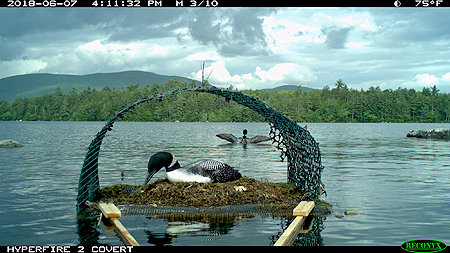
To be added to the weekly Squam mailing list send an email to squam@loon.org.
Well, it took them long enough but we have two eggs now. It was laid shortly before noon and the pair is busy building up the nest and incubating. Now we get down to the long, 28 day haul. The black flies are baddish but have certainly been worse.
Our colleague Walter Piper wrote a blog last week about older females not tolerating black flies very well. Very apropos for this pair because the blog gives a hint of how to distinguish between a male and an older female during black fly season, without the aid of bands. Read the blog and see if you can figure out which loon is which by looking at the back of their heads.
The bets are on as to whether the first egg is viable, seeing as how it got next to no incubation for two and a half days. This looks like it might have a similar outcome to the 2017 nest. Will they hatch one egg? Two eggs? We only have to wait four weeks for an answer.
The camera has been moved and, low and behold, there’s an egg in the nest! It was likely laid late yesterday or last night. With a little luck we’ll have two eggs by tomorrow.

The water may still be too high but the loons are starting to work on nest building. So far, it looks like they are building up the nest they used last year. If this continues we will be moving the camera to a better position. Copulation has also started. You can watch a video of their May 20 morning activities here.
We’re happy to announce that the same pair we’ve been watching on this webcam since 2014 has once again returned this year! We know this because both of the loons in this pair are banded. If you watch closely, you may be able to catch sight of the bands when the loons are swimming by the camera. The female’s bands are orange dot over blue on her left leg and blue dot over silver on her right leg. The male’s bands are red stripe over green on his left leg and white over silver on his right leg.
This pair has an interesting history. The female was originally banded as an adult in 1998. Loons do not mature until they are at least 3 years old, so we know that she is, at minimum, 24 years old. However, because loons will, on average, not breed successfully until they are 6 years old, it is likely that this female is actually at least 27! We know less about the male’s history because he was only banded in 2014. He was an adult at the time of banding, so we know that he is, at minimum, 8 years old.
Though we only know for certain that this pair has been together since 2014 (when the male was banded for the first time), it is possible that this pair has been together much longer. Prior to the male being banded in 2014, this female was paired with an unbanded mate since 1999. That means that there is a chance (though it is not possible to confirm) that this pair has been together for two decades! Since she was initially banded in 1998, this female has successfully hatched 17 chicks! At least 6 of these chicks were fathered by her current mate. This loon pair has a strong history of nesting success, and we hope that will continue this year!
The water is high, but the loons are already looking for a nesting spot. They have been visiting the looncam area several times a day, sometimes for an hour at a time. There has also been a pair of ducks poking around the area looking for a nest. In one of the longer videos posted, the loon pair appear to be checking out the banks of the pond, hoping to find a suitable nesting spot on shore. Check out our recent videos on the YouTube Looncam 2019 playlist.
Our hopes are that the rains subside and the pond level lowers enough for the loon nest to be built near the camera. -bg
The looncam went live on May 2’nd.
The loon pair were swimming around as we installed the camera and seemed interested in the potential nesting sites. There are several areas of vegetation in the water and they are expected to pick one of them.
The water is still too high to be building a nest right now, but should go down quickly. Over the past few years, mating and nest building started in the second or third week of May, eggs appeared about a week later, then hatched about 28 days later, near the first day of Summer.
Through May, expect to see the loons on camera several times a day, with increasing time spent in the nesting area.
Periodically, the camera will automatically pan to several different scenes, just in case the loons are off-camera. Once the pair starts hatching the egg, they will rarely leave the nest. -bg
Watch the loon nesting site live at https://youtu.be/1C2jQ7OYZEs
Winter seems to finally be losing its grip on New Hampshire. With temperatures exceeding 50 degrees F predicted every day for the next few weeks, spring has finally arrived. With it comes the return of loons- we already have one confirmed report of a loon returning to its breeding lake! The others will soon follow, and before we know it, the nesting season will be upon us.
Where have these loons been since we last saw them in the fall? Loons from New Hampshire spend their winters off the Atlantic Coast, though exactly where remains somewhat mysterious! Although we have banded hundreds of loons in New Hampshire since the 1990s, fewer than 40 of these loons have been identified on the ocean. That’s because it can be very difficult to see bands in the rough ocean waters. Thanks to some talented photographers and some dedicated biologists and citizen scientists, however, we have been able to resight some of our loons over the years! These band resights suggest that New Hampshire loons spent their winters all along the Atlantic coast, from as far north as Jericho Bay in Maine to as far south as Cape May in New Jersey!
Here at LPC, we’ve been eagerly preparing for the start of our live looncam. Over the winter, LPC biologists and our wonderful looncam operator have worked hard to ensure that the viewing experience is even better this year. Viewers can expect a smoother video stream, as we’ve been able to increase the frame rate at which we broadcast. We also have been experimenting with improving the sound-hopefully we will not have any microphone hum this year!
Our first looncam will be installed on the same lake as usual, so you will be able to watch the loon pair that you’ve come to know over the past several years. If all goes according to plan, we should have the looncam up and running at the nesting area by May 3rd. The loons likely will not begin nesting for a few weeks after that, but viewers will be able to watch as the loons select their nest site and begin to build their nest. The pre-nesting period is fascinating, and we’re excited to be able to share the pre-nesting behaviors of these loons with loon enthusiasts around the world!
We will continue to check in over the next few weeks with more updates! Happy spring!
Just a quick update to let you know that the three chicks on Squam Lake and the chick on Little Squam are growing and looking fantastic! The chicks are all at an age that they are able to feed themselves; but, like all teenagers, they’re more than happy to get a free meal and continue to beg their parents mercilessly for food. Loon chicks beg by pecking at the bill and neck of the adults and making begging calls—with the chicks the size that they are right now, the parents seem to find all this begging and pecking a bit trying, but they still patiently oblige by bringing up lots of fish for the chicks. One of the Big Squam chicks is particularly feisty—it has been learning the time-honored loon tradition of “cormorant bullying” and was even caught stealing a large fish right out of its parent’s bill that the parent was trying to eat! Very soon the chicks will start learning how to fly; and, for their part, the adults are beginning to molt into their winter plumage. Between the leaves and the loons, the changes of Fall are underway on Squam!
The changes of Fall are underway for me too—as I spend more time in the office, I turn my attention to analyzing the data from the year on Squam, selecting eggs to send in for contaminant testing, and conducting other analyses to help Loon Preservation Committee better understand and mitigate the many challenges facing Squam’s loons.
I will be leaving the orange “Caution: Loon Chicks” signs out until after Columbus Day weekend and will continue keeping an eye on the loons through the Fall; as always, please report any sick, injured, or dead loons to Loon Preservation Committee (603-476-5666).
Thank you for your interest in Squam’s loons! Enjoy a beautiful Autumn, and, as the days turn chillier, think about Squam’s loons getting ready to wing their way to the coast!
Tiffany
—
Tiffany Grade
Squam Lakes biologist
Loon Preservation Committee
To be added to the weekly Squam mailing list send an email to squam@loon.org.
I’m very sad to report that it has been a difficult week for one of Squam’s loon families. The family that had the two chicks has been dealing with frequent and intense loon intrusions over the past week. During one of these intrusions, one of the chicks was attacked by an intruding loon and it has subsequently disappeared. The remaining chick is hanging on, but the family remains in a tenuous position with these repeated intrusions. I just hope the adults can hold them off and the chick will make it. While this is loons being loons, it is also worth remembering that the frequency and intensity of these intrusions on Squam Lake appears to be related to high rates of human-caused mortality (including deaths from lead fishing tackle ingestion) going back to the early 2000’s. For more information on this, please see pages 10-12 of LPC’s Squam Lake Loon Initiative Progress Report that I emailed to you on July 25th and is also available from LPC’s website (https://www.loon.org/squam-lake-study.php).
Fortunately, the other families and their chicks are doing well! So at this point, there are 3 chicks on Squam Lake and 1 chick on Little Squam.
Loon Preservation Committee was featured on NBC last week! You can view the video clip at https://www.today.com/video/inside-the-mission-to-protect-the-loons-of-new-hampshire-s-lake-winnipesaukee-1302105155607?v=raila. It is wonderful that NBC highlighted loons, efforts of volunteers to protect them, and the work of LPC! Please note, however, that the loons are being approached much too closely by a kayaker on one of the video clips included in the piece. LPC does not in any way condone the close approach of boaters or photographers to loons. We always request that observers stay at least 150′ away from loons (i.e., no-wake distance) and to give the loons more space if they show any sign of stress. Enjoy the video, but please always keep in mind proper etiquette around loons!
Don’t forget about your chance to enjoy a wonderful dinner at The New Woodshed and support loons at the same time! Sunday, Aug. 26th, is “Loon Appreciation Night” at The New Woodshed! See the linked flyer for more information, and please come out and support loons!
This will be my last e-newsletter for the summer. You know what this means-it’s time for the end-of-season Squam Loon Achievement Awards! Please see the P.S. below to see who this year’s winners are! *Thank You* to everyone for your assistance protecting Squam’s loons this summer and educating neighbors and lake users about loons, and to everyone who participated in Loon Chick Watch! You have created a culture of respect for loons on Squam that will allow them to thrive as we all work together to help them overcome the challenges they have been facing. Thank you very much! I will continue checking on the loons through the fall, so please continue to let me know about any reports or concerns, and please report any sick, injured, or dead loons to Loon Preservation Committee (603-476-5666). I will let you know if anything happens to any of the loons through the remainder of the season.
Thank you for a great summer and for your interest in Squam’s loons!
Tiffany
P.S. Fifth Annual “Squam Loon Achievement Awards”: Happy awards season on Squam! It’s time to celebrate what Squam’s loons have all accomplished over the past year! But before we do, let’s pause to remember the loons we lost in the past year: the three chicks who died on Squam Lake this summer, the Little Squam loon who was tangled in fishing line, and the immature loon tangled in fishing line on Squam last fall. These are all very sad losses for Squam’s loon population.
And the winners of the 2018 Squam Loon Achievement Awards are.
Productivity Award: The coveted Productivity Award this year goes to the Kimball Island pair! Kudos to them for hatching the first chicks in this territory since 2007 and producing the first surviving chick since 2002!! I was all ready to celebrate the two chicks they hatched at Kimball in their Productivity Award until the loss of one of their chicks last weekend. While we remember the chick they lost, let’s celebrate what they accomplished and their surviving chick. I hope this chick will be the first of many more from this pair in the coming years! Congratulations to the Kimball pair, and may this family hang in there!!
Oldest Banded Loon Award: The grand old lady of the Squam Lakes is the Five Finger Point female! She was banded as an adult with chicks in 1998 at Five Finger Point. Given that banding studies have shown that loons do not begin nesting on average until they are 6-7 years old, she is at least in her mid-twenties. She was a little late coming back this year and I was starting to worry about her, but it was a happy day when I saw her back again! May she have many more happy returns to Squam Lake!
Pair Together the Longest Award: The Perch Island pair has been together for an impressive 8 years-not successively, mind you, but let’s not quibble over details! The pair was initially banded in 2007 and remained together until 2012. The female was out of the territory in 2013 and, by late summer, was frequently skirmishing with the Little Squam female. She spent 2014 as part of the Piper Cove pair, but was a single again in 2015 and 2016. After the death of the 2016 Perch Island female from a boat collision in late summer, this female made a serious bid to reclaim her place in the territory and succeeded in 2017. She has now been back with her old mate for two years. So it’s not 8 years in succession, but who’s counting those intervening years? OK, maybe I am, but I’m sure they aren’t! Let’s wish the Perch Island pair many more happy years together! Previous winners of this award have been the Dog Cove pair and the Little Squam pair (both at 7 years) and the Long Point pair (6 years).
Best Homebody Award: The Perch Island male has been a steady presence in his territory since he was banded in 2007. While many other loons go roaming the lake in late summer if they don’t have chicks to care for, the Perch Island male seems perfectly content to preen peacefully and just spend time in his territory. Even after a nest failure, when loons frequently vacate a territory for several days at least, the Perch Island male can be found floating near the old nest site. He is one contented loon-and definitely deserving of the Best Homebody Award!
Most Graceful Loon Award: Some of you may remember that, last year, the Mink Island male single-footedly booted 3 eggs off his nest and into the water, earning my first (and hopefully last!) “Klutziest Loon Award.” When I saw the Mink Island male back this year and starting to nest, it began 4 weeks of me holding my breath and wondering, did he recover his grace over the winter? Much to my (and, I’m sure, his mate’s) relief, he actually did-no eggs ended up in the water! So, in honor of him not kicking his eggs into the water, I could not be more pleased to award him the “Most Graceful Loon Award”! Maybe my standards are a little low.oh well!
Most Photogenic Award: The Moon Island pair triggered a truly wonderful image on their nest camera of loon life on Squam, which I have attached to this message. Please enjoy, and celebrate the beauty and wild spirit of loons!
Congratulations to the 2018 winners of the Squam Loon Achievement Awards, and kudos to all the families who produced chicks this year! May we have many more contenders for the Productivity Award next year! Wishing all of Squam’s loons a safe off-season, and we’ll look forward to welcoming them back next year!
To be added to the weekly Squam mailing list send an email to squam@loon.org.
The loon chicks of the Squam Lakes continue to do well! I’m happy to report that all 4 chicks on Squam Lake and the single chick on Little Squam are thriving! As the chicks grow, they continue to range farther into open water and areas of active, high-speed boating, so please remind your neighbors and other lake users to boat carefully in areas of the lake marked by orange “Caution: Loon Chick” signs and be aware that loons and chicks could be anywhere in those areas. Also, please remind people to stay at least 150′ away from loons and loon families (i.e., no-wake distance). Thank you for your help getting the word out!
If you feel like having a great dinner and supporting loons at the same time, come to The New Woodshed this Sunday (8/20) for “Loon Appreciation Night”! A portion of the sales will be donated to benefit Loon Preservation Committee (LPC). And please join us at The Loon Center next Thursday (8/23) for our Volunteer Appreciation Potluck at 5:30 followed by a presentation by Harry Vogel, LPC’s Senior Biologist, giving a first look at what the 2018 season was like for New Hampshire’s loons! If you can’t make the potluck, please still join us at 7:00 for Harry’s talk. Please see attached flyers for more information on both events. Hope you can join us in the coming week to celebrate loons!
Please see the P.S. below for this week’s edition of “Meet the Loons of Squam,” in which we’ll visit two loons for whom pairing up is always optional. As always, please don’t hesitate to contact me with any reports or questions, and please contact the Loon Preservation Committee to report any sick, injured, or dead loons (603-476-5666).
Thank you for your interest in Squam’s loons!
Tiffany
P.S. “Meet the Loons of Squam”: Sandwich Bay-This week we’ll head down to Sandwich Bay and meet a “pair” of loons who apparently consider pairing up to be optional. Much to my disappointment, this year was one of the “off” years for them-both loons were present in the territory, but they did not actually form a pair. But let’s back up and meet this on-again-off-again twosome.
The Sandwich loons first paired up in 2011. Before that, the male had been at the Yard Islands, where he successfully hatched a chick in 2008 with the incredible Yard Islands female who died from lead tackle ingestion last August, as I’m sure many of you will remember. But he was evicted from the Yards by another male early in 2009, and retreated to the fringes of the Sandwich Bay territory for the remainder of summer. He was an unpaired loon in 2010 but was continuing to size up the Sandwich Bay territory-and, by 2011, he had made his move and become the territorial male in Sandwich Bay! That year, he and his mate had a chick and were both captured during LPC’s banding that year. His mate was previously unbanded, so we don’t know her history before that point. However, one thing we learned after banding both of these loons caused us some concern. During banding, we always take a small blood sample from the loons that we run for various health tests, including testing for lead levels. The lead levels for both of these loons were somewhat elevated-not high enough to be toxic, but certainly elevated above background levels. Needless to say, I was watching these loons with a great deal of concern for the remainder of the summer, but, fortunately, the pair successfully raised their chick to fledging and all seemed well. I was wondering if they would survive to return the following year, and I could not have been happier when they did. So the question remains-what was the source of these slightly elevated lead levels? Given that both pair members had these levels suggests perhaps an environmental source in this part of the lake that caused their levels to be higher than background but not nearly at the toxic levels we see when a loon has ingested lead tackle. It still remains a mystery.
Fortunately, the loons were able to overcome any immediate effects of this exposure, raise their chick, and return to their territory the following year-but chick production, nesting, and even pairing has remained elusive since then. Fresh off successfully raising a chick, they should have been right back about the business of nesting in 2012.but they weren’t. Nor did they show any signs of nesting in 2013 before the female was driven out of the territory in mid-summer. She was the last of the females to fall in the “snowball effect” of female territorial evictions that rolled down the lake that summer. In 2014, the male was all ready to nest and spent the beginning of the summer sitting right next to the nesting area.but there was no female in sight. The days passed and he patiently waited and waited and waited for a female to come to the territory. Finally, SHE returned, the same female he had been with since taking over Sandwich Bay! Well, no rapturous reunions here-by that time, the male had had it with waiting and they never paired that year.
Finally, after all these years of not nesting, they got down to the business of nesting each year from 2015-2017; unfortunately, they have always been unsuccessful-territorial intrusions by other loons seemed to have contributed to nest failures in these years. This was extremely disappointing-not only are we always hoping for successful nestings and chicks, but we are also interested to monitor the lead levels in these loons and see if they continue to be exposed to an environmental source of lead. So I began 2018 with hopes for this pair that this would be the year of more chicks in Sandwich Bay. Much to my disappointment, my hopes were gradually dashed. The year began optimistically enough, as I spotted both of the loons in the territory, but there was a nagging worry in my mind as the “pair members” were at opposite ends of the territory from each other and nowhere near the nest area. But I tried to rationalize it-it was still early, they had plenty of time, etc., etc., etc. Soon enough, however, I could no longer make excuses for them-especially as the female was nowhere to be seen after my initial sighting early in the year. Soon I was reduced to watching the male spending the summer by himself in Sandwich Bay. I do not have an answer as to why the female put in an early appearance but did not pair up with her mate. I can only hope that next year will bring better things for these loons-a pairing, a nest, and hopefully a chick or two!
To be added to the weekly Squam mailing list send an email to squam@loon.org.
I’m happy to report that the loon chicks of the Squam Lakes continue to do well! Squam Lake still has 4 chicks and Little Squam still has 1 and all are continuing to grow and thrive! But there have been a number of close calls in the past week, which makes me extremely concerned for the safety of the families. I have received several reports of separate incidents and witnessed an incident myself in which loon families were in danger of being hit by oncoming boats traveling at high speeds. I also received a report of a photographer approaching a loon family very closely. I am extremely grateful to the people who helped head off boaters and photographers in many of these cases and helped protect the loon families and to everyone who helps educate neighbors and lake users about looking out for loons and keeping a respectful distance from them, especially families with chicks. And many thanks to those who volunteer for Loon Chick Watch and have helped protect the loon families throughout the summer! It truly takes all of us in the lake community working together to help ensure the safety of the loons and to create a culture of respect in which loons can thrive.
Here are a few points to remind neighbors, lake users, and renters about:
- Please always keep an eye out for loons and loon families when boating, especially in areas of the lake marked with Loon Preservation Committee’s bright orange “Caution: Loon Chicks” signs. Boat slowly and carefully in these areas, keeping an eye out for loons and chicks. Remember that loons and chicks could be *anywhere* in these general areas marked by orange signs, they will not only be near the signs. Loons and chicks will cross from one side of a cove to another, cross boat lanes between islands, and will sometimes just float out in open water.
- Be aware that sometimes chicks will be alone on the surface of the water while the adults are diving for food, or they may be some distance from an adult. Loon chicks are small, dark, and difficult to see on the water. This is another reason it is so important to boat slowly and carefully in the general area of the lake marked with orange chick signs. Boat and jet ski collisions are the second-leading documented cause of loon chick mortality-we certainly do not want Squam’s chicks to become part of this statistic.
- Please do not approach loons closer than 150 feet. This is especially important for loons with chicks. Loons that are concerned about the close approach of a boat, kayak, or canoe may stop feeding chicks to watch approaching boats instead, resulting in chicks not be cared for as well. Chicks that are stressed may refuse to eat for several hours after an incident. In extreme situations, these behaviors can lead to the starvation of the chick(s). Unfortunately, the repeated close approach of kayakers seems to have created just this sort of situation on Squam several years ago and likely contributed to the starvation of one of Squam’s chicks that year. We certainly don’t want that to happen again, so please remind everyone to treat the loons with respect and keep a safe distance. No photograph or “close look” is worth endangering the lives of loons or their chicks.
Thank you for helping to educate other lake users about loons and how we can all work together to protect them, I really appreciate your help with this! And please consider volunteering for Loon Chick Watch to help protect Squam’s loons-and thanks to all of you who have already volunteered, you have made a big difference for the loons! For more information, please visit https://www.squamlakes.org/loon-chick-watcher-program.
Just a few quick announcements about upcoming events: Our end-of-season volunteer appreciation potluck will be held Thursday, 8/23, at the Loon Center at 5:30, to be followed by a first look at what the 2018 season was like for New Hampshire’s loons by LPC Senior Biologist Harry Vogel. You are all invited! Then on Sunday, 8/26, The New Woodshed Restaurant in Moultonborough will donate a portion of their sales to benefit Loon Preservation Committee. We hope you can join us!
Please see the P.S. below for this week’s edition of “Meet the Loons of Squam”-after last week’s look at the sometimes fraught relationship between the Moon Island and Dog Cove loons, we’ll take a look at what life is like for the Dog Cove loons when they aren’t dealing with intruders from Great Island, Moon Island, etc., etc.! As always, please let me know of any questions or reports-and thank you again to people who reported some of this past week’s incidents to Loon Preservation Committee-and please report any sick, injured, or dead loons to LPC (603-476-5666).
Thank you for your interest in Squam’s loons!
Tiffany
P.S. “Meet the Loons of Squam”: Dog Cove-You may remember that last week we followed the current Moon Island male’s determined but ultimately unsuccessful efforts to win the Dog Cove territory and his current pairing with the former Dog Cove female. This week, we’re going to visit the territory he seemed so obsessed with and meet the male who was his nemesis in all his efforts to take over Dog Cove.
The Dog Cove male is one of Squam’s well-established, experienced loons. He was first banded as an adult with chicks in 2001, so, given that loons don’t begin nesting on average until they are 6-7 years old, he is at least in his early twenties. His life as a banded loon began at Great Island, where he was from 2001-2006. During those 6 years, he hatched an astonishing 11 chicks and 9 of them fledged from the lake. This is more than 3 times the average productivity rate in New Hampshire!
His status in 2007 is unclear; but, by 2008, he was in Dog Cove, where he has remained ever since and where his ability to produce chicks has sadly declined from those halcyon days at Great Island. Since arriving in Dog Cove, he has hatched 8 chicks and 3 of those have survived. All 3 of those surviving chicks were produced with the female who is currently at Moon Island, as we learned last week. You may remember from last week that the current Moon Island male was responsible for the loss of two of those 8 chicks; but the Dog Cove male battled him for 3 days following the death of those 2 chicks, managing to hang on to his territory even though his chicks were gone. Kudos to him for persistence and determination, despite the tragedy of his chicks. In 2015, he did not return to Dog Cove until just after Memorial Day. This was very surprising and unusual-prior to his arrival, his mate was first with an unbanded loon and then the Moon Island male. Finally the Dog Cove male returned, reclaimed his territory and booted the Moon Island male out yet again. To this day, I still don’t understand why he was so delayed in returning, but I was happy to see him back-and amused that the female was with 3 different males in the span of a month!
The Dog Cove male’s current mate arrived in 2016; but, for unknown reasons, the pair has not been as committed to nesting as previously. Last year, they mysteriously abandoned the nest after sitting on their eggs for only a few days-and this year, they showed almost no interest in nesting. This is puzzling and disappointing-and certainly breaks this male’s record. Up until this year, he nested every single year since 2001, with the possible exception of 2007 when data on his status is lacking. This was a remarkable run of consecutive nests, and I was very sorry to see it end.
I have many memories of this loon, both the fond and the frustrating. I’ll always remember hiking the trails at Chamberlain-Reynolds one early spring right after ice out. My boat wasn’t in the water yet, but I wanted to see if maybe I could see some loons. I went down to the cove where the raft was always placed for the Dog Cove loons-of course, because the ice had just gone out, the raft wasn’t in the water yet. But there was the Dog Cove male, sitting there in the spot we always put the raft! I could just about hear him thinking, “Well, I’m here-where’s my raft??!?” I’ll also always remember watching him incubating his eggs on a beautiful summer day, desperately trying to stay awake but he just kept nodding off. His head would keep nodding as he tried unsuccessfully to stay awake until he would jerk awake, look around and try to be alert for a few minutes before nodding off again. I certainly empathized with him-we’ve all been there! On the frustrating side of things, he has expertly learned how to evade LPC banding crews-to the point that, as soon as our light hits the territory, he leaves the area. He certainly doesn’t score any chivalry points, abandoning his mate and chicks to the banding crew while he saves himself! Despite his lack of chivalry, he has been a stable presence in Dog Cove and I’m always happy to see him back there each year. I hope that he and his current mate will get on better track with nesting in future years!
To be added to the weekly Squam mailing list send an email to squam@loon.org.
This past weekend was a very sad one on the Squam Lakes. Loon Preservation Committee received several reports of a loon tangled in fishing line on Little Squam over the weekend, and I was able to capture it on Sunday. The loon was severely debilitated, underweight, and fishing line was wound tightly around its bill and neck. I took the loon to Capital Area Veterinary Emergency and Specialty (CAVES) in Concord, where an x-ray revealed a mass in the loons throat, which the vet attributed to the line being wound so tightly around its neck that the loon was unable to swallow food, and a lot of tackle in the loon’s gizzard. Sadly, there was no choice but to euthanize this loon. The only relief in this terrible situation is that the loon was not one of the pair with the chick on Little Squam. Thank you very much to everyone who called in to report this loon to us, to the boater who pointed out to me where the loon was tucked in near shore and helped with the capture, to everyone at Squam Boat Livery for their assistance as I was coordinating logistics to get the loon to a vet, and to the veterinarians and staff at CAVES for caring for this loon in its final moments. I am so grateful to everyone who came together to help this loon and only wish the outcome had been very different.
The fate of this loon provides a harsh reminder of the need for everyone to practice responsible fishing practices-to always use only non-lead fishing tackle and to reel in fishing lines when loons are in the vicinity. Many baits are intended to look like small fish or crayfish, and a loon’s instinct is to strike at something that flashes past it that it thinks is a food item. Sadly, as in the case of this loon, what the loon thinks is something to eat may be a fishing lure. You may remember we had an immature loon tangled in fishing line that died last fall on Squam as well. Please help spread the word to anglers to reel their lines in and wait until a loon has left the area-otherwise, they may end up with a loon on the end of their line instead of a fish. And please help spread the word to anglers to always use only non-lead fishing tackle. Lead tackle can be dropped off for safe disposal at The Loon Center, all New Hampshire Fish and Game offices, and the Squam Lakes Association. For more information on lead-free fishing, please visit www.fishleadfree.org/nh/ . Thank you for your help getting the word out about safe and responsible angling practices.
On a happier note, all 4 chicks on Squam Lake and the chick on Little Squam continue to do well! Many thanks to those of you who have kept an eye on these loon families and have participated in Loon Chick Watch! If you would like to volunteer for Loon Chick Watch, please visit https://www.squamlakes.org/loon-chick-watcher-program.
Please see the P.S. below for this week’s edition of “Meet the Loons of Squam,” where we’ll meet two loons whose pairing has been many years in the making, just not quite in the way I expected! As always, please don’t hesitate to contact me with any questions or reports, and please report any sick, injured, or dead loons to Loon Preservation Committee (603-476-5666)-and thanks again to all who called in about the Little Squam loon.
Thank you for your interest in Squam’s loon!
Tiffany
P.S. “Meet the Loons of Squam”-Moon Island: Among the many things watching Squam’s loons has taught me, one of them is just what colorful lives loons lead. And a loon with one of the most colorful histories is the male at Moon Island, whose life has intersected numerous times over the years with his current mate -not always in a good way! But for loons, having a territory always wins out in the end.so let’s look at the strange series of events that led to the pairing of these two loons.
The Moon Island male first came onto LPC’s radar in 2010, when an unbanded male loon attacked the Great Island male, who was sick with lead poisoning, killed his chick, and took over the Great Island territory. The victorious male presumably returned the next year as the owner of Great Island, had two chicks, and LPC biologists were able to band him–now we could track his history eventually led him to Moon Island. Sadly, one of his chicks succumbed to starvation, likely exacerbated by disturbance from kayakers, and the second chick died of unknown causes. The following summer (2012), he was back at Great Island, but his mate spent 3 days sitting on the nest raft without producing an egg, and he decided it was time for a new territory. He set his sights on Dog Cove, leading to his first encounter with the loon that is now his mate at Moon Island.
The summer of 2012 was shaping up to be a good one for the loons of Dog Cove. The pair had two chicks that were 2 weeks old, and the adults were both experienced parents. The female had been in the territory since 2009, and she and her mate had successfully raised one chick in both 2009 and 2011. Now they had two thriving chicks.until the male from Great Island appeared. In the ensuing battle, both chicks were killed and it initially appeared like the male from Great Island was winning, but the Dog Cove male was not about to give up. The two males spent the next three days fighting; and, in the end, the Dog Cove male hung onto his territory and defeated the male from Great Island. But, in a case of loon karma, another male had moved into Great Island in those ensuing three days. The Great Island male had gambled on a new territory but lost all.
The next two years were difficult for both the now ex-Great Island male and the Dog Cove female. The male was a single loon without a territory from mid-summer 2012 through 2014, floating around the lake, picking the occasional fight to get a territory, but essentially down and out on his luck. The Dog Cove female still had her territory, along with her mate who had come through the fight to retain his territory, but multiple nesting attempts in 2013 and 2014 were unsuccessful. 2015 brought a change of fortunes for both of these loons, despite a rocky start. The ex-Great Island male took over the Moon Island territory.but the siren song of Dog Cove still called. His old rival in Dog Cove hadn’t returned yet in late May, so he booted out the unbanded male there at the time and finally had the territory he had always coveted…for about a week. He spent a week of bliss in Dog Cove, swimming around the territory with the Dog Cove female, but then his nemesis, the Dog Cove male, returned and booted him out yet again. So he settled for Moon Island-the territory he had just gained but apparently really didn’t want. In the meantime, back in Dog Cove, the female-having gone through 2 other males in the course May, was finally re-united with her old mate, and they successfully raised a chick in 2015.
Loons lives are nothing if not a roller-coaster; and, in 2016, the Dog Cove female’s fortunes plummeted. I was shocked to see that she was evicted from Dog Cove in 2016, and she spent both 2016 and 2017 as an unpaired loon. The male was still on his territory at Moon Island in 2016 and he finally seemed to be settling into a life of quiet domesticity-I was thrilled to see the pair go on the nest that year! But my elation was quickly tempered when his mate was evicted from the territory by another female within days of laying the egg. Usually this would result in immediate abandonment of the nest by the remaining mate; but, after all he had gone through, the male was apparently not ready to give up on that egg, and he just kept sitting on it, much to the frustration of the new female. She would swim around the nest raft, cooing seductively and seemingly trying to lure him off the raft, but he wasn’t having it and stubbornly kept sitting on the egg. However, loon parenting is a two-loon job, and he needed to get off the raft at times to eat and take care of himself, during which time the embryo died and the egg didn’t hatch. His new female finally gave up and laid an egg in the nest too, but her egg didn’t hatch either. However, for his efforts and stubborn refusal to give up on the egg, this one-time loose cannon male earned the “Father of the Year” award in my end-of-season Loon Achievement Awards in 2016. He was still at Moon Island in 2017, but frequent territorial intrusions of females meant no nesting for him that year.
But the stories of these two loons came together once again in 2018-imagine my shock when I saw them together at Moon Island this year! They seemed to be an unlikely pair-the solid, stable, good-mother female from Dog Cove who had fallen on hard times and the loose cannon male who desperately wanted the Dog Cove territory, killed two of her chicks in 2012, and was paired with her for a week in 2015. How ironic that they ended up as a pair but not in Dog Cove! But, for loons, territory conquers all-or, at least, whatever territory a loon can conquer. Despite all his efforts, he couldn’t conquer Dog Cove, so had to settle for what he could get-Moon Island. And she couldn’t hang on to Dog Cove but was able to take over Moon. So now circumstances of territories have brought them together. It’s not a terribly romantic ending, but it works for loons-so I’ll sign off by wishing them “Territorially Ever After,” and hopefully “Happily” as well!
Thank you for your interest in Squam’s loons!
Tiffany
To be added to the weekly Squam mailing list send an email to squam@loon.org.
I have fantastic news-the remaining loon nest on Squam hatched 2 chicks!! It’s very exciting to have a two-chick hatch-this is something we haven’t had on Squam Lake for two years, so it’s great to have a twosome out there again! Unfortunately, however, this wonderful news is tempered by the loss of one of Squam’s other chicks. You’ll recall that, in my last e-newsletter, I mentioned that one of the families was experiencing some difficulties with intruding loons. Sadly, the chick disappeared while this was going on. This brings our totals to 1 chick on Little Squam and 4 chicks on Squam Lake. Thanks very much to everyone who has been keeping an eye out for the loon families and helping with Loon Chick Watch! For more information on Loon Chick Watch and to volunteer to spend some time on the weekends helping to protect Squam’s loons, please visit https://www.squamlakes.org/loon-chick-watcher-program. We all need to do everything we can to help these chicks thrive on the Squam Lakes!
Thank you to everyone who participated in the Loon Census this past Saturday! We could not have asked for a more perfect day for counting Squam’s loons! Thirty-five adult loons were seen and all chicks were accounted for that day! Thanks to everyone for helping, and it was great to see many of you on Church Island!
In lieu of “Meet the Loons of Squam” this week, I’m attaching Loon Preservation Committee’s annual Progress Report on the Squam Lake Loon Initiative, our intensive research, monitoring, management, and outreach effort to understand the causes of the declines in Squam’s loon population and restore a healthy population of loons to the lake. As you will learn in the report, we have made important progress in the past year in bringing on additional collaborators to investigate the issue of contamination in the Squam watershed, and Loon Preservation Committee is continuing to advocate with these collaborators for comprehensive contaminants work to ensure the best possible outcome for Squam’s loons and other wildlife. Please don’t hesitate to let me know if you have any questions about the report or the Squam Lake Loon Initiative.
“Meet the Loons of Squam” will return next week, but, in the meantime, please let me know if you have any reports or questions about Squam’s loons. And, as always, please contact the Loon Preservation Committee to report any sick, injured, or dead loons (603-476-5666).
Thank you for your interest in Squam’s loons!
Tiffany
To be added to the weekly Squam mailing list send an email to squam@loon.org.
Rest assured, we’ve checked on the Loon Cam chicks this morning. Things have calmed down. The chicks are being civil to each other. There are sure to be more sibling spats but that’s all part of growing up. A short clip.
The first chick finished breaking out of the shell sometime in the late morning. The pip was first seen late afternoon-early evening yesterday. Around 12:30 pm Mom allowed us the first peek. Total incubation time was almost exactly 27 days. The second egg was laid a little more than 48 hours after the first egg but that doesn’t necessarily mean it won’t hatch tomorrow.

First good look at Chick #1
There are two new chicks on the Squam Lakes this week! Against all odds, a chick hatched on Little Squam after 32 days of incubation-normal incubation for loons is 28 days, so this was quite remarkable! Another chick hatched on Squam Lake as well! Unfortunately, there was a nest failure on Squam this past week as well, resulting from predation. And there was a serious scare with the family of the oldest chick on Squam, which is dealing with intrusions from other loons. Fortunately, the chick has been accounted for, but this family is not out of the woods yet, and I’m certainly hoping they will be able to fend off the intruders. So the totals for this week are one chick on Little Squam, 3 chicks on Squam, and one active nest remaining on Squam Lake. For information on how you can volunteer to help protect the chicks of the Squam Lakes, please visit https://www.squamlakes.org/loon-chick-watcher-program.
As many of you know, the annual Loon Census is this Saturday (7/21), and we could use a few more participants. If you have a boat and would be able to help out on Saturday morning from 8:00-9:00, please let me know!
Thank you!
The Loon Festival is this Saturday at The Loon Center! The Festival is from 10:00-2:00 and is a day of family fun celebrating loons! For more information, please visit https://www.loon.org/loon-festival.php. Hope to see you there!
“Meet the Loons of Squam” will take a hiatus this week as I work to get ready for Census/Festival day, but it will be back with more tales from the field! As always, please contact me with any questions or reports, and please contact Loon Preservation Committee to report any sick, injured, or dead loons (603-476-5666).
Thank you for your interest in Squam’s loons!
Tiffany
To be added to the weekly Squam mailing list send an email to squam@loon.org.

- There are city loons and country loons. After ten years of observing loon behavior on lakes throughout New Hampshire, I’m convinced that loons adapt to the presence or absence of human development. A loon in the channel of the Weirs on Winnipesaukee reacts to human presence much differently than a loon on Cummins Pond in the wilds of Dorchester.
- Loons learn through experience. First time nesters have a lower success rate than older, more experienced loons. Loons that experience a nest failure are much more likely to change the location of their next nest.
- Loons can recognize individual people by facial features and decide (on their own terms) whether that person is friend or foe . I and a colleague of mine have had too many first-hand experiences to doubt this. And if you think my assertion is far-fetched, read the work of John Marzluff, who studies crow behavior.
- Loons have a curious nature. Wave a bandanna over your head so that it flaps and/or give your best rendition of some loon hoots and there is a good chance a nearby loon will come over to investigate. They have no reason to be programmed to do that. They just want to know what’s going on. As soon as they see that there is nothing of interest to stick around, they just roll their eyes and swim away.
- Chicks often mimic their parent’s actions. They’re learning how to be loons.


We have a second chick on Squam! Another chick hatched last Friday and the chick from the first hatch continues to do well-all fantastic news! Many thanks to those of you participated in Loon Chick Watch over the past holiday week, I really appreciate your help protecting these loon families! The new chick is in a particularly busy part of the lake, so it would be great if we could have more people helping to protect both of these families. Plus, we have another hatch expected this week! For more information or to sign up for Loon Chick Watch, please visit https://www.squamlakes.org/loon-chick-watcher-program. With this new chick and a new nest that started in the past week, we now have two chicks on Squam Lake and three active nests. The nest is still active at Little Squam; but, sadly, it is looking increasingly doubtful that that nest will hatch.
If anyone was out at Yard Islands on Sunday, July 1st, I’m hoping you can help me out. It appears that a chick hatched at Yards that day but immediately disappeared. When I was there in the afternoon, the loon pair was extremely agitated and distressed, calling repeatedly. The pair had still been incubating contentedly on Saturday evening, so the hatch must have occurred overnight or Sunday morning. If anyone saw anything that might explain what happened, please let me know. Did you see a chick in the morning or early afternoon of the 1st? Did you see anything that might explain how the chick disappeared (eagle swooping down on loon family, splashing that might indicate underwater predator like snapping turtle or large fish, etc.)? There were numerous boats at Yards when I was there in the afternoon, so I’m hoping someone saw something. I’d be very grateful for any information. Thank you!
Loon Preservation Committee’s annual Loon Festival was on July 21st 2019 from 10:00-2:00! This free event celebrates “all things loon” and is a fun day for the whole family! Hope you were able to join us!
Please see the P.S. below for this week’s edition of “Meet of the Loons of Squam,” in which we’ll pay a visit to the oldest banded loon on Squam! As always, please don’t hesitate to contact me with questions or reports, and please report any sick, injured, or dead loons to Loon Preservation Committee at 603-476-5666.
Thank you for your interest in Squam’s loons!
Tiffany
P.S. “Meet the Loons of Squam”: Five Finger Point-This week, let’s head up to Five Finger Point to check in on the oldest banded loon on Squam, the female of the Five Finger pair! She is paired with an unbanded male, so we don’t know anything about his history-but she has quite a history, so let’s dive in!
She was originally banded at 5 Finger in 1998 as an adult with chicks. Banding studies have shown that, on average, loons don’t get a territory and start nesting until they are 6-7 years old, so she is now at least in her mid-20’s. Those first several years after she was banded were her golden years: from 1998-2002, she nested every year and hatched 7 chicks of which 3 survived, all from 5 Finger Point. But then things started to slip for her. She was not seen on the lake in 2003, did not nest in 2004-2005, and was again not observed from 2006-2008. It is quite a puzzle as to where she was during those years.
But in 2009 she was back, paired that year with a unbanded male with an injured wing. We kept a close eye on that male throughout the summer; but, fortunately, as the summer wore on, his wing got stronger and stronger, and he was fortunately able to leave the lake on his own in the fall. Needless to say, with that sort of injury, nesting was out of the question. By the next year, she was ready to make up for lost time and made quite a splash when she nested in 2010 right next to the boathouse at Rockywold-Deephaven Camps (RDC)! I am still very grateful to everyone at RDC for their consideration and concern for this nest and everything they did to protect the loons. If the female wanted a place in the spotlight after several years of obscurity, she certainly got it! Unfortunately, it all came to nothing-the nest was near a muskrat den. The loons had spent their days on the nest watching a muskrat swim back and forth in front of them, occasionally taking a jab with their bills at the supremely unconcerned muskrat. Just days before the nest was due to hatch, a mammal ate the eggs. Whether it was the resident muskrat or something else, I’m not sure-but I’ll always remain suspicious about that muskrat.
The following year (2011), she took over the Mink Island territory and produced her first chick since 2002. Sadly, that chick disappeared when it was less than two weeks old. But she tried again the next year, again producing one chick. She very nearly had two; but, unfortunately, the second chick died while breaking through the shell. Happily, however, her other chick survived, and Loon Preservation Committee captured her and her mate for banding. She weighed nearly 12 pounds-up a pound from the last time we had captured her back in 1998! However, the mate caused us considerable concern-he was extremely lethargic when we captured him and he remained lethargic for the remainder of the summer. The female stepped up and managed to successfully raise the chick. Considering the male’s condition, it was very fortunate that the male wasn’t kicked out of the territory-which would have resulted in the death of the chick. It was not surprising when his body was discovered up on shore the following summer. At that point, little remained of the carcass, so the necropsy was inconclusive.
The female was back in Mink in 2013, ready to try again, but she was driven out of the territory early in the season and remained a single loon through 2015. I often saw her in the Mink territory-she obviously still hadn’t given up on it! But 2016 saw her back in her old territory of 5 Finger and ready for her place in the spotlight again! She spent several days sitting on top of an old beaver lodge near the RDC boathouse-this loon clearly has a taste for celebrity! In the end, the pair opted for a more secluded nesting spot, which ended up getting hit by a mammal again. Last year, she was a single loon once more. This year, she was a late arrival on the lake and I was getting concerned about her. She eventually returned, much to my happiness, but she has struggled to hold on to the territory and dealt with numerous intrusions from another female. It appears her age is starting to catch up with her, but she is a survivor and I hope she manages to hang on!
To be added to the weekly Squam mailing list send an email to squam@loon.org.

Great news, Squam Lake has its first chick of the year! The chick hatched on Wednesday and the parents are very busily taking care of it, trying to convince the sometimes reluctant chick to eat all the minnows they bring! Unfortunately, the family seems to be struggling to find a quiet spot away from boating activity to brood the chick. More nests are expected to hatch this coming week, so it is very important to remind neighbors and lake users to keep an eye out for chicks, boat slowly and carefully, and give the loons plenty of space. Thanks for your help with this, and please consider volunteering for Loon Chick Watch to help protect the loon families! (https://www.squamlakes.org/loon-chick-watcher-program)
In another piece of good news, two more pairs went on the nest this past week! But life for loons on Squam is, sadly, always a rollercoaster. One of those pairs already abandoned their nest for reasons that are not entirely clear. And another pair lost their nest in a truly appalling set of circumstances. One of the signs protecting the nest was tampered with, causing the protective ropes/signs to drift in close to the nest. People were seen close to the nest at the time this occurred. Not surprisingly, the incubating loon flushed off the nest, and the eggs were subsequently eaten by an avian predator. It is very upsetting, sad, and disturbing that this happened. Given the challenges Squam’s loons are facing, it is appalling that a nest would be lost in this way. Let’s all work together to help create a culture of respect for loons on Squam.
The current tally for the Squam Lakes are 1 nesting pair on Little Squam, 1 chick on Squam, and 3 active nests on Squam. As of last night, an additional nest on Squam appears to be in jeopardy. I will be checking on its status today and let you know in my next report whether it made it or not. The spate of recent nest failures has certainly changed the prospects for the potential number of chicks on Squam this year, but I am hoping the remaining nests will hatch successfully and that some of the pairs that failed will re-nest.
As we head into a busy week on Squam, please also remind your neighbors and other lake users about the dangers of lead fishing tackle to loons, and don’t forget to clean out the old tackle boxes in your garage or boat house! Sadly, in the past week, the Loon Preservation Committee picked up two loons from lakes elsewhere in the state that died from lead tackle ingestion. Please dispose of old lead tackle safely-The Loon Center, Squam Lakes Association, and all New Hampshire Fish & Game offices are collection points for safe lead tackle disposal. Let’s make our lakes safe for loons and other wildlife and get the lead out!
Please see the P.S. below for this week’s edition of “Meet the Loons of Squam,” and don’t hesitate to contact me with any questions or reports. As always, please call Loon Preservation Committee to report any sick, injured, or dead loons (603-476-5666). Thank you for your interest in Squam’s loons, and have a safe, happy, and loon-safe 4th of July!
Tiffany
P.S. “Meet the Loons of Squam”-Moultonborough Bay: This week we’ll pay a visit to Moultonborough Bay (M’boro), a territory that historically had fairly reliable chick production but has struggled in recent years with an influx of loon intrusions-and high contaminant levels in loon eggs. In many ways, M’boro has been the poster territory in recent years for some of the key problems facing Squam’s loons in recent years. But let’s back up and see what the loons have been up to.
The current pair in M’boro is an unbanded male and a female who was banded in the territory in 2012, the year she had the only chick she has produced in the territory. At that time, she was paired with the Grand Old Male of Moultonborough Bay. He had been banded in M’boro as an adult in 1999, moved up to the Yard Islands in 2002-2004, but returned to M’boro in 2005 and spent his remaining years there. He was a calm and serene presence in the Bay, and it was very sad when he did not return in 2015. He hasn’t been seen since, and I presume he is dead after a long and productive life. From the time he was banded, he produced 7 chicks in M’boro and Yards, which is just about right on average for a loon in New Hampshire. Since that time, the male in M’boro has been unbanded, so we do not know his history.
Since the female arrived and produced a chick in 2012, her fortunes have taken a downward turn. In 2013, her eggs were inviable; and, in 2014, the nest was just days away from the expected hatch date when the female evicted from Sturtevant Cove in 2010 and the female evicted from the Yard Islands in 2013 teamed up to drive the M’boro female from the territory. This is the only time I have ever seen same-sex loons team up to chase a rival from her territory! Needless to say, only one female loon could have the territory, so the ex-Sturtevant and ex-Yards female then turned on each other once the M’boro female was gone. The ex-Yards female won the battle handily. In an interesting twist, the ex-Yards female had been paired with the Grand Old Male of Moultonborough Bay from 1999-2007, so it looked like the old pair was going to be back together again. Unfortunately, it was not to be. The male did not return in 2015; and, while the ex-Yards female won the battle, she lost the war. The ex-Sturtevant female was the territorial female in M’boro in 2015.
But that didn’t last for the ex-Sturtevant female either. The M’boro female was back on territory in 2016 and 2017, after spending the summer of 2015 as an unpaired loon. Just as in 2014, her nest attempts in those years ended after intrusions from other loons. To make matters worse, LPC tested one of her eggs from both 2013 and 2016. These eggs showed high levels of contaminants, particularly for PCB’s. While obviously LPC has only tested eggs from a relatively small number of loons in the state, we still have tested nearly 80 eggs statewide; and, based on these tested eggs, the M’boro female is carrying the heaviest contaminant body burden of any loon in the state.
So in many ways, M’boro typifies the problems Squam has been facing. Many nest failures in the territory have resulted from the “social chaos” that has overtaken the Squam’s loons, apparently as a result of high rates of adult mortality, resulting in frequent loon intrusions. Unhatched eggs from the territory have tested for high levels of contaminants. And lead poisoned loons have died in the territory in 2007 and 2017-this is not to say they acquired the lead tackle in the territory, but it adds to the picture of the challenges facing Squam’s loons being encapsulated by what has happened in the territory in recent years. Obviously, Loon Preservation Committee is working hard to help Squam’s loons overcome these challenges, and we are working for the best for the M’boro pair-and all of Squam’s loons!
To be added to the weekly Squam mailing list send an email to squam@loon.org.
Our next contestants reside on a large lake with many loon neighbors, unlike our first pair who claimed the entire lake as their territory. This new pair has rejected the back to earth movement – no natural nests for them – and built their nest on one of those newfangled “artificial nesting islands.” But let’s not put on airs, shall we? It’s just a raft for loons. Their first egg was laid sometime between 8:30 last night and 8 or 9 this morning. They’ve been on and off regularly all day. We hope to see a second egg by tomorrow morning and maybe they’ll settle down to some full-time incubating.
It’s been another busy week on the Squam Lakes! I’m delighted to report that we have two new nests on Squam! On a sad note, however, we did lose one nest that was attacked by a mammal. This brings the number of active nests to one nest on Little Squam and 5 nests on Squam Lake! There are several other pairs showing interest in nesting, so hopefully they will settle down soon!
It’s hard to believe but the first nest is due to hatch next week already! As we head into chick season, please remind your neighbors and other lake users to give the loon families (and, of course, the nests!) plenty of space. We ask people to stay at least 150′ away from loons and loon families so the loons can focus on the hard work of raising loon chicks without being stressed or disturbed. Also, please remind people to boat slowly and carefully in coves or areas of the lake marked with LPC’s orange “Caution: Loon Chick” signs and to keep an eye out for chicks. The chicks are small, dark, and can be hard to see on the water; and, sadly, boat/jetski collisions are the second-leading known cause of death for loon chicks. Please remind everyone to be careful so that doesn’t happen!
Loon Preservation Committee is once again partnering with the Squam Lakes Association for Loon Chick Watch this year! Loon Chick Watch is a wonderful way to volunteer and help protect Squam’s loons! For more information, please visit https://www.squamlakes.org/loon-chick-watcher-volunteer-sign.
In this week’s edition of “Meet the Loon of Squam,” I’ll introduce you to a new mystery loon on the lake–please see the P.S. below to learn more! As always, please do contact me with any reports, questions, or concerns, and please call the Loon Preservation Committee to report a sick, injured, or dead loon (603-476-5666).
Thank you for your interest in Squam’s loons! Tiffany
P.S. “Meet the Loons of Squam”–Kimball Island:
Kimball Island’s have been a something of a mystery for many years, but the mystery only deepened this year. There has not been a banded loon in that territory since 2009. The banded female, who was on territory in Kimball in 2009, decided to take over Sturtevant Cove in early spring 2010; since then, Kimball has been occupied by unbanded loons, so we really don’t know the history of these loons. The Kimball loons have had several nesting attempts over the intervening years (in 2010, 2013, and 2015); but none of these nesting attempts were successful, so we were unable to band them and begin to learn about these loons.
But the mystery surrounding Kimball has just gotten that much deeper! Much to my surprise, the female in Kimball this year is banded–but it is only a single silver band, so I have no idea who she is! The silver bands (well, actually aluminum, but it’s easier to call them silver!) are the official bands issued by the US Fish and Wildlife Service. Every banded loon gets one of these, and they have a number on it that is the official identifier of each loon. Of course, unless you have the loon in the hand, there is not a good way to read these numbers. This is why we put the unique color combination of lightweight plastic bands on the loons, so we can easily recognize them while looking through binoculars and keeping a safe and respectful distance. Given that this female only has a silver band, we will have no idea who she is or where she came from until we can capture her! You might be wondering why she only has a silver band. There are several possibilites–sometimes the plastic bands become loose and fall off. Also, if a loon has been with a wildlife rehabilitator, they are sometimes only given a silver band. Or she may have only been given a silver band originally, for whatever the reason.
You may recall from our “Meet the Loons of Squam” last year that there is a male in Rattlesnake Cove in the same situation. Here’s hoping that both of these loons will nest successfully and have chicks–most importantly, so that there will be more loon chicks contributed to the population. But also so we can capture these adults and begin to solve the mystery of these loons!
To be added to the weekly Squam mailing list send an email to squam@loon.org.

Sure looks like one.
.jpg)
It has been a very busy week for the loons on Squam! Nests have seemingly been popping up all over! We had one nest last week, and this week four more pairs have gone on the nest! We now have four nests on Squam Lake, and the pair on Little Squam is nesting also! This is a very good start, and I hope that all the pairs will do well and that more pairs will catch the “nesting bug” soon!
Please remind neighbors and lake users to give nesting loons all the help they can by keeping their distance from nests and respecting the protective signs and ropes around the nest areas. I received a report that we had a close call this past week when people trespassed near one of the nests, flushing the loon from the nest. Thankfully, the loon returned, but repeated disturbances (or one really bad disturbance) can cause loons to abandon their nests. Thank you for helping to spread the word!
Loon Preservation Committee’s (LPC) annual Summer Luncheon and Auction is coming up on June 24th! Our featured speaker this year is Steven Curwood, the host of Public Radio’s “Living on Earth.” The deadline for reservations is June 14th–please call LPC to join our celebration of loons (603-476-5666)!
Please see the P.S. below for this week’s edition of “Meet the Loons of Squam,” where we’ll meet a loon that has made a triumphant return to his territory after I feared he was dead–what a comeback! As always, please don’t hesitate to contact me with any questions or reports, and please call LPC to report any sick, injured, or dead loons (603-476-5666/603-476-LOON).
Thank you for your interest in Squam’s loon! Tiffany
P.S. “Meet the Loons of Squam”–Sturtevant Cove: Sturtevant Cove definitely saw quite the comeback this summer, much to my happiness! The male loon from two years ago, who I feared was dead, is back and looking as good as ever! As we pop the champagne, let’s backtrack a little bit to find out what happened to him and this pair.
This male was originally banded in Sturtevant Cove in 2013, and he was paired with a female who had moved in from Kimball Island and taken over the Sturtevant territory in 2010. They successfully raised one chick that year, but 2014 saw a succession of other males attempting to take over the territory from this male. He managed to hang on; but, due to all the fighting, the pair did not nest that year. 2015 brought another change, with a new, unbanded female in the territory. His previous female was still on the lake but obviously unable to hold the territory. The pair raised one chick, and LPC banded the female that year so we could begin tracking her.
Everything seemed to bode well for the pair in 2016. Both pair members were back; and, spurred on by their success of the previous year, they got right down to the business of nesting, hatching two chicks by the end of June. But a dark cloud was looming on the horizon, which first became apparent when we captured the pair to collect new samples. To our concern, the male was unusually lethargic while he was in the boat. The results of his blood work were concerning as well, showing indications of chronic stress or poor health of some sort. Unfortunately, the tests could not tell us more–simply that something was not right with this loon.
Sadly, this was borne out when another male intruded on the territory. We often see that loons are finely attuned to sickness or weakness in other loons and quickly move in to take over the territory, and this is exactly what happened in Sturtevant. The Sturtevant male was driven out, and one of the chicks immediately disappeared, presumably killed by the new male, as is normal. Much to my surprise, the second chick hung on for several days–this is quite unusual in these territory takeovers. The Sturtevant female tried to feed and care for it, but being a single parent is not easy for loons and the new male was hostile to the chick. To make matters worse, the female who had been paired with the Sturtevant male in 2013-2014 was jockeying for position and making life difficult for the Sturtevant female too. She hung on; but, sadly and predictably, the chick disappeared after several days.
I did not see the old male for the remainder of the summer of 2016. In 2017, an unbanded male was in the territory (likely the male who took over in 2016), along with the same female. Together they hatched the only chick on the lake last summer. There was still no sign of the old male around the lake, and I feared he had died. Between his lethargy during banding, his blood work indicating something was wrong with him, and his subsequent eviction, his absence seemed to not bode well, that perhaps he had not survived the fight and any injuries he may have sustained or his poor health. Imagine my surprise when I saw him this summer, paired up with the same female! They have already been looking at potential nest sites. Kudos to the Sturtevant male, back from the brink and hopefully getting ready to raise some more chicks!
To be added to the weekly Squam mailing list send an email to squam@loon.org.
Welcome to the 2018 Squam Loon Season! Despite the late ice-out this year (April 27th, latest since 2001!), the loons are off to a fast start! Loon pairs are mostly settled in their territories, and one pair is already on the nest!! Hopefully other pairs will follow suit soon and it will be a nice, quiet nesting season for Squam’s loons.
I do need to update you on a very unfortunate situation from last fall on Squam. In late October, our friends at Squam Boat Livery alerted us to an immature loon that was tangled in fishing line in the channel between Squam and Little Squam.
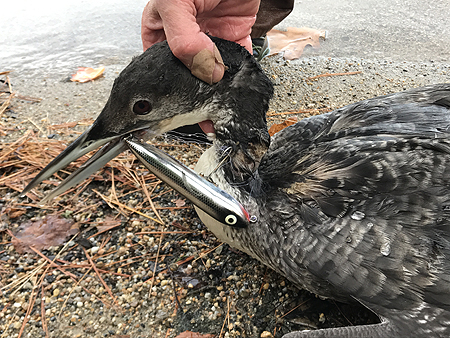
We captured it in Cotton Cove and found a large lure lodged in its bill and neck and fishing line wrapped tightly around its neck. We took it Meadow Pond Animal Hospital in Moultonborugh, where the vets made a tremendous effort to try to save the loon. Sadly, it did not make it. This was a loon that was migrating through Squam–not the chick from Squam last year–but, sadly, its migration ended here.
With fishing season well underway, please remind your neighbors and other lake users to reel their lines in when loons are in the vicinity and to use only non-lead fishing tackle. Loons mistake lures being reeled in for fish and will strike at them, becoming tangled up as this young loon did and possibly ingesting tackle. Please ask anglers, if a loon comes in the vicinity of where they are fishing, to refrain from casting until the loon moves on.
I’m sure you will all remember that we had a loon die from lead tackle ingestion on Squam last summer, and we have already had 3 lead-poisoned loons elsewhere in the state this spring–2 have died, and one is with a wildlife rehabilitator fighting for its life. In addition to spreading the word to neighbors and lake users about using only non-lead tackle, please check for old tackle boxes in your garages and boat houses. Old tackle boxes are full of lead. A good rule of thumb is, if the tackle is old, it’s lead. Please clean out those old tackle boxes and re-stock them with non-lead tackle. The Loon Center, Squam Lakes Association, and NH Fish and Game offices are all ready to accept old lead tackle and dispose of it safely and properly. Thank you very much!
If you are looking for something to do when you have visitors at the lake, don’t forget the loon cruises! Loon Preservation Committee is once again partnering with our friends at the Squam Lakes Natural Science Center to offer loon cruises this summer! They begin next Friday (June 8th) and will run on June 15th and June 22nd and then Monday’s and Fridays from June 25th through August 31st at 3:00. For more information, visit https://www.nhnature.org/programs/loon_cruise.php. Hope to see you on a cruise!
Our series “Meet the Loons of Squam” will resume next week! If your portion of the lake wasn’t covered last summer, don’t worry–we’ll visit it this summer for a look at the fascinating and complex lives of the loons that live there! As always, please don’t hesitate to contact me with any reports or concerns, and please call the Loon Preservation Committee to report any sick, injured, or dead loons (603-476-5666).
I’m very excited we already have a nesting pair this summer, and let’s all work together to help make 2018 a great year for Squam’s loons!
Best,
Tiffany
To be added to the weekly Squam mailing list send an email to squam@loon.org.
It was a dry May, barely over an inch of rain when we would normally have expected over four inches. The nesting loon is perched on a high throne above the waterline. It takes a bit of effort for a bird that can’t walk to crawl up the side of the nest.
Fluctuating water levels are a common cause of loon nest failure, usually because of flooding but sometimes because the nest becomes inaccessible to the loons. See this video, taken by photographer and LPC supporter John Rockwood, for an example of an extreme overland trek for a loon to reach the nest.
The good news is, because this nest is on a hummock in the lake, the nest bowl will never be more than a few feet from the water and now we have a good buffer in case June is a rainy month.

The loons have decided it’s time to get things going. They copulated at least twice around 6 am this morning. Mating typically continues for a few days and the loons usually visit the nest site early each morning so it might be worth it for early risers to watch the live feed while you have your coffee. It will probably be at least a few days to a week before any eggs are laid.
.jpg)
The 2018 LPC Loon Cam is now live! Same lake as the successful pair last year. The loons are already interested in the nest site and this video shows them inspecting the area on May 3rd. You can see one of the loons pecking at the new mic. This year we installed a mic just a few feet from and directed toward the nest. This should allow us to keep the mic on full-time without the nearby human sounds being too distracting.
Early yesterday morning, one egg was crushed while the female was on the nest. A while later, the male removed the broken egg from the nest. Crushed eggs during incubation is not that uncommon. It is a possibility we need to investigate any time we determine a nest failure cause.
So, what’s the deal? Are loons just naturally clumsy? Well yeah, they are, at least when they are out of the water. But there are other factors that can exacerbate the problem.
There can be a number of reasons for eggs not hatching. They may never have been fertilized, which could be the result of a physiological problem with one of the pair. Contaminants such as mercury or PCB (yes,PCB is still in our lakes in spite of the fact its use has been restricted for the past 20 or 30 years) can affect the eggs or the nesting behavior of the loons. Prolonged periods of being off the nest can also result in inviable eggs. This can be caused by other loons, humans, or black flies. Anything that can overheat or chill an egg will lessen the chance of hatching.
We may never know the exact cause of this nest failure, especially where we don’t know what the conditions were for the first ten days of incubation.
At this point, the hatch is a full week overdue. The loons are beginning to lose interest in incubating the eggs and the nest is occasionally being left unattended for an hour or so, as shown in this video. For all practical purposes, the chances of a hatch are nil.
This pair overincubated last year and abandoned the nest at 36 days. It remains to be seen how long they will continue to occupy the nest this year.
Here is a snippet of last night’s evening loon concert. The female is on the nest and she is listening to tremolos and yodels coming from a distance. The yodels are most likely from her mate (only males yodel). The tremolos are from neighboring loons. Since loons haven’t mastered texting yet, these calls are what they use to keep tabs on the rest of the community. Sounds like the male is saying “We’re still here and we intend to stay. Don’t mess with us!”
Viewers familiar with the first nesting pair we watched this year may recall the quick nest exchanges they had. Often, the incubating loon would jump off the nest as soon as they saw the mate approaching.
Well, this pair seems to be the opposite extreme. The female has a hard time convincing the male to leave the nest. In this video, we actually see two loons sitting on the nest before the male reluctantly slips into the water.
This video shows a very sudden flush by the loon sitting on the nest. Normally, we would see a head down/neck extended posture or some other indication of alertness before a loon flushes from a nest. And rather than a wail after leaving the nest, we would hear either a tremolo or a yodel, vocalizations more indicative of alarm.
It appears that the loon’s eyes were looking almost straight up prior to flushing. Could an eagle have flown a little too close to the nest? We’ll probably never know.
Viewers who followed the first nesting pair have likely noticed that this pair experiences fewer intrusions and less time off the nest. Much of this has to do with the nest site location. This pair is nesting on an island and the nest is on the side facing the mainland. Being on an island reduces the chance of terrestrial predation and facing the main shore limits exposure to weather and waves. When such a location exists, loons will usually choose it for their nest site.
Other advantages of this location are the overhanging hemlock trees and large boulders protruding from the water in front of the nest. The nesting loons are well hidden from the open water and the hemlocks provide shade, giving the nest a much cooler environment than the exposed hummock used by the first nesting pair.
We have started live-streaming another loon nest. This video shows a nest exchange. You can see that only one of the loons is banded. The banded loon is the female and we know that she has occupied this territory since 2009. Because the male is unbanded, we can’t be sure how long he has been on territory but we know it can’t be more than three years because prior to that there was a banded male on territory.
Here we see boat wake waves lapping against the nest. This nest is on a lake that is much larger than the previous nest so there are much larger boats going past it. Wake waves can be a cause of nest failure when they wash the eggs out of the nest.
After trying to incubate the egg on the nest for two days, Mom, Dad, and the chick that hatched on June 17 packed up and moved to a brooding area in another location on the pond. We waited for 24 hours to be sure the loons didn’t come back to the nest and we then collected the unhatched egg from the nest. We will inspect this egg and try to determine why it did not hatch.
Although it may seem sad that only one egg hatched, We view this as a successful nest. If the loon parents are able to raise the chick to fledge, then they will be twice as successful as the average pair. Typically, only one chick survives for every two territorial pairs in New Hampshire. That is precariously close to the survival rate needed for long term sustainability of the population (0.48 per pair). So, you can see why the recovery of the loon population is happening so slowly.
Dad tries to feed the chick a fish that is half his size. The chick can’t even hold on to it. But don’t worry, both parents have been feeding the chick small minnows, bugs, leeches and other acceptable food for a two-day-old chick. Meanwhile, the second egg still shows no sign of pipping.
The parents have their hands (wings?) full now with a chick to take care of and an egg to incubate. Here we see mom coming back to nest to meet her chick for the first time. This video shows the chick wandering off on its own when it was only about 5 hours old. These videos show the chick swiming with parents and getting fed.
The chick was rapidly breaking out of its shell between 5 and 6 am this morning. By 7am we were getting our first views of the chick. It will be a busy day today for the parents, protecting the chick until it dries while still incubating the second egg.
Seven hours old and the chick is ready to hit the water on its own. But we still have another egg to hatch.
.jpg)
Ir’s hard to be sure but it looks like there might be a pip, a crack in the egg with the membrane showing, This photo is from 4:25 pm, when the female was rolling the eggs. Hatch could be any time now.

It continues to be a very wet nesting season. The nest site has received about two and a half inches of new precipitation over the past week. Although the dam operator is doing a great job of maintaining a constant water level, the loons are taking no chances. They’ve managed to build the nest up at least another 3 or 4 inches above the height it was at nest initiation. On June 5th and today (June 7th) we see the male adding material to the nest while the female incubates the eggs.


Most people reading this will probably agree that loons are special. However, when it comes to black flies, you may not realize just how special loons are. The Common Loon is decidedly uncommon because it purportedly shares the distinction of having the most host-specific blood-sucking parasite known to science.
Simulium annulus is the black fly in question. It’s been found that these flies use both visual and chemical cues to find their host and, other than a few confused, myopic individuals with nasal congestion, they are only found on loons and whooping cranes. Since we don’t have cranes in New Hampshire, loons are the only acceptable host for these flies.
The life history of a black fly is ruled by precipitation and temperature. Plenty of fast moving water followed by an increase in temperature is a black fly’s paradise. Sorta sounds like last week’s weather, doesn’t it? Under “perfect storm” conditions, these flies can wreak havoc. In 2014, 70% of loon nests in Wisconsin were abandoned due to a black fly infestation. It all depends on timing and intensity. Climatic trends and projections suggest that the probability of these infestations will be increasing.
But for now, we can only wait and watch. The loons continue to occasionally get on the nest and turn the egg but they can’t tolerate the black flies enough to continuously incubate it.
The first egg was laid at 3:07:55 AM this morning. At dawn, the loons could be seen tending and incubating the egg. Loons usually lay a second egg about one day later, so we can’t say for sure that this is a one egg clutch.
The bad news is that Simulium annulus, a black fly species that specializes on loons, is abundant this year. Sometime before 8:30 am the nest was abandoned. Around 9:35 am one of the pair made an attempt to incubate but within seconds its head was totally covered in black flies and it retreated back into the water. We are aware of this problem on at least one other pond in the state.
We’ll just have to wait and see what happens.
Some viewers have have been concerned that turtles have been using the empty nest as a basking platform. Almost all of these turtles are painted turtles; They rarely get more than ten inches in length, they are plant eaters, and they are no threat to the loons or the nest. In fact, they often simultaneously share a nesting raft with the loons.

Yesterday we had a snapping turtle on the nest. Snappers are a bit more of a threat to loons, but mostly to young chicks in the water. There have been some recorded altercations between adult loons and snapping turtles but the loon’s speed and agility give them a defensive advantage. Snappers are not known to be a significant nest predation threat.
Other common nest visitors include herons, which use nests and rafts as resting spots and observation platforms; and muskrats, which often use nests as feeding platforms. Loons manage to cohabitate with both of these species.
One species whose presence can affect loon nesting is geese. Geese have similar nest location preferences and they typically initiate nesting earlier than loons do. If a pair of geese nests on a loon nest site, this could delay loon nest initiation.
After a few soggy days of the loons paying little attention to the nest area, they are now back on a regular basis. In this videohttps://youtu.be/csId0j2_rLU, we see one of the pair back on the primary nest, giving it a test fit and adding more material.
Notice the black flies on and circling the head and neck. These are most likely Simulium annulus, a species of black fly that specializes on attacking loons. During a particularly heavy black fly year loons have been known to abandon nests. What we see here is not a particularly heavy infestation. Let’s hope it doesn’t become a problem.
1.8 inches of rain over the past 36 hours and the water level is creeping back up. The nest is on the verge of flooding and it’s still raining. This nest is on a small pond with a small watershed, so there is a good chance that the water level will begin to drop soon after the rain stops.
But meanwhile, the loons appear to be concerned. This video shows the water level about even with the bottom of the nest bowl. The female climbs onto the nest and lowers her head, ready for copulation. The male approaches, hesitates, makes a tentative attempt to climb up, but then swims away. Was it the water level that affected his mood? The fact that it was still raining? Or maybe it was because they had just successfully mated less than a half hour earlier and he simply wasn’t ready. Or maybe he was entangled in something. There’s a line across his back that looks like it could be a plant stem or a length of rope. We’ll have to monitor this closely.
The loon pair is definitely getting serious now that the nest is exposed above the water and ready for use. This video and this video show copulation and were both recorded in the past 24 hours. The loons are spending a lot of time around the nest. Eggs could be laid any time in the next few days.
This video clip is a great example of the complexity of loon vocalizations. We normally think of loons as having four basic calls and you can listen to them here. But anyone who has had the good fortune to study loons in the field over an extended period of time is aware that loons have a much broader vocabulary. By varying intensity and pitch, loons can also use inflection to vary the meaning of their calls. Jay Mager, of Ohio Northern University, has done some extensive studies on how loons vocally communicate.
In the case of this video, we can hear a range of “mews” and “coos” and moans mixed with various changes in pitch and volume. These calls are normally identified as courting behavior. As for exactly what they mean, we can only speculate. But we must admit that an extensive repertoire of vocalizations could allow a complex syntax.
The water level has dropped, the primary nest is exposed and ready, and we should be seeing some serious nesting activity soon. Some viewers have been asking why the loons prefer this particular spot, so this is a good time to discuss loon nest site selection.
Although loons are excellent divers and competent fliers, walking is near impossible for them because their legs are set far to the rear of their bodies. Consequently, they must choose a nest site that is just barely higher than the water level and right on the edge of the water. The number one favorite loon nest site is a small island; the smaller the better. A dense, bushy island is a huge plus. The island makes it more difficult for terrestrial predators to find them and dense foliage serves as cover to make them less conspicuous and also thwart attacks from aerial predators.
This particular pond doesn’t have any islands, so the loons have chosen the second most common nest site, a hummock in a shallow area with emergent vegetation. This kind of site still offers some protection from raccoons and other terrestrial predators. The emergent vegetation can provide some cover, although in this case, the cover is minimal. But it is the best the loons can do on this pond.
Although this loon pair is working at a disadvantage, they are up to the challenge. They are experienced, productive nesters. And their disadvantage (and reliability) is why we chose this site for our nest cam. It provides an excellent view of the daily nesting activities.
Close to two inches of rain over the past week has slowed down the loons’ progress. In this video, which shows three clips, the loons are first seen peering at the primary nest, which is completely submerged. One of them makes a few futile attempts at adding material to build up the nest. They then move to the alternate nest, the top of which is right at the water surface. We see some serious nest building happening here.
The alternate nest was used in 2014, so there’s a good chance they will use it again. It probably all depends on whether the loons can build it up faster than the water level recedes. If the dam operator pulled a board yesterday, as planned, the water level might drop enough to expose the primary nest before eggs are laid.
Time will tell.
The loons are anxious to get started. By May 2nd the water level had dropped enough to expose the nest and the next day the loons were recorded copulating on the nest. It only takes two or three days after successful copulation before eggs are laid but it usually requires numerous tries, up to a week or so, before fertilization occurs. Meanwhile, the rainy weather has raised the water level and the nest is once again under water. The dam operators are removing a board today and we hope to have the nest re-exposed in a day or two.
Water level fluctuation is a serious problem for nesting loons. In this case, it might just delay nesting. But after nesting is initiated, water level fluctuation is a significant cause of nest failure, second only to egg predation. If the water level rises, the nest is flooded and incubation is prevented; if the water level drops, the nest can be stranded too far from the water and the loons will abandon it. LPC works with dam operators all over the state of New Hampshire to maintain steady water levels during the nesting season.
To make matters more complicated, this loon pair has an alternative nest site, a little higher in elevation, just a few feet away. If the female decides that waiting is not an option, we might find the loons hastily preparing the alternative nest for the imminent arrival of the eggs. Meanwhile, we have been scrambling to make improvements to the nest cam, including focusing in closer to the primary nest location, to improve both the video and audio quality. If the loons choose to move, we’ll have to move. If the water level drops quickly and the loons choose to stay put, we could be live streaming by the end of the week. Otherwise, we’ve got some serious adaptations to make. Stay tuned.
So much to talk about in one clip!
First, we see the male pulling up pieces of vegetation from the water and tossing them around. This is classic nest site selection behavior. In this case, we know that the camera is focused on the traditional nest site for this pair, so we could interpret this as a tentative effort at nest building or maintenance.
There actually is an existing nest bowl on a hummock here; it just happens to be submerged. Water levels all over the Lakes Region are especially high this Spring. We see the female glide up to the nest, take a quick look, and then begin to paddle away. It’s as if she’s saying “It’s not time yet.”
Just the fact that the loons are thinking about nesting on April 30th is remarkable. This is a good two weeks earlier than we would normally expect. The trend toward earlier springs is resulting in earlier nesting.
It has gotten hard to tell if a loon is still on the nest, behind all the vegetation that has grown up in the last two months. We did notice a loon climbing on to the nest at about 3:45 pm today (it was visible underwater as it approached!), but they appear to be off the nest more often now, as they approach 60 days of sitting. We hope for their sake that they’ll give up entirely, soon. Viewers have asked whether the loons might be tending a second, viable egg, produced after the first one failed to hatch. It’s conceivable, but the odds are remote. A field survey will be needed this week to get a better view of what’s in the nest, and confirm that it has been abandoned. Or–shooting for the moon–a second egg.
After 36 days, approaching 10 days past the expected hatch, the incubating loon pair continues to sit through temperatures in the mid-80s. This is hard work. Less than 3% of all nest attempts we’ve recorded over the past four decades have gone past the 5th week, like this one. As we watch, and watch….and watch this loon pair, their stick-to-itiveness underscores an evolutionary tradeoff. Their efforts at this point, for this nest attempt, are a costly mistake. But in the process of natural selection, the risks and energetic costs that would select against overincubation are, with each additional day, more and more clearly outweighed by all the advantages that come with an unyielding drive to tend the nest.
We’re now at 31 full days of incubation, and the chances that the single egg will hatch are low. Loons sometimes stick with a nest, or overincubate, long after the egg should have hatched. Most inviable eggs are abandoned in the first week after expected hatch, but some loon pairs overincubate for a month more. A new record of 84 total days on the nest–eight weeks past the expected hatch date—was set last year by a pair on Squam Lake.
Eggs that don’t hatch may have been inviable from the start, or may have been chilled, overheated, or otherwise compromised during incubation. Loon Preservation Committee field biologists collect confirmed inviable eggs for analysis and archiving, following a protocol under state and federal permits. On average, about 10% of successful nests, where at least one egg hatches, yield a whole, unhatched second egg. This gives some indication of how often eggs are inviable from the start, since we know the conditions were adequate for the second, successful egg in these nests. Infertility, and failure of a fertilized egg to develop, may be influenced by the health and contaminant burden of the loon pair as the egg is formed, as well as the host of factors that can inhibit development once the egg is laid. Protecting loons means understanding and preventing these factors where that can done. But even when some factors, like environmental mercury, are clear problems in general, it’s usually impossible to pinpoint a single cause at particular nests. So the unhatched egg we’re watching so closely on the webcam will likely remain an unsolved mystery. We are rooting for these loons to move on soon to a second nest attempt, with better luck. And remembering that the loons are in it for the long haul—this female loon has fledged nine chicks since she was originally banded in the late 1990s, already enough to assure her legacy in the gene pool.
It’s Day 30 today and the loons are still sitting on the nest. We are watching the nest with growing concern that the single egg may not be viable. The average incubation period for loons is 28 days, but perhaps the chick needs a few extra days after the recent cold snap. Once the chick hatches it will likely spend hours afterward drying out on the nest and resting. You may see the adult loons remove the cream-colored egg membrane from the nest and drop it in the water, to keep the nest itself less visible. The chick is a tiny, black down puffball, weighing in at just over 100 grams (4 ounces) when it hatches, and gaining 40 grams (over an ounce) a day. It can triple its weight in the first week on a steady diet of minnows, leeches, and other aquatic invertebrates. This will be the most vulnerable time in the loon chick’s life. As they leave the nest for good a day or so after the egg hatches, the parental focus of the adult loons will shift to the brooding area, in a quiet cove on the main part of the pond, but will require just as much energy and attention as the last four weeks.
Our webcam loons have been nesting for almost three weeks, with only one week to go before hatching is expected on June 11. In the day or two leading up to the hatch, the chick inside the egg will start peeping—making noises that the adult loon on the nest can hear. Check out this description of a Whooping Crane egg’s development for an exciting look at what goes on inside the egg as it approaches hatching: https://journeynorth.org/tm/crane/VisualizeEgg.html. As the loon chick continues to develop in this final week it is more sensitive to fluctuations in temperature than it was in the early stages of incubation, and the adults are thought to be more committed to the nest. They will continue to attend it carefully, and are less likely to leave the nest if a threat comes near. With every hot day we watch the incubating adult loons pant, and speculate about how much heat stress they can tolerate. The immediate forecast calls for 1-2 inches (3-5 cm) of rain tomorrow evening and into Monday, another potential nest hazard. On its elevated mound this nest should be safe from flooding, but managers who regulate the nearby dam have been enlisted to watch closely and let more water out if needed, to offset any extreme rise. Usually, nest flooding is considered a real risk if the lake rises by 4-6 inches (10-15 cm) or more.
The second week of nesting has been hot! Temperatures are forecast to be in the mid-80’s on Saturday, and topped out at 86 F on Wednesday in nearby Laconia, NH. As the mercury rises above 70-75 F, you will see the loon pant, breathing with an open bill to cool off. Sitting in the blazing sun in a black, waterproof, down parka for hours and days on end…you’d be panting, too! On the hottest summer days, loons may leave the nest more often for relief from the heat, exposing the eggs to overheating or predation. It seems likely that heat stress, especially while incubating, may be part of the reason why loons do not breed much farther south than New Hampshire. Preliminary analyses have found that over the Loon Preservation Committee’s 40-year monitoring period, higher average breeding season temperatures are correlated with lower nesting success in the southern half of the state, where we would expect heat waves to be a bigger factor. Using cameras and temperature loggers, LPC is tracking the potential impact of heat waves like the one this week on nesting loons. Should we be starting to add a solar-powered fan to each of our nest rafts? Only time will tell, although some loon watchers are already experimenting. In the meantime, send a cool breeze to these loons, and hope that they can beat the odds, beat the heat, and outlast the black flies, which haven’t disappeared yet, either!
Incubation duties are shared almost equally between male and female loons. A nest exchange takes place every 4-6 hours, on average. If you are lucky enough to catch a nest exchange on the webcam, take a look at the bands on their legs to see if you are looking at the male or female!
A loon will lower its head and neck over the nest when it feels threatened. Yesterday late in the day a viewer noticed the loon was in this position because a boat was in the area. This position indicates the loon may flush from the
nest and leave the eggs to overheat, chill, or be taken by a predator. If you come across a loon in this position, please back away quickly!
The black flies continue….and viewers have noticed an injury or damage to feathers on the left side of the male loon’s head. This might indeed have resulted from earlier scuffles with a rival loon, visible on camera at the beginning of the week. The loon on the nest now, mid-afternoon on Friday, is likely the male loon. Although both pair members share incubation duties, behavioral studies have found that the female loon is more likely to have the night shift. Interestingly, the male loon’s share of incubation duty peaks in the first half of the nesting period, after the egg(s) are deposited. This gives the female more time to forage and recoup the energy spent on producing eggs. Later in the incubation, she may take on more nest sitting.
This morning the black flies continue to crawl and swarm on the nesting loon. This nuisance can be enough to cause nest abandonment, and there is actually a black fly species (Similium annulus) that targets loons. Yesterday it looked at one point like there might be a second egg. If you’ve been watching at just the right time and gotten a convincing view of two or one in the deep nest bowl, let us know!
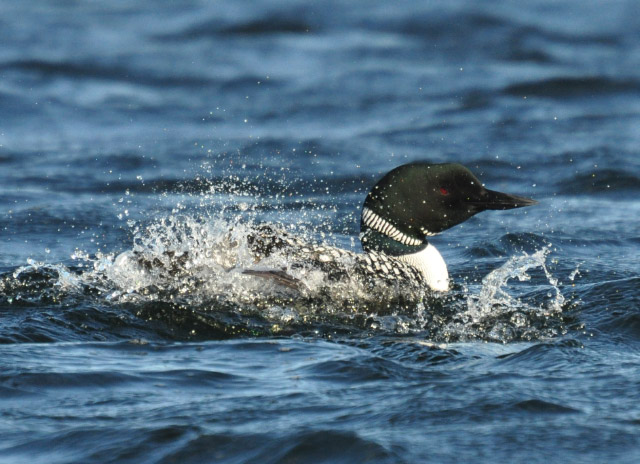
Both adult loons are marked with color bands on their legs. The female loon of this pair has been breeding here on this pond since she was originally banded in 1998. Since the earliest known breeding age for loons is 4 years and the average age at first breeding in New Hampshire is 6 years, she is at least 22 years old, but most likely 24 years or older! She has an orange band on her left leg and blue and silver bands on her right leg. The male loon was banded for the first time in 2014. He has red and green The female loon of this pair has been breeding here on this pond since she was originally banded in 1998. Since the earliest known breeding age for loons is 4 years and the average age at first breeding in New Hampshire is 6 years, she is at least 22 years old, but most likely 24 years or older! She has an orange band on her left leg and blue and silver bands on her right leg.
The male loon was banded for the first time in 2014. He has red and green The female loon of this pair has been breeding here on this pond since she was originally banded in 1998. Since the earliest known breeding age for loons is 4 years and the average age at first breeding in New Hampshire is 6 years, she is at least 22 years old, but most likely 24 years or older! She has an orange band on her left leg and blue and silver bands on her right leg. The male loon was banded for the first time in 2014. He has red and green
An Introduction to the Loons of Loon Cam 1
Loon Cam season is rapidly approaching—if all goes according to schedule, Loon Cam 1 will be live by mid-May. This year, Loon Cam 1 will be streamed from a different lake than usual. We know that many will miss the pair from our previous Loon Cam 1 site, but rest assured that the pair on the new lake is made up of two wonderful loons! To help you become acquainted with them, we’ve compiled some information on their history. Please note that LPC biologists are not out surveying yet for the year, and as such, we can’t be 100% sure that the same banded loons are back on the lake this season; however, given that loons have high rates of territory fidelity and that they are a long-lived species, it is very likely that the pair we watch on Loon Cam 1 will be made up of the two loons described below. We hope that you fall in love with them, as the people who live on their lake have!
The members of the regular pair on this lake were both originally banded in 2013. Because they were banded as adults and loons do not reach adulthood until age three, we know that they are, at minimum, 11 years old; however, because they were banded after hatching chicks and the average loon does not hatch a chick until ~6 years of age, it is likely that these loons are 14 years old or older.
The male loon’s left leg band combination is white stripe (white background with a horizontal black stripe through the middle) over orange. His right leg band combination is silver over blue stripe (blue with a horizontal white stripe through the middle). This past winter, this male loon was photographed on the ocean, so we know that he spends his winters off the Connecticut coast.
The female loon is only banded on her right leg, which has an orange band over a silver band. The reason that she is not banded on her left leg is because she is tiny! When our banding crew caught her in 2013, they did not have small enough bands on hand to fit her left leg. Generally, the legs of the loons we band here in New Hampshire range from 24–27 millimeters wide along the flat edge. This female’s legs were just 21.4 millimeters—quite small for a New Hampshire loon! While we were able to trim down her aluminum US Fish and Wildlife service ID band to fit her leg, we only had a single plastic band with us that was small enough for her. As such, her left leg had to remain bare.
This loon pair has been together every year since they were originally banded in 2013. In that time, they have hatched 8 chicks, 6 of which have survived to the end of the summer. We hope that they will add to that number this year, and we’re excited to watch along with you as they nest!
It was a tough decision to change the Loon Cam location, and one that was made after careful consideration. We know that viewers have become attached to the pair that we’ve been livestreaming since 2014; however, a few different factors played into our decision to feature a new loon pair and location this year:
We hope that you enjoy the new location and getting to know the new nesting pair, and we look forward to the Loon Cam going live in just a few short weeks!