
Courtesy of Rick Libbey
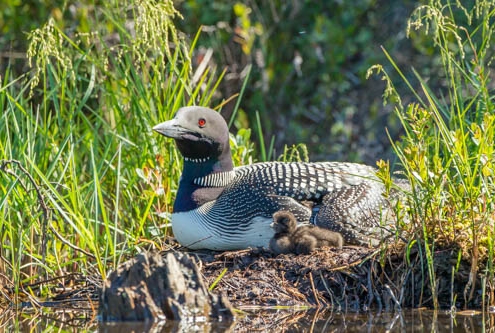
The New Hampshire Loon Recovery Plan is a document that formalizes the relationships and steps needed to restore and maintain a healthy and biologically stable population of loons throughout the state. Loons and other wildlife are exposed to multiple stressors concurrently and throughout their lifetimes. LPC’s data provide the basis for the development and testing of mathematical models to evaluate the effects, and predict the risks, of these threats to loons.
Loon habitat suitability models developed in conjunction with the U.S. Environmental Protection Agency have assessed the relative importance of natural and anthropogenic features of New Hampshire’s lakes in defining and predicting loon distribution and abundance. These models and historical occupancy of lakes by loons have allowed LPC to estimate the loon carrying capacity of New Hampshire’s lakes (the greatest number of loons our lakes could be expected to hold), a critical step in creating population models and setting goals for LPC’s efforts to increase our loon populations.

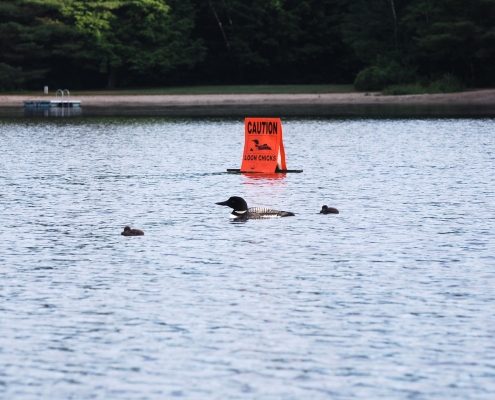
Population models created for LPC’s Loon Recovery Plan determine the long-term survival rates and reproductive success needed to maintain a stable and viable loon population; measure the effects of current and predicted future stressors on our loon population; and determine the types and amounts of management and education needed to mitigate these stressors now and in the future. These models are an essential component of population viability analyses, which provide probability estimates for specific population endpoints (e.g., the probability of a 50% decline in our loon population) under different stressor scenarios. The models reveal site-specific risks to our loon populations, forecast future population and mortality trends, and set science-based goals for LPC’s work to safeguard New Hampshire’s loon population.