Courtesy of Kittie Wilson
Common Merganser
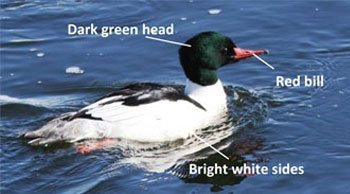
Male Common Merganser
Adult Common Loon (male or female)
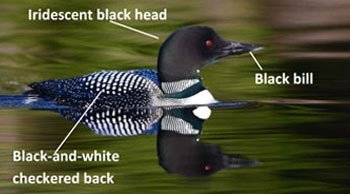
Common Mergansers are commonly mistaken for adult loons in breeding plumage, however a few key traits differentiate the species.
- Bill color: The Common Loon in its breeding plumage has a black bill. A male Common Merganser has a red bill.
- Head color: The Common Loon has an iridescent black head. The male Common Merganser has a green head.
- Body color: The Common Loon has a black and white checkered back. The male Common Merganser has black and white plumage but has bright white sides.
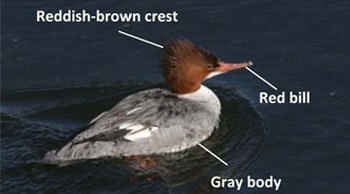
Female Common Merganser
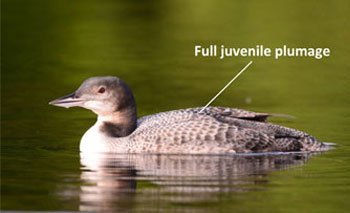
Juvenile Loon (male or female)
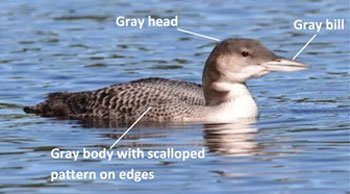
Juvenile loons (chicks older than 8-weeks) and immature loons (2nd year birds that occasionally summer on lakes) may be mistaken for female common mergansers. The following characteristics can help to distinguish between the two:
- Bill color: Juvenile and immature loons have gray or grayish-white bills. Female Common Mergansers have red bills.
- Head color: Juvenile and immature loons have gray heads. Female Common Mergansers have reddish-brown crested heads.
- Body color: Juvenile and immature loons have gray plumage that with a distinct white scalloped pattern. Female Common Mergansers have gray plumage with no such scalloping.
Double-crested Cormorant
Common Loon
Double-crested Cormorant
Common Loon
Double-crested Cormorant
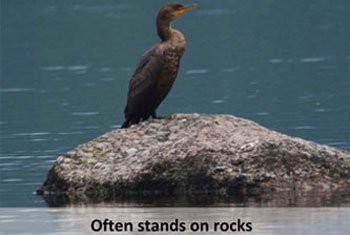
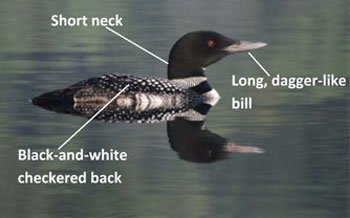
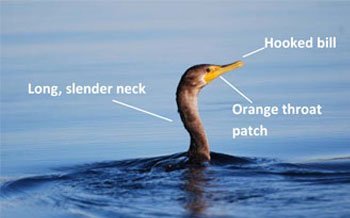
Another diving, fish-eating bird that is sometimes mistaken for a loon is the Double-crested Cormorant. Characteristics that help to differentiate between Double-crested Cormorants and Common Loons include:
Body and head shape: Double-crested Cormorants have slender bodies with a long neck. Common loons have larger bodies with a shorter, thicker neck and head.
Bill shape and color: The bill of the Common Loon is long, black, and pointed. Its shape is best described as “dagger like.” The bill of the Double Crested Cormorant is hooked and is yellow with an orange patch of the base.
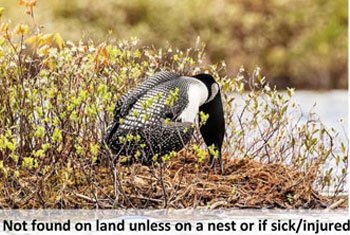
Behavior: Double-crested Cormorants are often seen standing on docks, rocks, or buoys with wings outstretched to dry. Common Loons are not able to stand upright and only go on land to nest or if they are sick or injured.
Canada Goose
Common Loon
Canada Goose
Common Loon

Canada Goose

Another waterbird that is sometimes confused with a loon is the Canada Goose. Characteristics useful for distinguishing these species include:
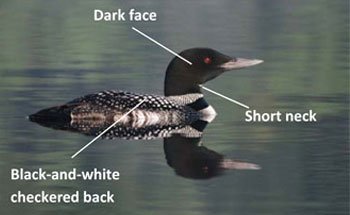
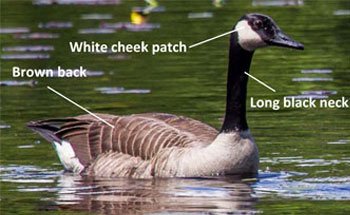
Neck length: Common Loons have short, relatively thicker necks. Canada geese have long, slender necks.
Head color: The head of the Common Loon is black and iridescent. The Canada Goose has a white cheek patch on its face.
Bill shape: Common Loons have long, sharp, black bills. Canada Geese have wide, flat bills.
Behavior: Common Loons cannot walk upright and only go on land when nesting or injured. Canada Geese can stand upright and frequently walk on land.
Birds with Chicks
Common Loon
Female Common Merganser
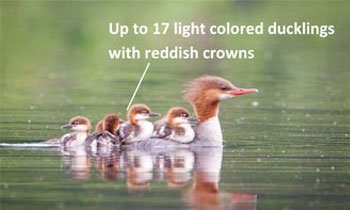
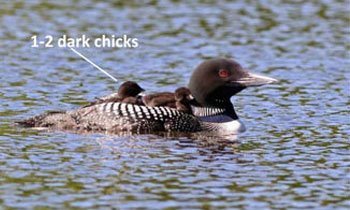
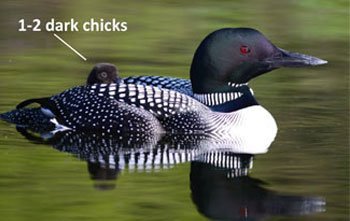
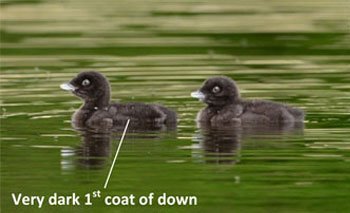
Common Mergansers have up to 17 ducklings who are sometimes seen riding on the female’s back, but they are lighter in color than loon chicks and have a reddish crown. Common Loons have 1-2 chicks. Loon chicks change in color from almost black to light brown to grey as they grow. Scroll to the bottom of the page to see the loon chick stages. Merganser broods can be reduced to 2 chicks or fewer due to predation.
Common Loon
Canada Goose
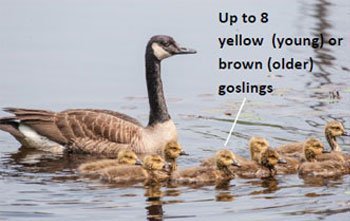
Canada Geese have broods of 2-8 goslings that are yellow and brown when young (unlike loon chicks that are very dark) and do not ride on a parent’s back. In New Hampshire, geese nest earlier than loons, so most Canada Goose chicks have already hatched by late spring. Young goslings are also susceptible to predation (like merganser ducklings), so a brood may be reduced to one or two chicks rather quickly.
Loon Chicks
Less than one week old
Two weeks old
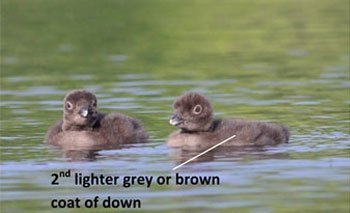
Five weeks old
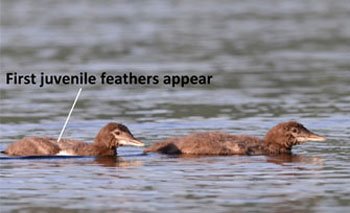
Eight weeks old
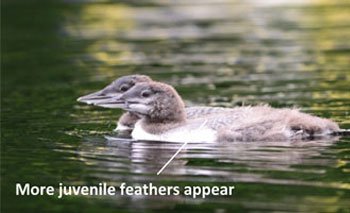
Ten weeks old