
Courtesy of Kittie Wilson
When used correctly, nesting rafts are a very effective management tool; however, they are not a cure-all for improving nesting success. In fact, the placement of a raft on a lake where loons typically nest successfully on natural sites may actually do more harm than good if it lures loons away from sheltered and well-hidden natural nesting sites to nest in more exposed or visible areas of the lake. For this reason, our protocol is to only float rafts on lakes where the natural nests have failed for three or more consecutive years due to a problem that can be solved by a raft, such as water level fluctuations or lack of adequate natural habitat.

Each year, LPC Biologists float more than 80 loon nesting rafts throughout the state.
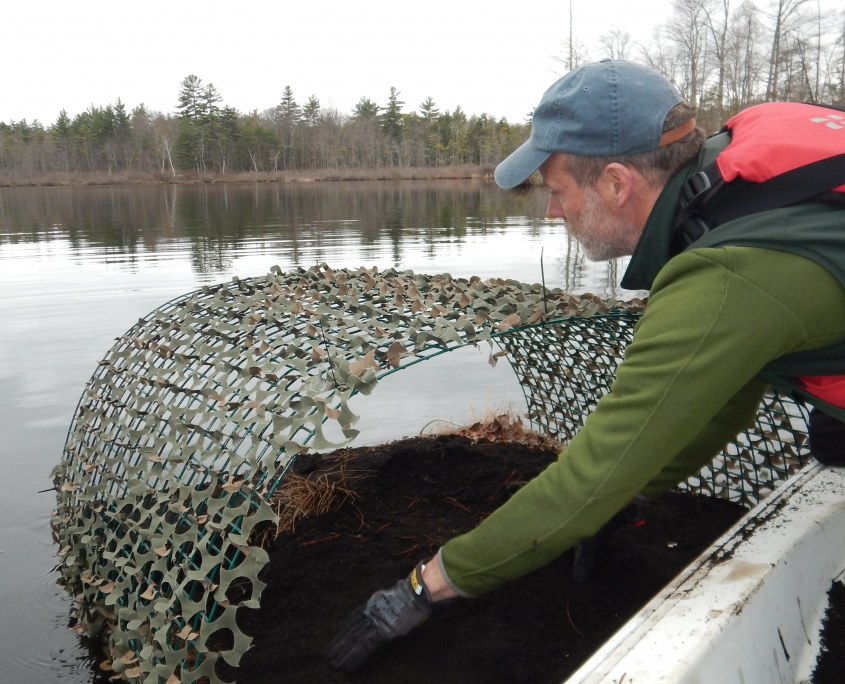
Over the past two decades, loons nesting on rafts have produced roughly 25% of the chicks hatched in New Hampshire.
We would much rather see loons nesting on natural sites than on man-made rafts, and preserving natural shorelines is still a priority for LPC because these measures help loons as well as providing habitat for other wildlife. Over time, we hope that our education efforts will encourage shoreline conservation and other practices that reduce the need for nesting rafts. Until then, rafts are the most practical solution to some of the problems facing nesting loons.