Courtesy of Kittie Wilson
Raft Criteria
In order to qualify for a nest raft, a loon territory should meet the following criteria:
1) A territorial loon pair must be present. Nest rafts do not attract loons to water bodies that are currently unoccupied. In order to qualify for a nest raft, a lake must have a resident territorial pair (a pair that is observed consistently on the lake for at least a 4 week period from mid-May through mid-August).
2) The resident pair must have a demonstrated need for a raft. We don’t want to make loons dependent on human intervention for nesting if they don’t need to be. If there is suitable natural habitat available on the lake, we want to give the loons the opportunity to nest naturally. Occasional nest failures are normal and natural, so our protocol is to only float rafts at sites where the loons have experienced repeated nest failures and have proven that they are unlikely to be able to nest successfully at natural sites. Nest rafts will only be helpful if the natural nest is failing due to a problem that a raft can solve, such as water level fluctuations, predation, or lack of high quality natural nest sites. If nests are failing for other reasons, different management strategies, such as floating nest signs, might be more appropriate.
3) There must be a team of local volunteers willing to help maintain, float, and retrieve the raft each year. Please click here to learn more about raft floating teams.
If your lake meets these criteria, LPC will provide a raft and will help you float it the first year.
Exceptions
In general, we use the criteria listed above to determine whether or not a loon pair qualifies to receive a nest raft. However, we sometimes make exceptions. If you would like to discuss a particular lake or loon pair that you think would benefit from a raft, please email field@loon.org or call us at (603)476-5666. Please note that we tend to make decisions about new raft locations in late winter, from mid-February to mid-March, so that we can incorporate the construction and floating of those rafts into our tight spring schedule. If possible, please contact us with your raft request in February so that we can evaluate the lake’s eligibility and incorporate it into our planning.
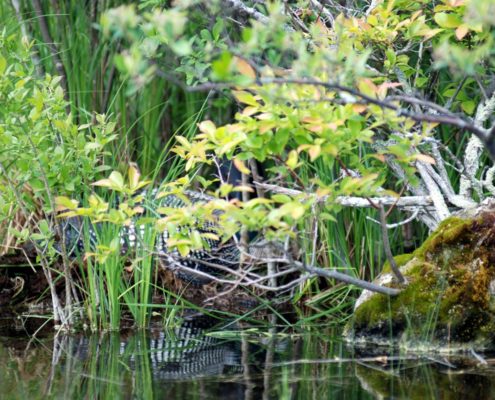
Loon nest rafts may do more harm than good if they lure loons away from well hidden natural sites, like the one above, to the relatively more exposed raft.
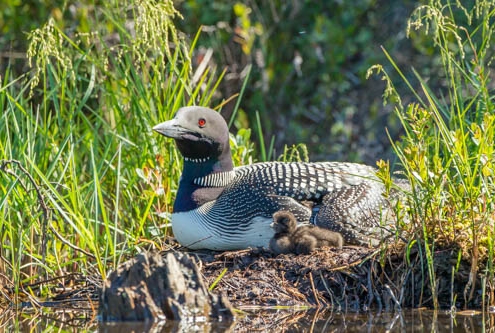
We want to see loons nesting at natural nest sites whenever possible. Loon conservation organizations across North America (including LPC) agree that loons are considered successful if they hatch chicks once every three years. Loons that can achieve that level of nesting success at natural sites do not need a nest raft. Photo courtesy of Brian Reilly.
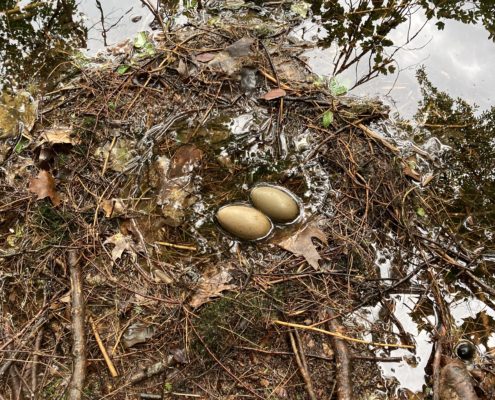
Nest flooding or stranding due to water level fluctuations are problems that can be solved by a raft. If a loon pair fails for three consecutive years due to these problems, or to other raft-solvable problems such as predation or lack of high-quality natural habitat, they meet the criteria for a nest raft.

