
Platform
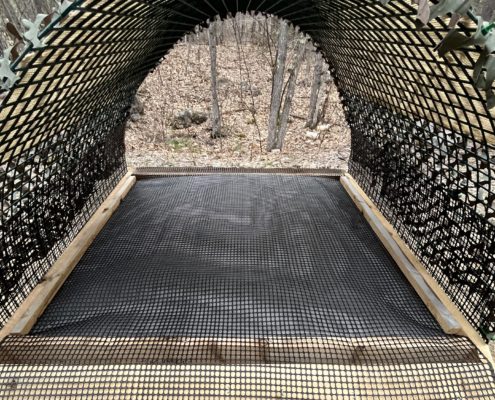
Check the raft frame: Ensure that wood is not rotted, and that the frame is sturdy and securely fastened together. Add or replace screws as needed.
Check the floor of the raft: If there are holes or gaps in the foam, fill them in to ensure that a chick cannot fall in and become trapped.
Check the plastic mesh covering the floor of the raft: Ensure there are no large tears or holes for chicks to get stuck in. Patch or replace damaged plastic mesh, and make sure there are no sharp edges.
Cover
Ensure the raft cover is firmly attached to the raft: Sometimes, raft covers collapse over the course of the winter under the weight of snow. Prior to floating, they need to be reattached or bent back into shape. We attach the covers to the raft using stainless steel fender washers and 2″ stainless steel screws. Fender washers should be positioned so that they are within a corner of the lobster trap mesh, pinching it tightly against the wooden frame of the raft. Use a minimum of 3, and ideally 4, washers per side to attach the cover. Washers should be placed at equal intervals.
Check the chick guards: Chick guards are 10-12 inch tall sections of plastic mesh that extend up the inside of the raft cover, starting at the floor of the raft. Their purpose is to ensure that a chick does not get its head or body caught in the large squares of the lobster trap mesh. Use zip ties to secure the chick guards tightly to the raft cover so that that there is no way for a chick to get stuck between the guard and the lobster trap mesh.
**Some older rafts may not yet have chick guards. If your raft does not have them, please contact LPC at field@loon.org so that we can send you some.
Check the UV-blocking shade fabric: This fabric should cover the top 1/3 of the raft cover, leaving the sides open to allow for air flow. Check to make sure the fabric is not torn.
Check the camouflage netting: This goes over the UV blocking shade fabric and should extend over the entire raft cover. A little tearing is fine, but if your camoflage netting is very tattered or worn out, contact LPC for a replacement. Attach camoflage netting to the raft cover using zip ties.
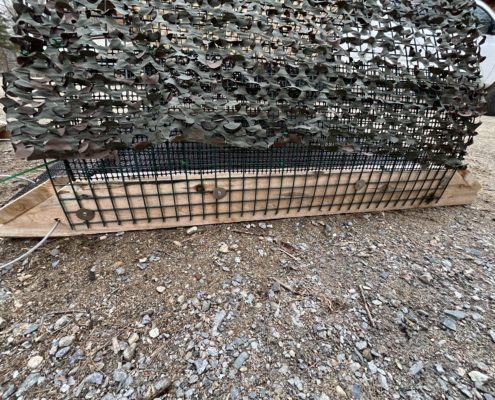
Check to make sure that the raft cover is firmly attached to the raft frame on both sides. Use 2″ screws and large stainless steel fender washers, 3-4 per side, as shown in this photo.
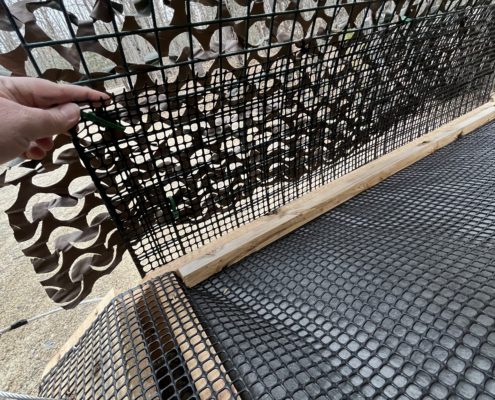
Check that the chick guards are firmly secured. If your raft needs chick guards, please email us at field@loon.org.
Anchors
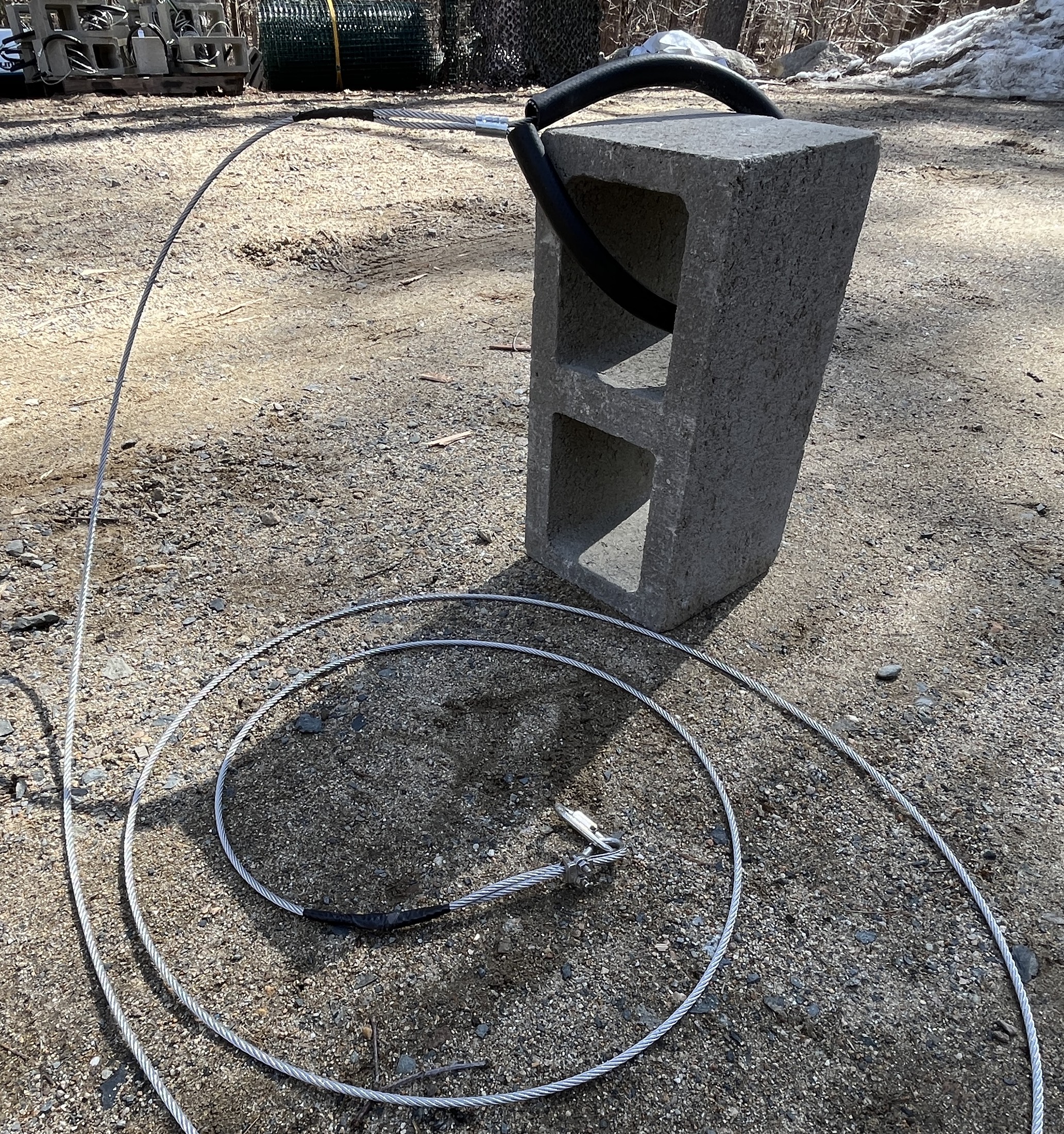
Anchors are constructed using cinder blocks, stainless steel wire rope (at least 3/16″ diameter), and stainless steel cable clamps. To prevent fraying, feed the wire rope that loops around the cinder block through a length of garden hose or new fuel line, or other protective material, and snug the whole loop close to the block. Unprotected cable or a loose loop will chafe against the block and may eventually fail. A thimble should be added at the other end of the wire rope to pad the link to the raft. Use a reliable screw-gate quick link or locking carabiner to connect the anchor to the raft. Wrap wire rope ends with duct tape to avoid frayed, sharp strands, or tuck the wire rope ends into garden hose padding. Each spring, check your anchors to make sure they are intact and that the cable clamps are firmly pinching the wire rope. Tighten clamps if needed. Check the wire rope for fraying or wear. Contact LPC at field@loon.org if you need replacement anchors. If necessary, sturdy nylon rope can be used instead of wire rope for the anchor line. Anchor lines should be at least two or three times longer than the water depth at the raft, to allow a low angle on the line when the anchor is placed. If the water is five feet deep, for example, the anchor line should be 10-15 feet long.
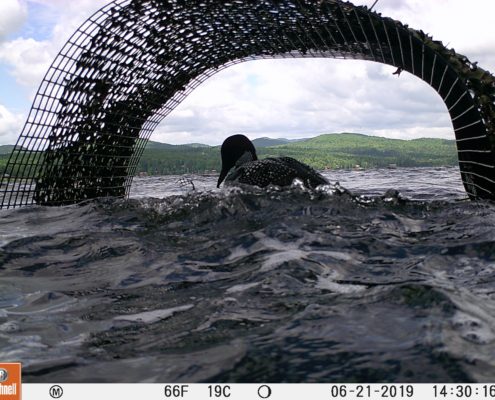
This raft did not have enough flotation, and a game camera caught the moment that it was overwhelmed by wave action.
Flotation
It is essential that rafts have adequate flotation A raft that is sitting too low in the water is vulnerable to flooding from natural waves or from boat wakes. If you notice that the raft is floating low as you put it in the water, you can add flotation (rigid foam, plastic floats, or even a capped, empty plastic bottle if you are in a pinch) underneath. Use your judgment: the outer corners of the raft may be low in the water but if the middle, with the nest bowl, is high and dry and safe from waves, the flotation may be adequate. Rafts may be built or arranged so that they float in a lopsided way, with one edge lower, to make it easy for the adult loons and loon chicks to climb on and off of the raft. Contact LPC at field@loon.org if you need large sections of replacement rigid foam flotation for your raft.