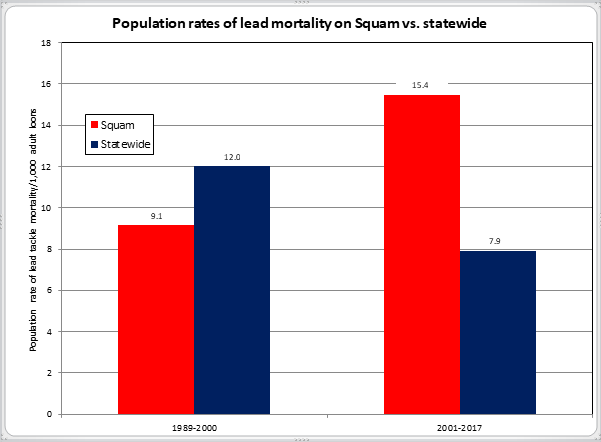
Squam’s loon population has also experienced extremely high levels of mortality from lead fishing tackle. Since the opening of the reconstructed public boat launch in 2001, the rate of mortality from lead fishing tackle on Squam Lake has doubled and is twice the overall statewide rate of lead mortality during the same period. From 2001-2012, Squam lost on average 1.9% of its adult loon population annually due to lead fishing tackle. Although it is not possible to demonstrate causation, it is worth noting that, since 2001, the number of boats counted during an annual boat census of Squam, the number of fishing tournaments, and the number of boats participating in fishing tournaments has increased at a statistically significant level.
The Squam Lake Loon Initiative (SLLI) includes an increased monitoring, research, management, and outreach effort in order to achieve the following goals:
-
- Determine the overall survival and reproductive success of Squam’s remaining loon population.
- Assess causes of nest failure and collect inviable eggs from failed nests for analysis of a wide range of contaminants and pathogens.
- Rescue sick or injured loons to increase loon survival whenever possible.
- Find and collect loon carcasses, determine causes of death, and test liver samples from dead loons for contaminants and pathogens
- Band loons to allow us to identify and track individual bird and collect blood and feather samples for analysis
- Determine survival and breeding success of previously banded and sampled loons, and related survival and breeding success of individuals to their levels of contaminants and pathogens
- Incorporate results into a systems dynamics or other explanatory model to determine the relative contributions of a wide range of possible stressors on the mortality and reproductive failure of loons on Squam Lake
- Restore and maintain a healthy and stable population of loons on Squam Lake as a component of a healthy statewide population of loons

