
The Loon Safe Patch
Lead poisoning resulting from the ingestion of lead fishing tackle is the leading cause of known adult loon mortality in New Hampshire, accounting for 36% of documented adult loon deaths since 1989. Research conducted by the Loon Preservation Committee has shown that the high mortality rate from lead tackle experienced by New Hampshire’s loon population since 1989 has significantly reduced the population growth rate.
In fall 2024, the Loon Preservation Committee partnered with Scouting America New Hampshire to create the Loon Safe Patch and the Loon Safe Troop Award as a way to educate scouts about this issue and to recruit their help in working to solve it.
How to Earn the Loon Safe Patch
Scouts can earn the Loon Safe Patch by collecting 8 oz (1/2 lb) of illegal lead fishing tackle (lead sinkers and lead-headed jigs that individually weigh 1 oz or less) and turning it in to the Loon Preservation Committee. The troop that cumulatively turns in the largest amount of tackle by the end of the calendar year each year will receive the Loon Safe Troop Award.
Lead is a toxic substance for humans as well as wildlife, so we want to make sure that scouts handle it safely. The Loon Preservation Committee will provide nitrile gloves to scouts and troops pursuing the Loon Safe Patch and Troop Award. Please contact us by calling (603)476-5666 or by sending an email to volunteers@loon.org if you would like us to send gloves.
When you have collected enough tackle to earn the patch, give us a call at (603)476-5666, send an email to volunteers@loon.org, or stop by the Loon Center (183 Lees Mill Road, Moultonborough NH). If you are part of a troop that is pursuing the Loon Safe Award and want your tackle to count towards the troop’s cumulative total, please be sure to tell us your troop number. We will arrange a time to meet with you to collect your tackle and award your patch. If your troop is pursuing the Loon Safe Award, you also have the option to pool your tackle and turn it all in at once rather than individual scouts turning in tackle over time.
Why is lead such a problem for loons?
Loons do not start producing chicks until they are 6-7 years old, on average. Once they start producing chicks, they add to the population very slowly—the average loon pair in New Hampshire will fledge just one chick every other year, and only about half of the chicks that fledge survive to adulthood. Loons make up for this slow reproductive rate by the fact that they live for a long time—the oldest known loons are in their late 30’s or early 40’s. All of these factors combine to mean that it is important for adult loons to survive to the end of their natural lifespan in order to maintain a stable loon population. When we lose large numbers of adult loons to a cause that is not natural, like lead, it can have population-level impacts. In New Hampshire, our loon population’s growth rate has been significantly reduced by the lead mortalities that have occurred.
What are lead sinkers and lead-headed jigs?
Sinkers and jigs are weights used during fishing to weigh an angler’s line down in the water. This allows them to control where their line sits so that they can better target and catch fish. Sinkers are weights that are tied or molded around a line, and jigs are weights that are molded around a hook.
Sinkers and jigs can be made out of many different types of metal, or even out of stone. Historically, lead is the metal that has most commonly been used because it is cheap, dense, and soft. However, lead is a poisonous substance, and accidental ingestion of lead fishing tackle has been documented in over 30 species (including loons).
Sinkers and jigs come in many shapes and sizes. In New Hampshire, it is illegal to use or to sell lead sinkers and lead-headed jigs that weigh 1 oz or less because of their negative impacts on loons and other wildlife. However, many people may have old tackle, purchased before this law was in place, that they may not realize is now illegall to use in our state. In addition, not every state bans the sale and use of lead tackle, so people visiting our lakes from other states may be using tackle that they purchased legally in their state and don’t realize is illegal to use here.
Through the Loon Safe Patch program, we invite New Hampshire scouts to join us in educating anglers about the threat that this tackle poses to our loons and other wildlife and to help us get this tackle out of use on our lakes.
The pictures below show some examples of lead sinkers and lead-headed jigs.
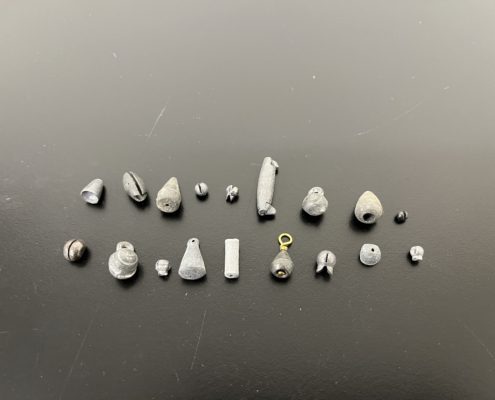
Lead sinkers are weights made out of lead that are tied or molded to fishing lines. They come in many shapes and sizes.
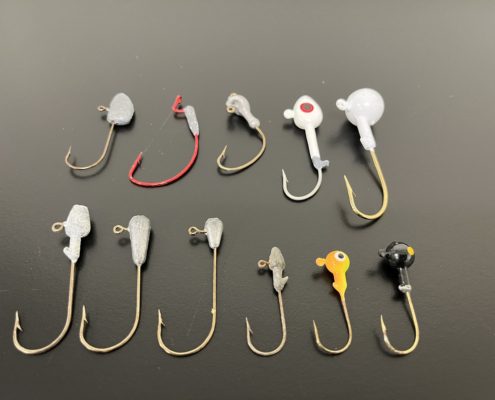
Lead-headed jigs are hooks that have a lead weight molded around them. They can be painted or unpainted.
How can I tell if tackle is made out of lead?
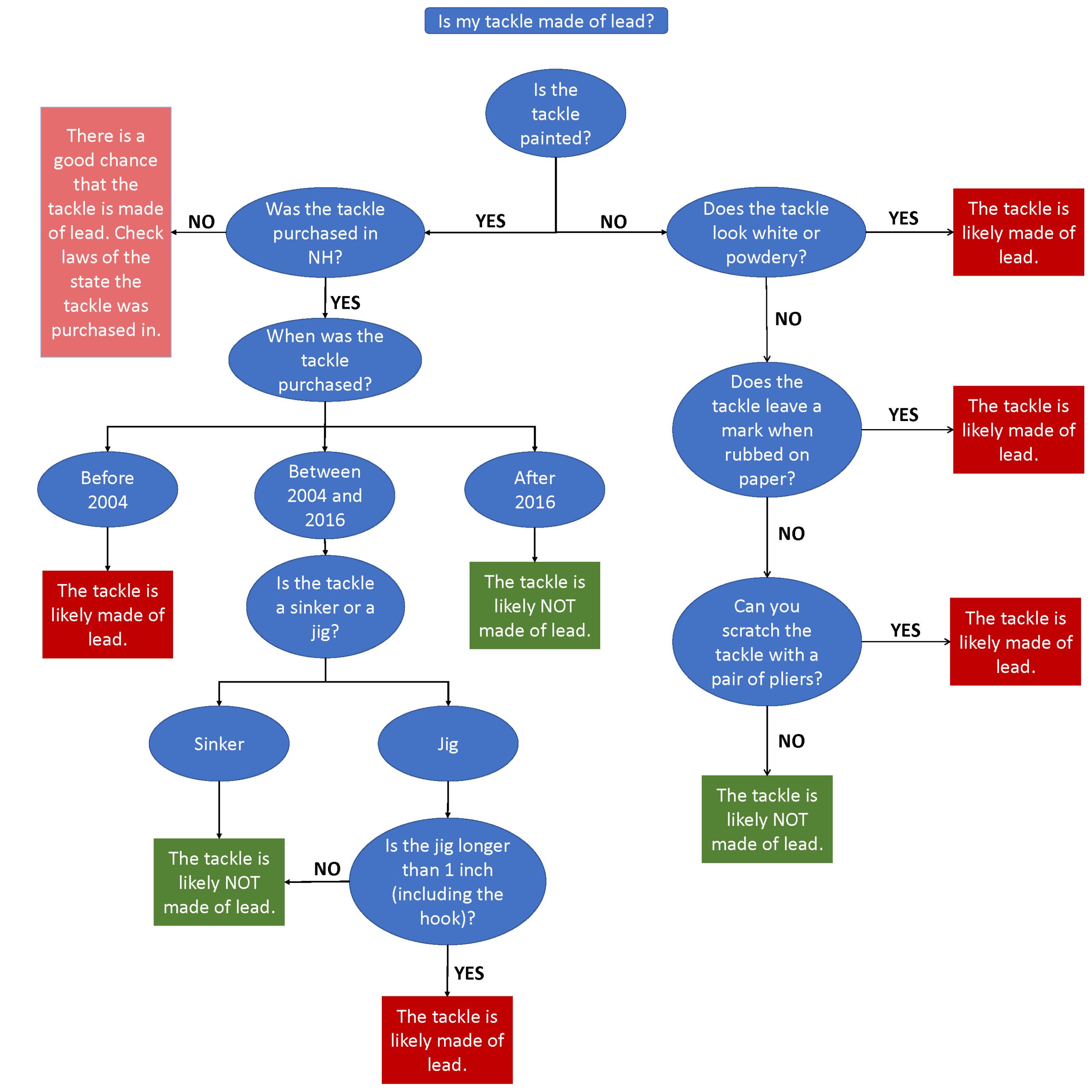
Lead is a soft metal, which means that if it is unpainted, it is usually easy to be able to identify. You can use the following three methods to determine if unpainted tackle is lead. Always wear gloves when testing tackle that may be lead, and wear a mask if the tackle looks powdery.
1) The powder test: Over time, unpainted lead reacts to air and moisture, creating a powdery layer on the exterior. If tackle looks white and powdery, it is very likely made out of lead. If you see powdery white tackle, make sure to handle it wearing gloves, and do not breathe in the powder.
2) The streak test: If unpainted tackle is not powdery, rub it across a piece of paper. Lead fishing tackle will leave a gray streak behind when rubbed on paper. Always wear gloves when handling tackle that may be made of lead.
3) The softness test: Try to scratch the tackle with a pair of pliers. Lead is a soft metal, so it is easily scratched or dented.
If tackle is painted, it is harder to tell if it is made of lead. In those situations, the easiest way to determine if it may contain lead is to know where and when it was purchased. If the tackle was purchased in a store in New Hampshire:
1) Sinkers purchased in a store in New Hampshire after 2004 are most likely NOT made of lead. Sinkers purchased in a store in New Hampshire before 2004 are likely made of lead.
2) Jigs that are less than 1 inch long (including the hook) that were purchased before 2004 are likely made of lead. Jigs that are less than 1 inch long that were purchased after 2004 are likely NOT lead.
3) Jigs that are more than 1 inch long (including the hook) that were purchased before 2016 are likely made of lead. Jigs more than 1 inch long purchased after 2016 are likely NOT lead.
Ideas for Tackle Collection
There are many ways that you can go about getting lead tackle out of use, and we encourage scouts and troops to be creative! Below are some ideas for getting started. Please note that if you intend to collect tackle at a public place (like a boat launch or a town-owned property), you will need to get permission from the organization that owns or operates the property first. You should wear nitrile gloves whenever handling lead. If you would like LPC to provide some gloves for you, please call (603)476-5666 or email volunteers@loon.org
1) Speak with members of your community: Many people may have inherited their family’s old tackle box, and it’s possible that people you know may have old lead still lingering in their tackleboxes. Talk with family members, friends, neighbors, or other members of your community who fish. Ask if you can look through their tackleboxes together for lead.
2) Set up a table at a local boat launch: If there is a lake near you, consider setting up a tabling event at the boat launch with your troop. You will need to get permission from the organization that operates the boat launch first—that’s usually the town or New Hampshire Fish and Game. Speak with anglers as they use the launch about the threat that lead tackle poses to loons and other wildlife, and offer to look through their tackle box with them to see if there’s any old lead remaining. If you are planning a tackle box tabling event, please contact LPC beforehand—we can give you some non-lead tackle to hand out!
3) Set up a table at a fishing derby: If you are aware of a fishing derby taking place on a lake near you, consider reaching out to the organizers to set up a table at the event. During the event, talk with participants, and offer to look through their tackle box together. If you are planning to do this, please reach out to LPC in advance so that we can give you some non-lead tackle to distribute!